








Agency
How to Choose a Web Design Agency in 2026: 12 Questions to Ask

There is no single number that answers this well, and any agency that gives you one before understanding your project is guessing. The real cost of hiring a design agency depends on the scope of work, the complexity of what you are building, how much research is involved, and how the engagement is billed. What we can do here is walk through exactly what drives that price up or down, so you can budget with a realistic range in mind rather than a figure pulled out of thin air.
We are not going to publish a specific price table, because any number we gave you would be wrong for your project. Pricing that looks precise but ignores scope is not more useful than no number at all; it is just more convincing. Instead, this guide gives you the framework agencies actually use, so you can read a quote and understand what it is really telling you.
Two projects that sound similar on a call can cost very different amounts once the scope is written down. A five-screen marketing site and a five-screen SaaS dashboard both count as "five screens," but the dashboard likely involves data states, permission levels, and edge cases the marketing site never touches. Agencies price against the actual work: the number of unique screens and states, how much original research is needed before design starts, whether a design system needs to be built from scratch or already exists, and how tight the timeline is.
The stage of your product matters too. An early-stage idea that needs research, positioning, and exploration costs differently than a mature product that needs a focused redesign of one flow. Neither is more or less valid, but they call for different scopes, and scope is what agencies actually price. A brand-new product also tends to need more assumption-testing along the way, since there is less existing user behavior to design against. A mature product usually has real usage data, support tickets, and analytics to draw from, which narrows the amount of open-ended exploration required.
Team structure on your side plays a role as well. A project with a single decision-maker who has the authority to approve work quickly tends to move faster and cost less than one that needs sign-off from several stakeholders with different priorities. Agencies often build a small buffer into estimates for the back-and-forth that comes with a longer approval chain, simply because that back-and-forth is real work, even if it does not look like design work on the surface.
Most agencies, including ours, work within a handful of common billing structures. Knowing the difference helps you compare quotes that look nothing alike on paper but cover similar ground.
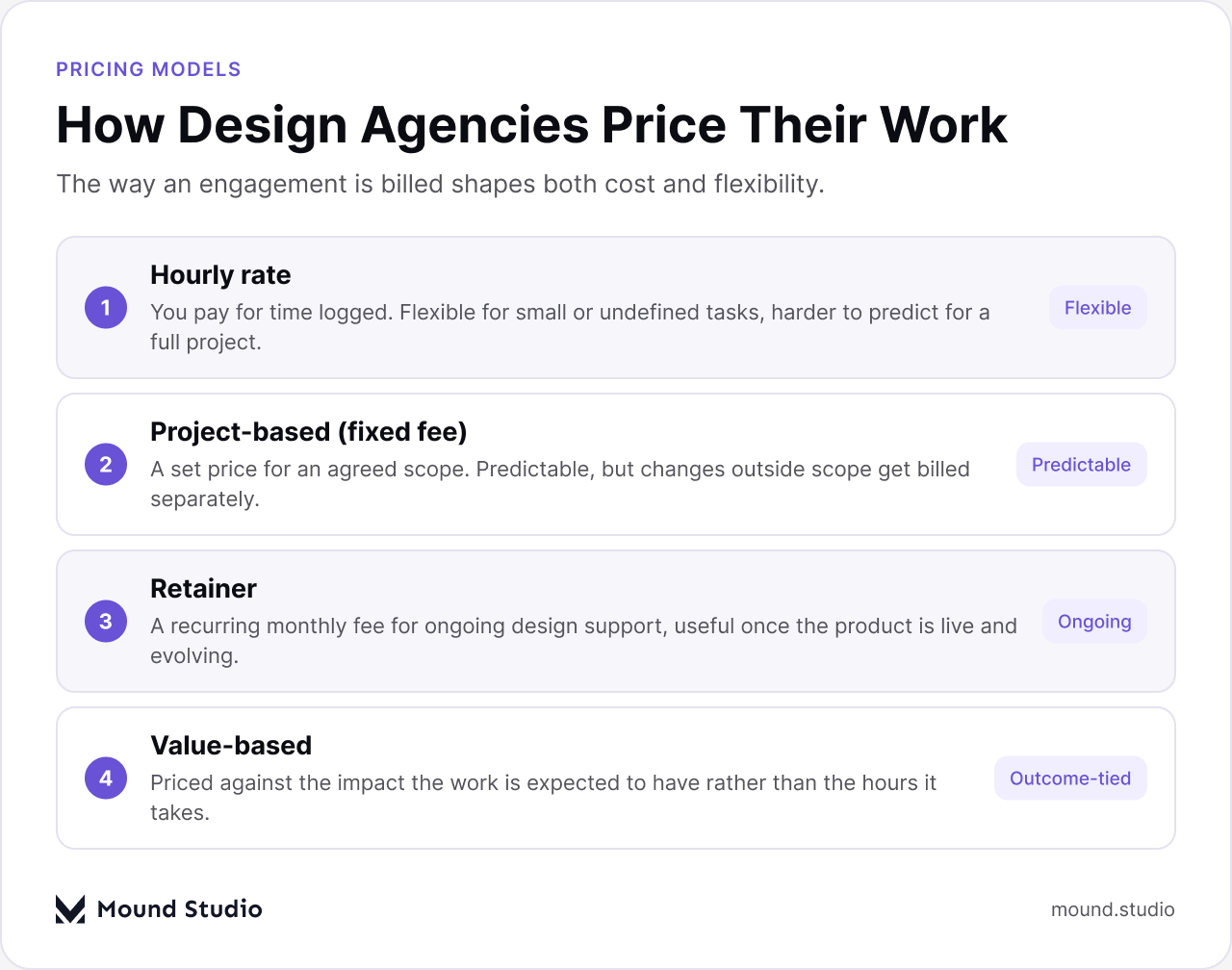
Hourly billing suits small, loosely defined tasks where the scope might shift as you go. It gives you the most flexibility but the least budget certainty, since the final number depends on how much work actually gets logged. Project-based (fixed-fee) pricing is the most common choice for a defined deliverable, like a website redesign or a new product flow, because it gives you a number to plan around before the work starts. The tradeoff is that any request outside the agreed scope becomes a separate conversation.
Retainers make sense once a product is live and needs steady design attention rather than a single big push: ongoing feature work, small improvements, and design QA as engineering ships. Value-based pricing ties the fee to the expected impact of the work rather than the hours behind it, and it shows up most often on high-stakes projects where the design decision itself carries real weight, such as a core purchase flow or an onboarding sequence that shapes long-term retention.
A quote is more than a number. It is a definition of what you get for that number, and that definition is where most budget surprises come from. Before comparing prices between agencies, compare what is actually inside each quote, because two proposals with very different numbers sometimes cover almost the same work, and two proposals with similar numbers sometimes cover very different amounts of it.
| Item | Typically included | Often billed separately |
|---|---|---|
| Discovery and research | A defined number of interviews or a competitive review | Large-scale user research programs |
| Design deliverables | Wireframes, high-fidelity screens, a basic component set | A full, documented design system |
| Revisions | An agreed number of feedback rounds per phase | Rounds beyond the agreed limit, or scope changes mid-project |
| Handoff | Developer-ready files and specs | Ongoing design QA during development |
Ask specifically about the revision limit and what counts as a scope change before you sign anything. This single question prevents more budget disagreements than any other line in the proposal, because "revisions" means different things to different people until it is written down as a number.
The path from a first conversation to a signed proposal follows a fairly consistent pattern across agencies, ours included. Understanding it helps you come to that first call prepared, which usually means a tighter, more accurate quote.
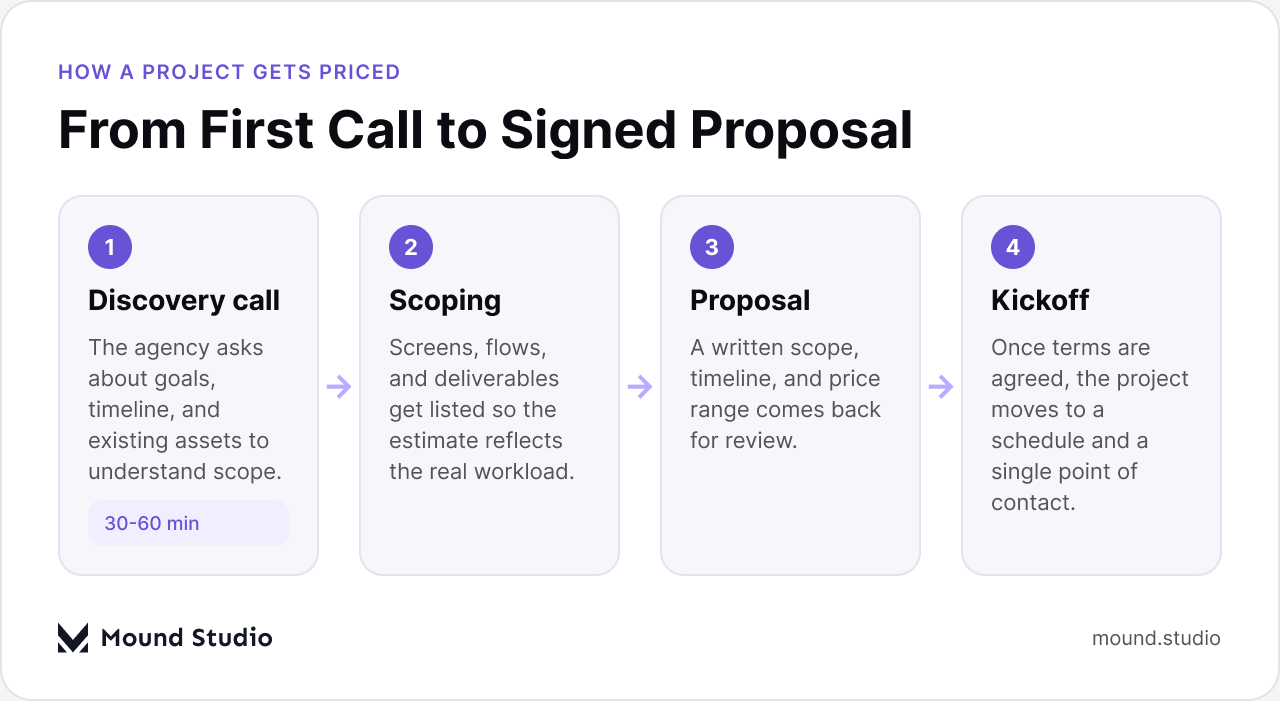
The discovery call is where an agency learns enough to size the work: your goals, your timeline, what already exists (brand guidelines, an existing design system, prior research), and what "done" looks like. Scoping turns that conversation into a list of concrete deliverables: specific screens, specific flows, a specific number of revision rounds. The proposal translates the scope into a price and a timeline, usually alongside the assumptions the estimate is based on. Kickoff is where the estimate becomes a real schedule, typically with a single point of contact so you are not chasing updates across several people.
The more clearly you can describe your goals and constraints on that first call, the tighter the resulting quote will be. Vague scope produces vague pricing, and vague pricing is where budgets go over. If you can, come to the discovery call with existing materials: brand guidelines, analytics, prior research, or even a rough list of the screens you think you need. It shortens the scoping phase and gives the agency something concrete to price against instead of a general description.
Some factors affect cost more than others. None of the figures below are fixed numbers, since actual cost always depends on your specific project, but this is roughly how much weight each factor tends to carry relative to the others.

Screen count is the most obvious driver, but it is really a proxy for something else: how many unique states and edge cases exist across those screens. A five-screen app with three user roles and a dozen empty, loading, and error states will take longer than a fifteen-screen marketing site where every page follows the same template. Counting screens without counting states is one of the most common ways early estimates end up wrong.
Research depth adds time upfront but often saves time later, since fewer assumptions need revisiting mid-project. Whether a design system already exists changes the math significantly: building one from scratch is a project in itself, while extending an existing one is comparatively fast, because the foundational decisions about type, color, spacing, and components are already made. Timeline urgency also matters in a very direct way. Compressing a project into a shorter window usually means dedicating more capacity to it at once, which changes the cost even though the scope has not changed at all.
Use this as a starting point when you are weighing pricing models and deciding what to ask for in a proposal.
Not every engagement is a full redesign, and the right pricing model often shifts with the size of the ask. A small, well-defined task, such as designing a single new screen inside an existing product, usually fits hourly billing or a small fixed fee, since the scope is narrow enough to define precisely. A full redesign touches more of the product at once, which makes a fixed-fee model with clearly staged milestones more common, because it gives both sides a way to check progress against the plan before moving to the next phase. If you are not sure which category your project falls into, that uncertainty itself is worth raising on the discovery call. A good agency will help you scope it down to something concrete rather than pricing the uncertainty itself.
A short amount of preparation on your side tends to produce a noticeably more accurate quote. Before the discovery call, it helps to have a rough idea of your budget range, even a wide one, since agencies can often suggest a scope that fits it rather than pricing a scope that does not. Bring any existing brand guidelines, prior research, or analytics that describe how people currently use your product. If you already have a list of must-have screens or flows, share it, even in draft form. None of this needs to be polished. The goal is simply to reduce the number of open questions before scoping starts, since every open question either adds time to the estimate or gets resolved with an assumption that may turn out to be wrong.
Agency pricing is not a mystery once you know what to look for: the model it is billed under, what is actually included, and how many of the cost drivers above apply to your project. A quote that seems high might include far more than a quote that seems low, and the only way to know is to compare scope, not just the number at the bottom of the page. If you want a straight answer on what your specific project would involve, talk to us about your project.
It depends entirely on scope: the number of unique screens and states, how much research is needed, whether a design system already exists, and the timeline. There is no fixed price that applies across projects.
Hourly billing charges for actual time logged and suits loosely defined tasks. Fixed-fee pricing sets one price for an agreed scope, which gives you budget certainty but means anything outside that scope is billed as a change request.
Most include an agreed number of revision rounds in the base price. Rounds beyond that limit, or changes that go beyond the original scope, are usually billed separately.
It depends on how long the work will continue. An agency fits a defined project with a clear scope, while an in-house team suits ongoing, long-term product work. Many teams use both at different stages.
A clear quote lists the deliverables, the number of revision rounds, what research is included, and what happens at handoff. If a quote does not spell these out, ask before signing.