








Agency
How to Choose a Web Design Agency in 2026: 12 Questions to Ask

Most website projects that go over time or budget were unclear at the start. A design brief is the cheapest fix. It is a short document that says what you need, why and by when, so an agency can respond with a realistic plan. This guide explains what to put in it, with examples of weak and strong lines you can borrow.
A website design brief is a short written summary of a website project. It covers your goals, your audience, the pages and features you need, the content you already have, your timeline, who approves the work and your budget range. You write it before you hire, and the agency uses it to ask better questions and to prepare an accurate proposal.
A brief is not a full specification. You do not need to name fonts or page layouts. You need to explain the problem the site should solve and the limits the project has to respect.
Writing a brief forces decisions that are easier to make before a project starts than during it. It also makes proposals comparable, because every agency responds to the same information. If you are still choosing who to work with, our guide on how to choose a web design agency lists what to ask once proposals arrive.
The short answer: goals, audience, scope, content, references, timeline and budget. Seven parts cover almost every project. Here they are with a line on what each should say.
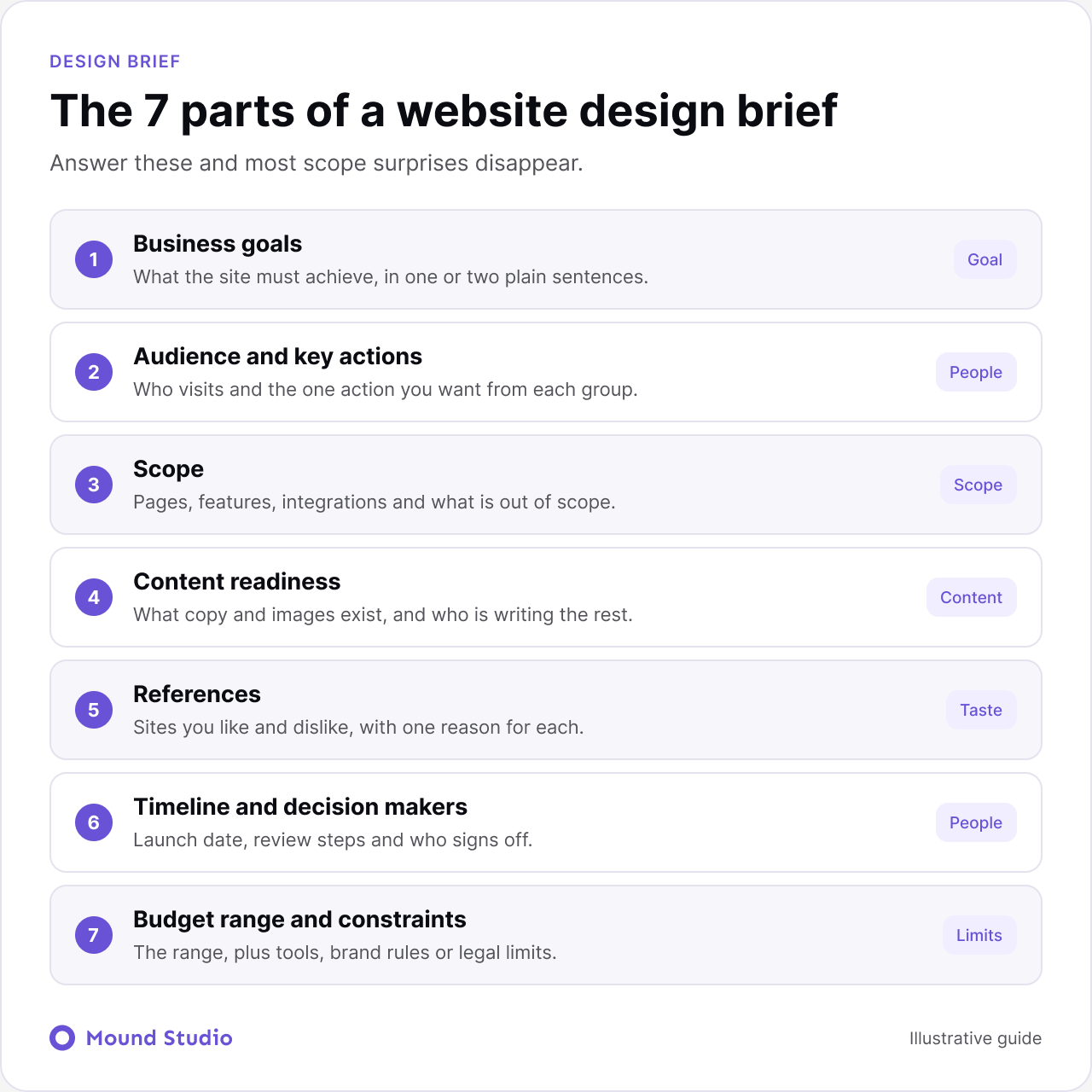
Say what the website has to achieve for the business in one or two sentences. Good goals point at a result you could check later: more qualified enquiries, fewer support questions, clearer pricing, a better first impression for investors. Avoid goals that are only about appearance.
Describe who visits the site and what you want each group to do. Be specific about roles and situations, not just demographics. A visitor comparing three suppliers behaves differently from a customer looking for help. If you have research, interview notes or analytics, mention them.
List the pages and features you expect, and what is out of scope. Include integrations such as forms, a CRM, booking or payments. If you are unsure, list what you have now and what feels missing. It is fine to mark items as maybe.
State what content exists, who will write the rest and when it will be ready. Late content is one of the most common causes of delay. Also note if you will need photography, illustration or video, and who is responsible for it.
Share a few sites you like and a few you do not, and say why. Reasons matter more than the sites. A note such as clear pricing table, calm layout, too much animation tells the design team more than a list of links.
Give a launch date if one exists, and the reason behind it, such as a product launch or an event. Name who will give feedback and who has the final say. A project with five reviewers and no clear owner moves slowly.
Give a range you are comfortable with, plus any constraints such as existing tools, brand rules, accessibility needs or legal requirements. A range does not lock you in. It helps the agency propose the right scope. For a sense of how scope affects price, see how much UI/UX design costs and SaaS website design cost.
Here is a typical case. A small software company wants a new marketing site. The first draft of the brief says: "We want a modern site that looks professional." That line describes every website and helps no one.
After a short conversation, the brief changes. The goal becomes: "Get more qualified demo requests from operations managers at mid-sized clinics." The audience section names two visitor types, the manager comparing tools and the existing customer looking for help. The scope lists five pages and one form, with the blog marked as a maybe. The content section admits that pricing copy does not exist yet and names the person who will write it.
None of this took long to write. What changed is that an agency can now respond with a plan that fits, and the team has already agreed on what success means. The second version is not more polished. It is more specific, and that is what makes it useful.
Most briefs fail because the lines are too vague to act on. Compare the two versions below and rewrite your own until each line could be checked.
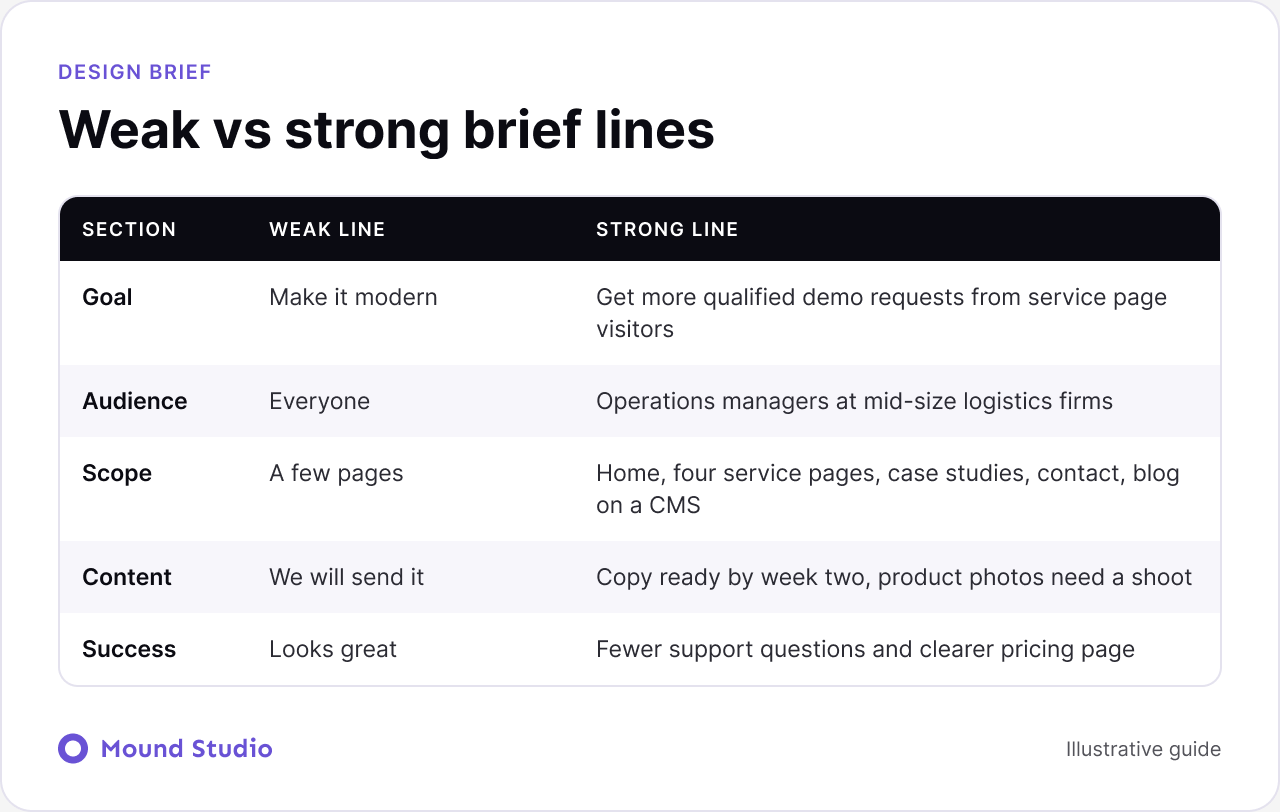
A useful test: if two different agencies could read the line and imagine two very different projects, the line is too vague.
Use this as a starting structure. Answer each item in one to three sentences.
| Section | Question to answer | Example of a good answer |
|---|---|---|
| Company | What do you do and for whom? | We sell scheduling software to small clinics |
| Goal | What must the site achieve? | Increase demo requests from clinic owners |
| Audience | Who visits and what do they want? | Clinic managers comparing tools and pricing |
| Scope | Which pages and features? | Home, features, pricing, blog, demo form |
| Content | What is ready, and who writes the rest? | Copy for features is ready, pricing copy is not |
| Timeline | When and why? | Live before the spring conference |
| Decisions | Who approves the work? | Head of marketing, with the founder at two checkpoints |
| Budget | What range and limits? | A stated range, existing CRM must stay |
Ask a colleague who was not part of the discussion to read it. Their questions show you where the brief is unclear.
A good agency will not simply return a price. They read it, ask questions and check your scope against what is realistic. Here is the sequence we follow.

The call is for gaps and risks, not for a sales pitch. Expect questions about priorities, the audience, past attempts and what would make the project a failure. Honest answers here save weeks later.
The scope is written down in a form both sides can point to. It lists the pages, features, milestones and responsibilities. When something new comes up, you can see whether it is inside or outside the agreement. That is how surprises become planned decisions.
The difference shows up quickly. With a vague brief, proposals come back as generic packages with a price attached, and it is hard to tell them apart. With a clear brief, agencies respond to your actual situation. They question assumptions, point out risks, and explain how their approach fits your goal.
You also learn more from the questions than from the prices. An agency that asks about your visitors, your content, and your success measures is thinking about the outcome. One that asks only about the number of pages is thinking about the invoice.
If conversion is the main goal of the site, read how to design a website that converts before you write your brief. It helps you choose goals and key actions that a design team can act on. For the structure of the site itself, our information architecture guide explains how pages and navigation get planned.
Add three things. First, what is not working today, backed by whatever evidence you have, such as analytics, support tickets or sales feedback. Second, what must stay, such as URLs that rank, content that performs and integrations that work. Third, the reason for redesigning now. If you are unsure whether it is time, read when to redesign your website, and use our website redesign checklist to plan the steps before, during and after.
That is normal. Write what you know, and use a section called open questions for the rest. Good open questions are specific: should we sell online or take enquiries, do we need more than one language, do we replace our current CMS. An agency can help you work through them, and they are much easier to discuss when they are written down.
| Check | Ready when |
|---|---|
| Goals | Each goal can be checked after launch |
| Audience | You can name the main visitor types and their key action |
| Scope | Pages and features are listed, with maybe items marked |
| Content | Owner and date exist for every content type |
| References | Each reference has a reason next to it |
| Timeline | Launch date, review steps and approvers are named |
| Budget | A range and known constraints are written down |
A brief written by one person often hides the opinions of everyone else. Before you send it, run through this short list.
This takes an hour or two and prevents the most common late surprise: a new reviewer joining the project halfway through and asking for a different direction.
Send the brief as a short document or a page that everyone can open, and add a link to any research or examples. Send it to every agency at the same time, so proposals answer the same questions. Offer a short call for questions, and share answers with all the agencies, not just the one who asked. This keeps the comparison fair.
Finally, keep the brief alive. After you choose an agency, treat it as the starting point for the scope and update it when decisions change. When the project ends, it is a useful record of why the site was built the way it was.
A website design brief does not need to be long or polished. It needs clear goals, a defined audience, a realistic scope and honest notes on content, timing and budget. Write it in plain sentences, share it early and use it to guide the conversation. If you would like help shaping your brief or turning it into a plan, talk to us about your website project.
A website design brief is a short document that tells a design team what you need: your goals, your audience, the pages and features, the content you have, the timeline and the budget range. It helps agencies understand the project and quote accurately.
Between one and three pages is enough for most projects. A brief is about clarity, not length. If it is longer, add a short summary at the top.
Yes, a range is very helpful. It lets the agency propose a scope that fits, instead of guessing. If you are unsure, say what you are comfortable with and ask what can be done at different levels.
No. You need to know the problem, the audience and the goal. A good agency helps with the solution. Say what you know, mark what you do not, and list your open questions.
The agency reviews it, usually asks a few questions on a call, then proposes a scope, timeline and price. A clear brief shortens that loop and reduces changes later.