








Website
Website Redesign Checklist for 2026: What to Do Before, During, and After
Most agency websites look impressive. Polished case studies, big client logos, smooth animations. The problem is that a portfolio shows you the finished result, not how the team got there, how long it took, or whether the client was happy with the process.
That gap matters because a website project is months of shared work. You will review designs, answer questions, write or approve content, and live with the platform choice for years. If the fit is wrong, you feel it in missed deadlines, surprise costs, and a site your team cannot update.
Choose a web design agency that understands your business goal, explains its process in plain words, tells you exactly who will do the work, recommends a platform for a reason, and has a clear plan for after launch. Ask the 12 questions below on your first calls, and compare the answers side by side.

We grouped the questions into four themes. You do not need to ask all of them in one call. Use the first call for fit and process, and the second for build and support.
A good agency can describe its ideal client in one or two sentences. If the answer is "everyone", the team probably does not have a clear point of view. Look for experience with your type of business, your stage, or your kind of website, such as a SaaS marketing site, a service business, or a content-heavy blog.
Ask them to explain one case study in detail: the goal, what they changed, what went wrong, and the result. Real teams talk about trade-offs and problems. A pitch that only mentions wins is a script, not experience.
The answer tells you whether design starts from strategy or from taste. Strong teams ask about your audience, your offer, your competitors, and what the website should make people do. If they jump straight to colors and fonts, expect a pretty site that does not move your numbers.
Kickoff shows how organized a team is. You should hear about a discovery session, a content and sitemap plan, and a clear list of what they need from you, such as access to analytics, brand files, and a decision maker.
At larger agencies, the people on the sales call are often not the people doing the work. Ask for names and roles. Ask whether any part of the design or development is outsourced to freelancers or another company. There is nothing wrong with partners, but you should know who they are.
Most budget arguments come from unclear revision rules. A clear answer sounds like: two rounds on the homepage design, one round on inner pages, and anything beyond that is quoted before work starts.
The platform should follow your needs, not the agency's habits. A marketing team that edits pages every week has different needs from a store with thousands of products. If you are weighing options, our Webflow vs WordPress comparison and Webflow vs Framer guide explain the trade-offs.
These should be part of the build, not an extra you remember at launch. Ask how they keep existing URLs and rankings, how they check page speed, and which accessibility standard they design to. A redesign that drops your search traffic is an expensive mistake. Our website redesign checklist covers what should happen here.
You should own everything you pay for: the Figma files, the site, the hosting account, the domain, and the analytics. Get this in writing. Some agencies host sites on their own accounts, which makes it hard to leave later.
Listen for a checklist: redirects, forms, tracking, mobile checks on real devices, and a rollback plan. A calm launch is the result of preparation, not luck.
Your marketing team should be able to publish a blog post or change a headline without opening a support ticket. Ask whether training, documentation, or a short video walkthrough is included.
Sites need fixes, updates, and new pages. Ask about response times, what a support plan costs, and whether the same team stays involved. The most common complaint after launch is slow responses, so settle this before you sign.
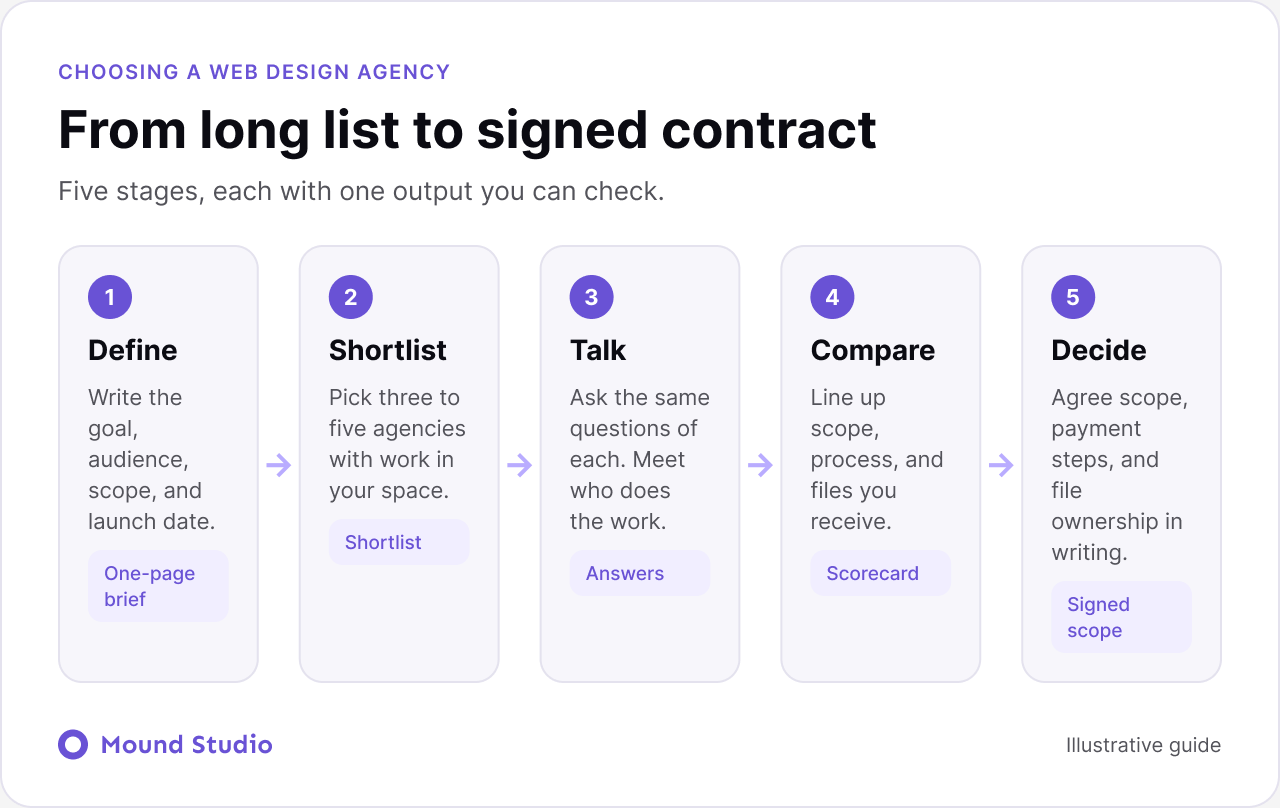
The questions work best inside a simple process. Each stage should end with something you can check, such as a one-page brief, a shortlist, or a written scope. If a stage has no output, it is easy to skip and hard to defend later.
Some warning signs appear in the very first conversation. Others show up in the proposal. Here are the patterns we see most often when clients come to us after a project went wrong.

Proposals rarely line up neatly. One agency quotes a low number with fewer pages, another includes copywriting and SEO, a third bundles a year of support. To compare them, put the proposals in a simple table with the same rows for each agency. Here is the layout we suggest.
| What to compare | What to look for | Why it matters |
|---|---|---|
| Pages and templates | Number and type of pages, plus blog and CMS templates | Extra pages are the most common source of added cost |
| Strategy and research | Discovery work before design starts | Skipping it leads to redesigns later |
| Feedback rounds | Rounds included and how extra changes are priced | Unclear rules cause budget arguments |
| Platform and hosting | Who owns the accounts and pays for hosting | Ownership decides whether you can leave |
| SEO, speed, accessibility | Migration, testing, and standards named in writing | These protect traffic and reach |
| Content | Who writes it and who loads it | Content delays are the top cause of late launches |
| Timeline | Dates, including the ones you are responsible for | Projects slip when client tasks are vague |
| Training and support | What is included after launch and response times | Your team needs to run the site without help |
Once the scope is visible, the price differences usually make sense. If you want a deeper look at what moves the number, read how much a SaaS website costs and how UI/UX design is priced.
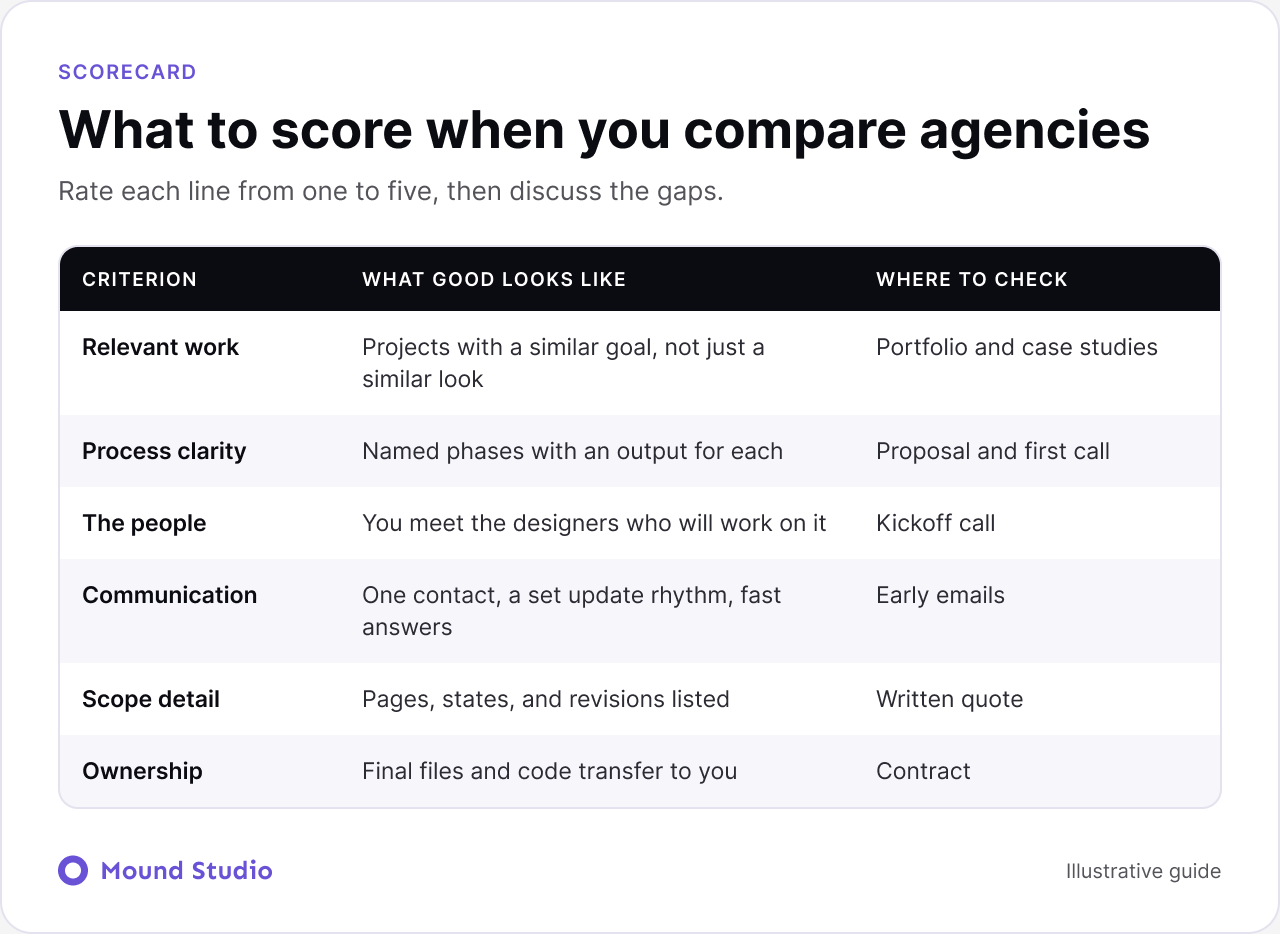
After the calls, score each agency on the same criteria. A simple one to five scale is enough. The point is to make the gaps visible, so the conversation with your team is about evidence, not gut feeling.
There is no single right size. A freelancer can be a great fit for a small, well-defined site with a tight budget, but you depend on one person's time and skills. A large agency brings many specialists and process, but you may pay for layers of management and see less of the senior team. A small, senior studio sits in between.
| Option | Strengths | Watch out for |
|---|---|---|
| Freelancer | Direct contact, flexible, good for small defined sites | One person's capacity, and gaps outside their skill |
| Small studio | Design and development together, fewer handoffs | Check availability and how support works |
| Large agency | Many specialists and established process | Layers of management, junior staff doing the work |
A small studio gives you design and development under one roof, direct contact with the people doing the work, and fewer handoffs. That is the model we run at Mound Studio, because we have seen how much quality is lost when strategy, design, and development are split across different companies.
The right agency is the one that understands your goal, is clear about how it works, and tells you the truth before you sign. If you are planning a new site or a redesign, talk to the Mound Studio team. We will answer every question on this list, including the uncomfortable ones.
Start with your goal, then shortlist agencies with relevant work. Ask how they work, who does the work, which platform they recommend and why, and what happens after launch. Compare proposals on scope and process before price.
Ask about their ideal clients, a similar past project, their first two weeks, who designs and builds your site, feedback rounds, platform choice, SEO and speed, ownership of files and accounts, launch testing, training, and support.
Guaranteed rankings, the same package for every client, no questions about your goals, unclear ownership or hosting terms, and a price with no scope attached.
A freelancer suits small, well-defined sites. An agency or studio suits projects that need strategy, design, and development together, or ongoing support. Choose based on scope and risk, not size alone.
You should own the domain, hosting account, design files, code or site project, and analytics. Put ownership in the contract before work starts.