









Agency
How to Choose a Web Design Agency in 2026: 12 Questions to Ask
Before you hire a design agency, ask about their process, who you will actually work with, what is included in the price, and who owns the final files. Those four areas cover almost every misunderstanding that comes up mid-project. A polished portfolio tells you an agency can produce good work. It does not tell you how they will communicate with you, what happens when the scope shifts, or whether you will be able to use the final designs however you need to. This guide walks through the specific questions worth asking in each area, and what a strong answer usually sounds like.
A strong portfolio is a filter, not a decision. It tells you an agency has produced work you like the look of, but it does not tell you how that work got made: how many rounds of feedback it took, how closely the team stuck to the original scope, or how the relationship felt day to day. Two agencies with equally strong portfolios can be very different to actually work with, and the only way to find out is to ask directly, before you sign anything.
Most vetting questions fall into a handful of categories. Working through each one systematically, rather than asking whatever comes to mind on the call, makes it much easier to compare agencies afterward.
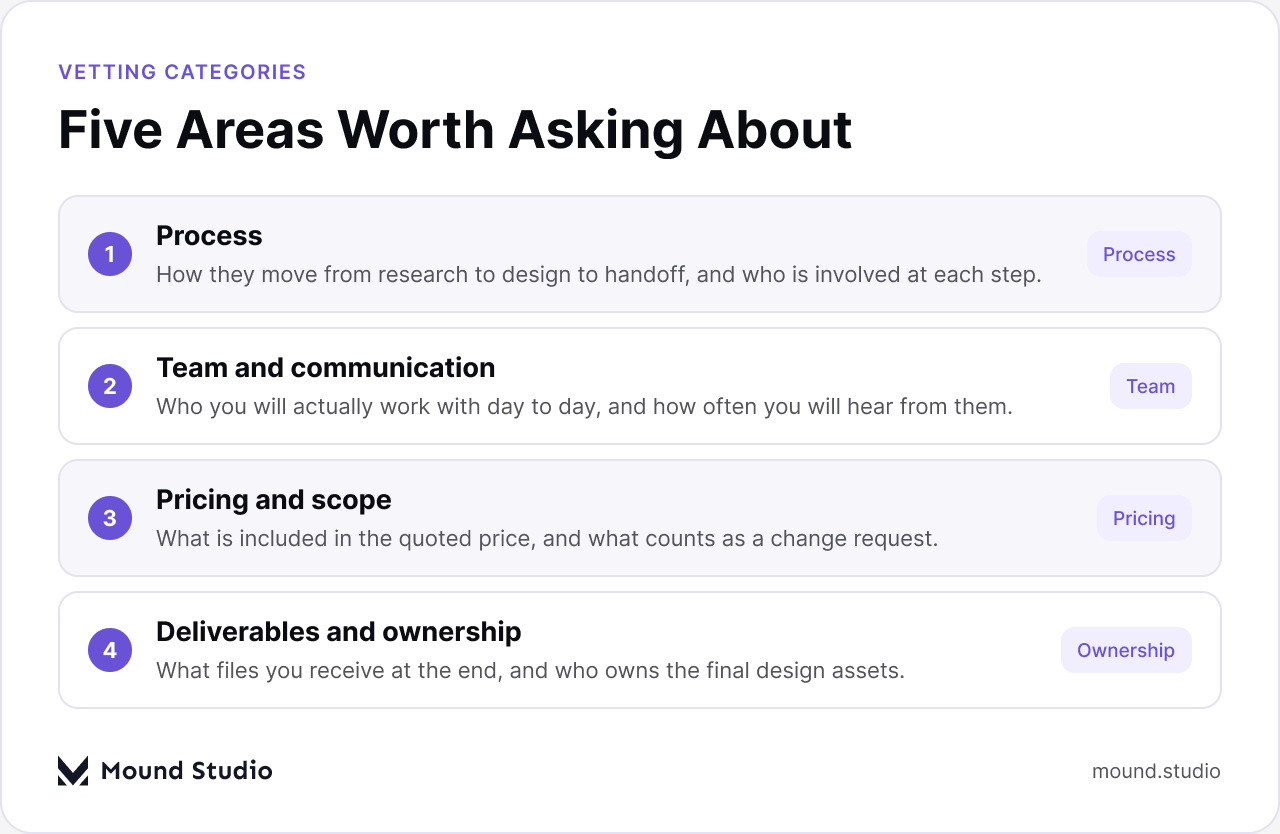
Process. Ask how they move from research to design to handoff, and who is involved at each step. A vague answer here is a warning sign, since a real process should be easy to describe in a few sentences. Team and communication. Ask who you will actually work with day to day, not just who is on the pitch call, and how often you should expect updates. Pricing and scope. Ask exactly what is included in the quoted price, and what specifically counts as a change request. Deliverables and ownership. Ask what files you receive at the end of the project, and who owns the final design assets once the engagement is over.
| Category | Questions to ask |
|---|---|
| Process | What does a typical project timeline look like? Who reviews and approves work at each stage? |
| Team | Who will we actually work with? How often will we hear from you, and through what channel? |
| Pricing | What's included in this quote? What counts as a change request outside the agreed scope? |
| Ownership | What files do we receive at handoff? Do we own the final design assets? |
Vetting works best as a process, not a single conversation. The steps below describe a practical path from a long list of possible agencies to a signed proposal.

Start by shortlisting a few agencies whose past work matches your industry or the type of product you are building. From there, review portfolios for range rather than just polish. An agency that has solved similar problems in different ways is often more adaptable than one with a single visual style applied to everything. A discovery call is where you ask the direct questions above, before requesting a full proposal. Finally, compare proposals by scope and assumptions side by side, not just by the number at the bottom of the page, since two very different numbers can represent similar amounts of actual work.
Some of the questions worth asking are really about whether an agency is the right choice at all, compared with building the capability in-house. Neither option is universally better. They fit different situations.

An in-house team builds deep, ongoing context about your product over time, but comes with hiring and management overhead, and it is harder to flex up quickly for a single large project. Working with an agency brings outside perspective and range, and it scales up or down with the project, but there is a ramp-up period while the agency learns your product. Many teams end up using both at different stages: an agency for a defined project with a clear scope, and an in-house team for continuous, long-term product work once the foundation is in place.
Some signals are easier to catch on a first call than others. This table lists a few of the most common ones worth watching for.
| Signal | Red flag | Green flag |
|---|---|---|
| Process | Cannot describe how a typical project runs | Walks you through a clear, repeatable process |
| Communication | Vague about who you'll actually work with | Introduces the specific team before you sign |
| Pricing | Reluctant to define what counts as a scope change | Puts the revision limit and scope in writing upfront |
| References | Cannot provide any past client to speak with | Offers references without being asked twice |
It helps to know what a good response actually sounds like, not just what question to ask. On process, a strong answer names specific stages and roughly how long each one takes, rather than a general description of "research, design, and testing." On team, a strong answer names the actual people who will work on your project, and how you will reach them. On pricing, a strong answer states the revision limit as a specific number and gives concrete examples of what counts as a change request. On ownership, a strong answer confirms in plain terms that you receive full source files at handoff, or explains clearly why that is not the case for a particular engagement.
If an answer stays general when you ask a specific question, that is worth noting. It does not necessarily mean the agency is a poor fit, but it is a signal to ask a follow-up question rather than move on.
A few questions are worth holding until you are down to a final shortlist, since they take more time for an agency to answer well and are less useful to ask everyone up front. These include how the agency handles disagreements about design direction, what their process looks like when a deadline is at risk, and how they typically structure a working relationship that continues past the first project. Asking these of two or three finalists, rather than every agency on your initial list, respects everyone's time while still giving you the detail you need to make a final call.
It also helps to ask how a disagreement over a design decision actually gets resolved in practice. Every project eventually runs into a point where you and the agency see something differently, whether it is a layout choice, a copy direction, or how a flow should work. A strong agency will describe a specific way this gets handled, such as presenting options with reasoning behind each one, rather than simply saying they will "figure it out together." That specificity is a good sign the agency has actually navigated this situation before, rather than avoiding it.
A reference check takes more effort than reading a portfolio, which is exactly why it is worth doing. A short conversation with a past client tends to surface details a proposal never mentions: how responsive the team actually was, whether the project stayed close to the original timeline, and how disagreements got resolved along the way. Ask the reference what they would do differently if they started the project again. That question usually produces more useful detail than a general "how was it," since it invites a specific, practical answer rather than a polite summary.
Vetting an agency goes more smoothly when your own side is prepared, too. Before the first call, it helps to agree internally on who has the authority to make the final decision, since a vetting process that involves five stakeholders with equal say tends to stall. It also helps to write down, even briefly, what you actually need from the engagement: a specific deliverable, a specific timeline, or ongoing support. Agencies can give sharper, more useful answers to your questions when they understand what you are actually trying to accomplish, rather than answering in the abstract.
It is also worth deciding ahead of time what would disqualify an agency outright, versus what is a minor concern worth raising but not a dealbreaker. Having this distinction in mind before the calls start makes it much easier to compare agencies afterward without relitigating the same tradeoffs each time.
There is no fixed timeline, but a vetting process that moves too quickly is often a sign that important questions are getting skipped. A reasonable process usually includes enough time to have a real discovery call with each shortlisted agency, follow up with clarifying questions, and check at least one reference before making a final decision. Rushing this stage to save a few days rarely pays off, since the cost of choosing the wrong partner, in time, rework, and frustration, is almost always higher than the time saved by skipping a step. If a timeline is truly tight, it is better to shorten the shortlist than to skip the vetting steps entirely.
The questions above are meant to set you up for a smoother relationship once the project actually starts, not just to help you pick a name off a list. Once you have chosen an agency, revisit the answers they gave you during vetting and put them into the kickoff materials: the agreed process, the named points of contact, the revision limit, and the ownership terms. Having these written down in one place, rather than scattered across emails and call notes, makes it much easier to hold the relationship to what was actually promised, and it gives both sides a clear reference point if a disagreement comes up later.
Choosing a design agency is easier once you know what to ask: how they work, who you will work with, what is included in the price, and who owns the result. A strong agency will answer these questions clearly and specifically, without needing to be pressed. If you are putting together a shortlist and want to talk through what to look for, reach out to us.
Ask about their process, who you'll actually work with, what's included in the price, and who owns the final files. These four areas cover most of the misunderstandings that come up mid-project.
No. A portfolio shows the quality of past work but doesn't tell you how the agency communicates, handles scope changes, or structures ownership of the final files.
It depends on the type of work. An agency fits a defined project with a clear scope, while an in-house team suits continuous, long-term product work. Many teams use both at different stages.
Very. A short conversation with a past client often surfaces details about responsiveness and working style that a proposal never mentions.
That depends on the agreement, but it should be confirmed in writing before the project starts, not assumed or clarified only after it ends.