









SEO & AEO
How to Optimize Your Website for AI Search in 2026 (AEO Guide)

Content that ranks in AI search answers the question directly in the first few sentences, uses clear structure so the answer is easy to lift, and backs that answer up with specifics rather than vague claims. AI search systems are not reading your page the way a person browsing top to bottom would. They are scanning for the passage that most directly answers a specific question, so the page that wins is usually the one that makes that passage easy to find and easy to trust.
This matters more each year, as more searches resolve into a direct AI-generated answer instead of a list of links to click through. A page that used to rank well under traditional SEO can still miss out entirely on AI search visibility if its answer is buried, its structure is inconsistent, or its credibility signals are weak. The good news is that the fix is rarely a full rewrite. It is usually a matter of reordering and clarifying content that already exists.
Traditional SEO writing optimizes for a click: a compelling title, a meta description that earns the tap, and a page built to hold attention once someone lands on it. Writing for AI search optimizes for something slightly different: being the passage an AI system chooses to quote, summarize, or cite when it builds an answer. The two overlap a lot, since both reward clear, well-organized, trustworthy content. But AEO puts more weight on the opening paragraph carrying a complete answer on its own, since that is often the part a system pulls out and uses directly.
| Element | SEO-first approach | AEO-first approach |
|---|---|---|
| Opening paragraph | Sets up the topic before getting to the point | States the direct answer immediately |
| Headings | Often stylistic or brand-driven | Phrased as the actual questions people ask |
| Structure | Long-form paragraphs are common | Short lists and tables make answers easy to extract |
| Success metric | Clicks and ranking position | Being cited or summarized in an AI-generated answer |
The steps below apply whether you are writing a new page from scratch or rewriting an existing one that is not performing the way you expected.
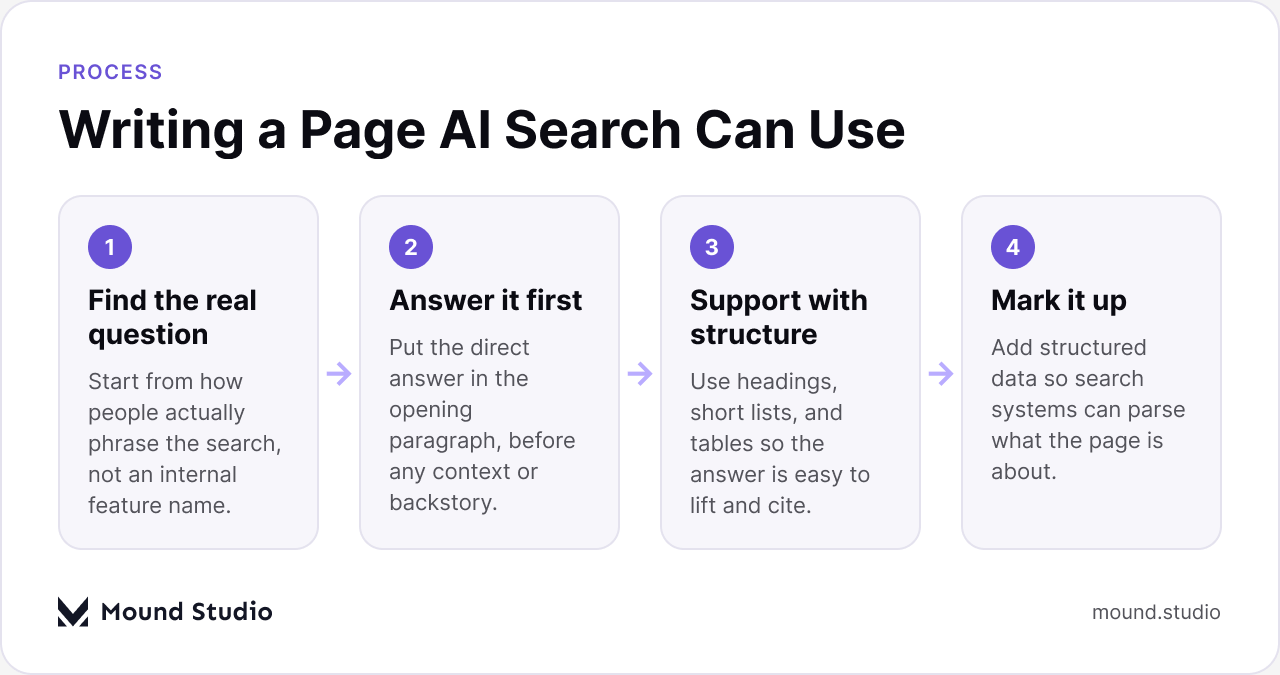
Start by finding the real question, phrased the way someone would actually type or say it, not the internal name your team uses for the feature or topic. Then answer it directly in the opening paragraph, before any setup or backstory. From there, support that answer with structure: headings, short lists, and tables that make the surrounding detail easy to scan. Finally, mark the page up with structured data so search systems have an explicit, machine-readable description of what the page is about, not just a human-readable one.
A few signals show up consistently across pages that perform well in AI-generated answers. None of them are tricks. They are mostly just good writing habits applied consistently.
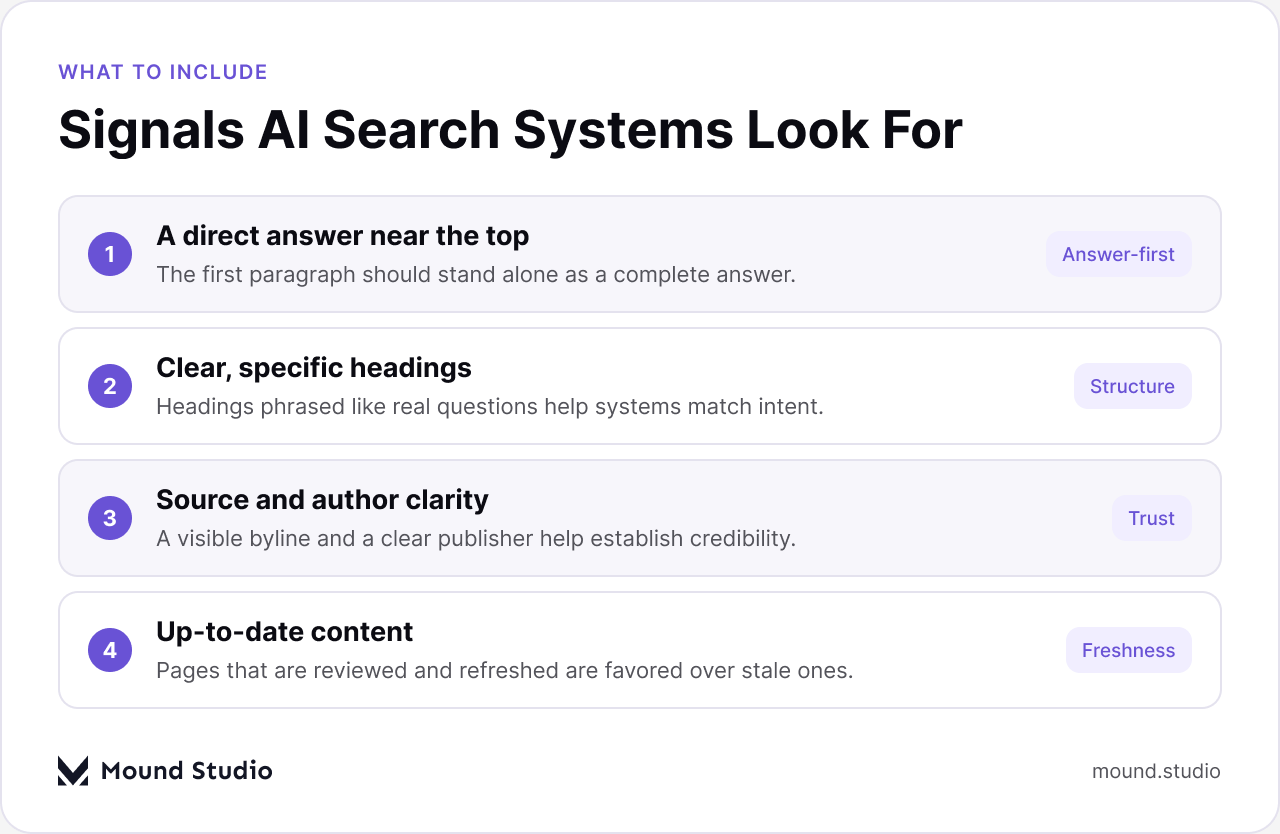
A direct answer near the top matters most. The first paragraph should stand on its own as a complete answer, so that if a system extracts only that paragraph, it still makes sense out of context. Clear, specific headings help too, especially when they are phrased as real questions, because that phrasing maps closely to how people actually search. Source and author clarity, a visible byline, and a clear sense of who is publishing the page, helps establish the credibility that AI systems weigh when choosing what to cite. Up-to-date content also gets favored over stale pages, since a page that has clearly been reviewed recently is a safer thing to cite than one that has not been touched in years.
Not every improvement carries equal weight. If you are working with limited time, it helps to know where to spend it first.
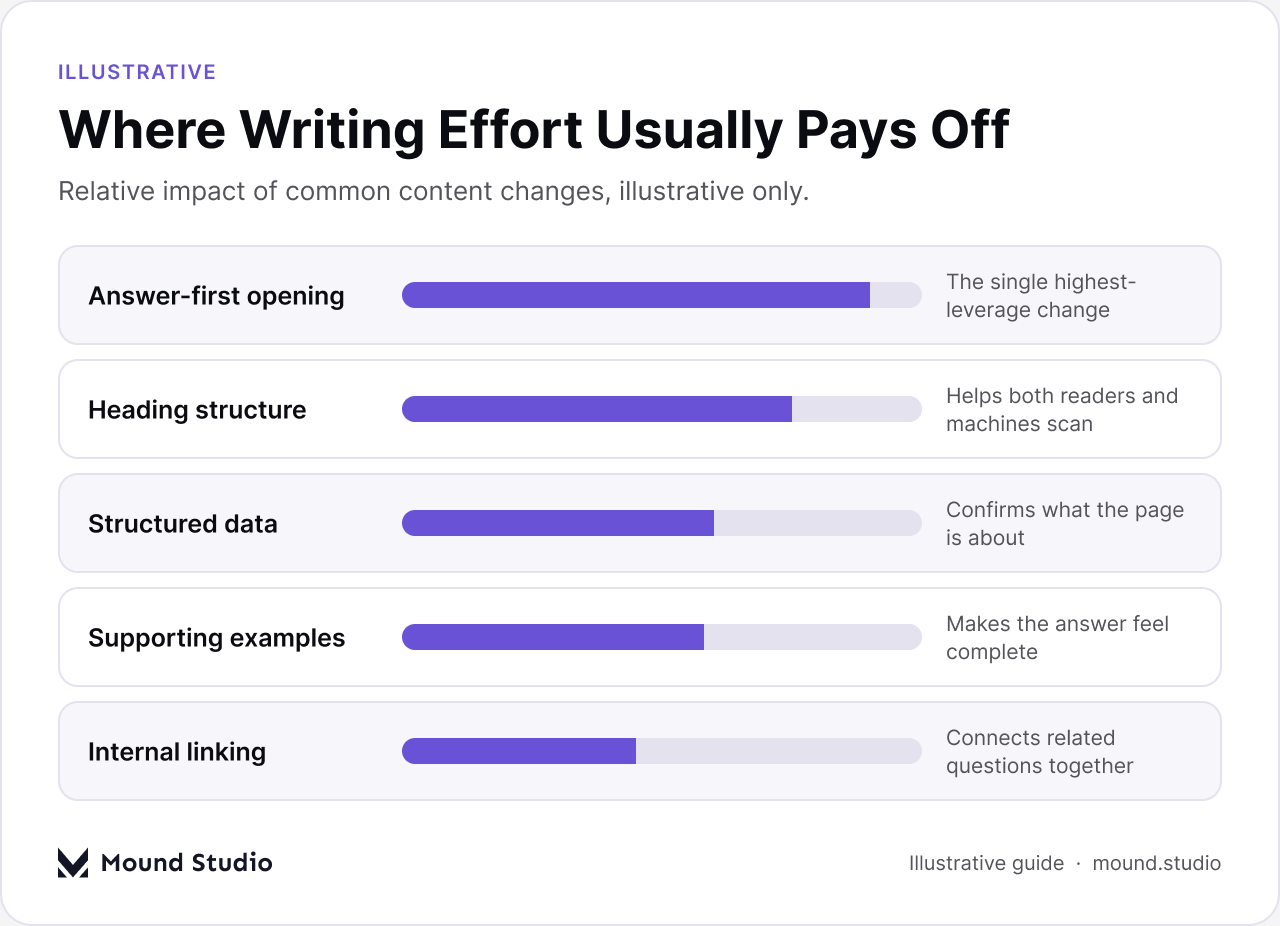
Rewriting the opening paragraph to answer the question directly is usually the single most effective change you can make, and it is often the fastest to do. Fixing heading structure comes next, since it helps both human readers scanning the page and machine systems trying to parse it. Structured data confirms what the page is about in a format systems can read reliably, which matters even when the content itself is already strong. Supporting examples and internal links round out the page, making the answer feel complete and connecting it to related questions your other content already answers.
| Checklist item | Why it matters |
|---|---|
| Opening paragraph answers the question directly | Often the exact passage a system extracts and cites |
| Headings are phrased as real questions | Matches how people actually search and how systems match intent |
| Lists and tables break up long explanations | Structured content is easier to extract accurately |
| Author and publisher are clearly identified | Signals credibility to both readers and AI systems |
| Structured data is present and accurate | Gives systems an explicit, machine-readable summary |
| Content is reviewed and updated periodically | Freshness is a factor in what gets cited |
It helps to see the difference in practice. A buried-answer opening often starts with context: a sentence or two about why the topic matters, a mention of how things used to work, and only then the actual answer, several sentences in. An answer-first opening flips that order. The first sentence states the answer plainly, the second sentence adds the most important qualifier or condition, and everything after that is supporting detail for a reader who wants more. This does not mean cutting the context out of the page entirely. It means moving it after the answer instead of before it, so a system, or a person skimming, gets the useful part first.
This is a bigger adjustment than it sounds like for teams used to writing introductions the way a print article might: scene-setting first, point second. On the web, and especially for AI search, that order works against you. The habit worth building is asking, for every page, "if someone read only the first two sentences, would they have their answer?" If not, the opening needs to move.
The answer-first principle applies a little differently depending on what kind of page you are writing. A blog post answering a specific question benefits most directly: state the answer, then explain it. A product or service page is less about answering a question and more about describing what something is and who it is for, so the equivalent move is leading with a clear, specific description instead of a vague value statement. Documentation and help content benefit from the same structure as blog posts: state what the reader needs to do or know first, then explain the reasoning or edge cases afterward. Across all three, the underlying habit is the same: put the most useful sentence first, regardless of the format.
Measuring AEO performance directly is still an evolving practice, since visibility inside an AI-generated answer does not show up in the same reports as a search ranking. That said, a few signals are worth tracking over time: whether your pages show up when you test relevant questions directly in AI search tools, whether referral traffic from AI-powered search surfaces appears in your analytics, and whether pages you have rewritten with an answer-first structure see any change in engagement from readers who do click through. None of these are perfect measurements, but tracking them consistently gives you a rough sense of whether the changes are having an effect, rather than making changes once and never revisiting the question.
Writing for AI search does not mean abandoning what already works for traditional search. Most of the habits described here, answer-first writing, clear structure, credible sourcing, also help human readers scan a page faster and trust it more. The main shift is prioritization: instead of treating the opening paragraph as a warm-up before the real content, treat it as the most important sentence or two on the page. Everything else can still build out the full explanation, examples, and nuance that a thorough reader wants. You are not choosing between writing for people and writing for AI systems. You are ordering the same good content so the most useful part comes first.
Internal links do double duty for AI search. They help a system understand how your content relates across a topic, which builds a sense of topical depth beyond any single page, and they give readers a direct path to related questions once their immediate one is answered. When you rewrite a page for AEO, it is worth checking whether it links to and from the other pages that cover adjacent questions on the same topic. A single strong page answering one question well is useful. A cluster of pages that clearly connect to each other signals a more complete, more trustworthy source on the topic as a whole, which is exactly the kind of source an AI system is more comfortable citing repeatedly.
This does not require a large restructuring project. Adding two or three relevant internal links to an existing page, and making sure the anchor text describes what the linked page actually covers, is usually enough to start building that sense of connected coverage.
Content that ranks in AI search is not fundamentally different from good content in general. It answers the real question directly, organizes the supporting detail so it is easy to scan, and gives systems a clear, structured way to understand what the page is about. Start with your highest-traffic pages, check whether the opening paragraph actually answers the question, and work outward from there. If you want a hand auditing your existing content for AI search readiness, reach out to us.
Answer the real question directly in the opening paragraph, structure the rest of the page with clear headings and lists, and add structured data so systems can parse what the page is about.
SEO writing optimizes for a click and a ranking position. AEO writing optimizes for being the passage an AI system quotes or cites directly, which puts more weight on the opening paragraph carrying a complete answer.
Yes. It gives search systems an explicit, machine-readable description of what a page is about, rather than leaving that interpretation to chance.
There's no fixed schedule, but pages that show clear signs of recent review are generally safer for a system to cite than pages that haven't been touched in years.
It can, but a page trying to answer too many questions at once often dilutes the clarity of each answer. Splitting related questions into focused, linked pages usually performs better.