








Product
SaaS MVP Development: How to Build Your First Version

There is no single number that answers this well for every project, because "MVP" describes a stage of a product, not a size. A narrowly scoped app with one core user flow and no outside integrations can move through design and build in a tightly managed span of weeks. A multi-role SaaS product with permissions, several integrations, and a compliance review stretches into months before it is ready for real users. What decides which end of that range you land on is not effort or budget alone. It is how clearly the scope is defined before anyone opens a design file, how many outside systems the product depends on, and how fast your team can turn feedback into the next version.
This guide walks through the phases every MVP moves through, the factors that actually stretch or compress a timeline, the mistakes that quietly add time nobody budgeted for, and a short decision guide you can use to check your own launch date against reality.
An MVP timeline is set less by the idea and more by the scope behind it. A single-platform product with one clear user flow and no third-party dependencies typically moves from kickoff to launch in a matter of weeks. Add user roles, integrations, a second platform, or a compliance requirement, and the same label, MVP, can take several months, because each addition multiplies the number of screens, states, and edge cases that have to be designed, built, and tested before launch. The fastest path to a realistic date is a scope that has been written down and agreed on before design work starts, not a faster design or development team.
Every MVP, regardless of complexity, moves through the same five phases. Knowing what happens in each one is the easiest way to spot where your own project's timeline is likely to stretch, and which delays are normal versus which ones are a sign something upstream was left unresolved.
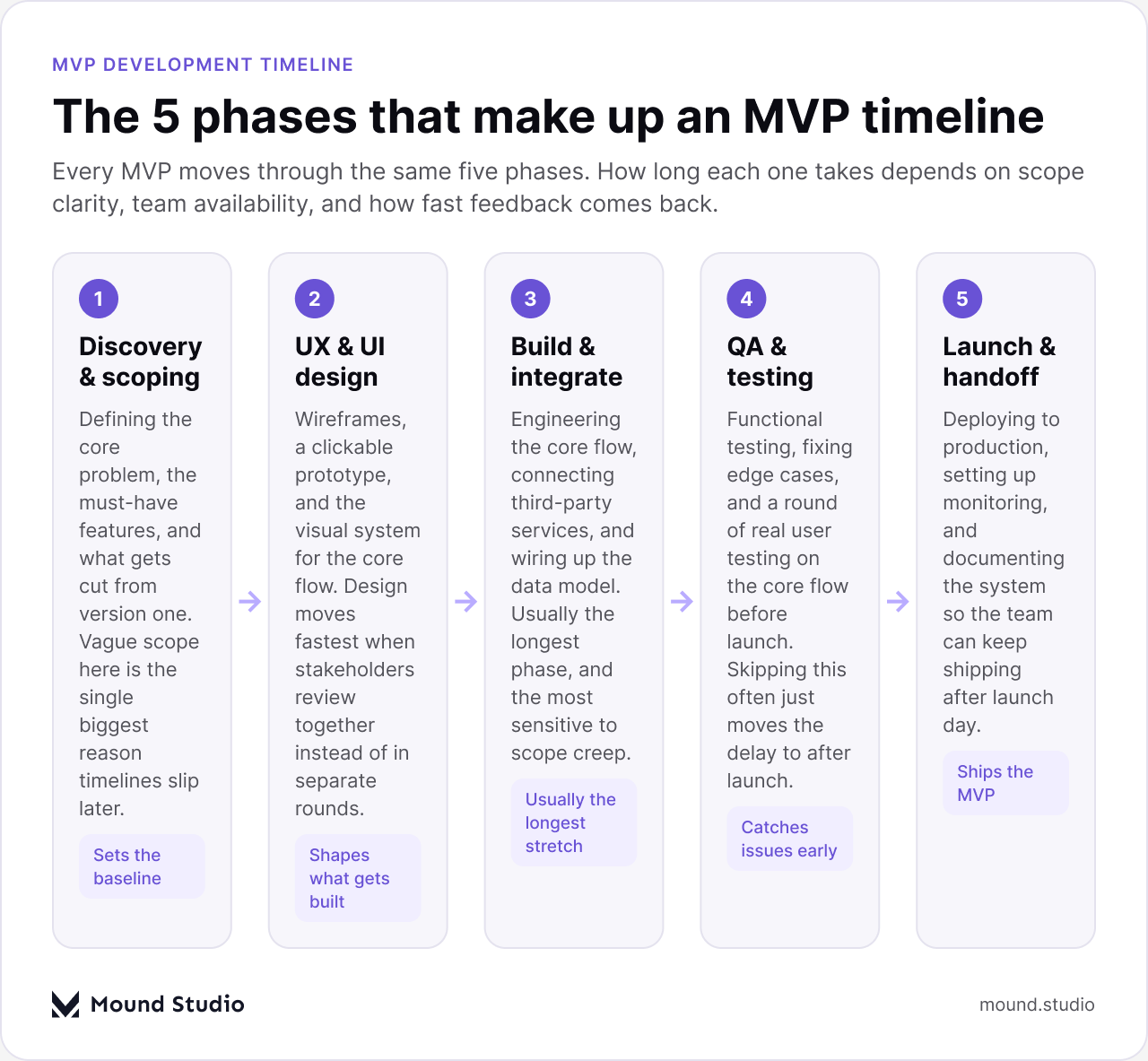
This phase sets the ceiling for everything that follows. The goal is a written brief that names the core problem, the must-have features, and what gets cut from version one. A vague brief here tends to resurface as a scope argument during build, which is far more expensive to resolve mid-project than it would have been to settle upfront. Teams that move fastest overall are rarely the ones with the most resources. They are the ones who answered the hard scope questions before design started.
Design turns the brief into wireframes, a clickable prototype, and the visual system for the core flow. This phase moves fastest when stakeholders review together instead of in separate, staggered rounds that each produce their own set of notes. A tested prototype also catches structural problems while they still cost a redesign, not a rebuild. If your product needs a reusable set of components rather than one-off screens, this is also where a design system gets its foundation, which pays off well beyond the first release.
Engineering turns the design into working software: the core flow, the data model, and any third-party services the product depends on. This is usually the longest phase, and the most sensitive to scope creep, because every state a designer sketched now has to actually work, including the edge cases nobody thought about until they showed up in a pull request. Integrations deserve special attention here, since a dependency on an external API or service ties part of your timeline to another company's release schedule, not just your own.
This phase covers functional testing, fixing edge cases, and a round of testing with real users on the core flow before launch. It looks skippable on a schedule because it produces no new features. Skipping it does not remove the work, though. It just moves the same problems to after launch, where they cost more to fix and are visible to the people you are trying to win over.
The final phase covers deploying to production, setting up monitoring, and documenting the system well enough that the team can keep shipping after launch day without re-learning decisions that were only ever in someone's head. A rushed handoff here is a common, quiet source of slowdowns in the weeks right after an MVP ships, since the team is now debugging a live product without the context that got it there.
Two products can both be described as an MVP and need very different amounts of work. The difference almost always comes down to complexity: how many user types the product serves, how many systems it depends on, and how much of the experience has to work correctly the first time a real user touches it.
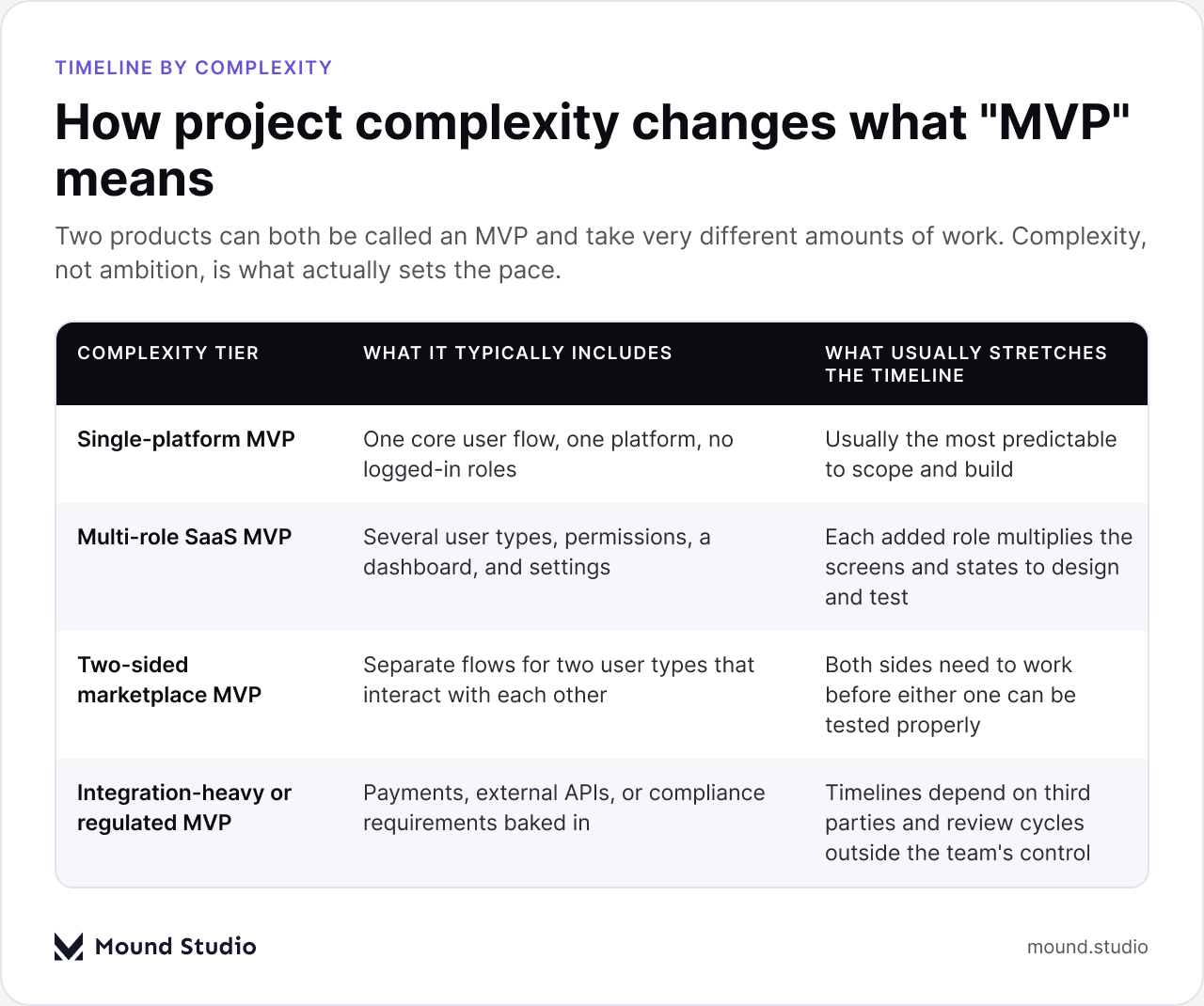
A single-platform product with one audience and no logged-in roles is the easiest case to scope accurately, because there is only one path through the product to design, build, and test. Add a second role, an admin alongside an end user, for example, and the work does not simply double. It multiplies, because every screen now needs to account for what each role can see and do, and every permission boundary needs its own test case. A two-sided marketplace is harder still, because neither side of the product can be properly tested until the other side exists in a usable form. And any MVP that touches payments, health information, or another regulated area inherits review cycles that live outside your team's control, which is often the single hardest part of a timeline to predict with any confidence. Our guide to SaaS MVP development goes deeper into what a multi-role build actually involves.
Before you ask how long a build will take, it is worth writing down which of these complexity tiers your product actually sits in. A rough idea that is secretly a two-sided marketplace with payments attached will never fit a single-platform timeline, no matter how experienced the team you hire is.
| Question | What it tells you |
|---|---|
| Can you describe the core flow in two sentences? | A clear yes usually means the scope is tight enough to move quickly. |
| Does the product need more than one user role at launch? | Each added role adds real design and testing time, not just a setting to flip. |
| Does it depend on a system your team does not control? | That dependency's pace becomes part of your timeline, not just your team's. |
| Does anyone outside the team need to approve or review it? | Budget time for cycles your team cannot shorten just by working harder. |
Beyond the phase and the complexity tier, a handful of factors decide whether a specific MVP comes in faster or slower than a typical project at the same complexity level.
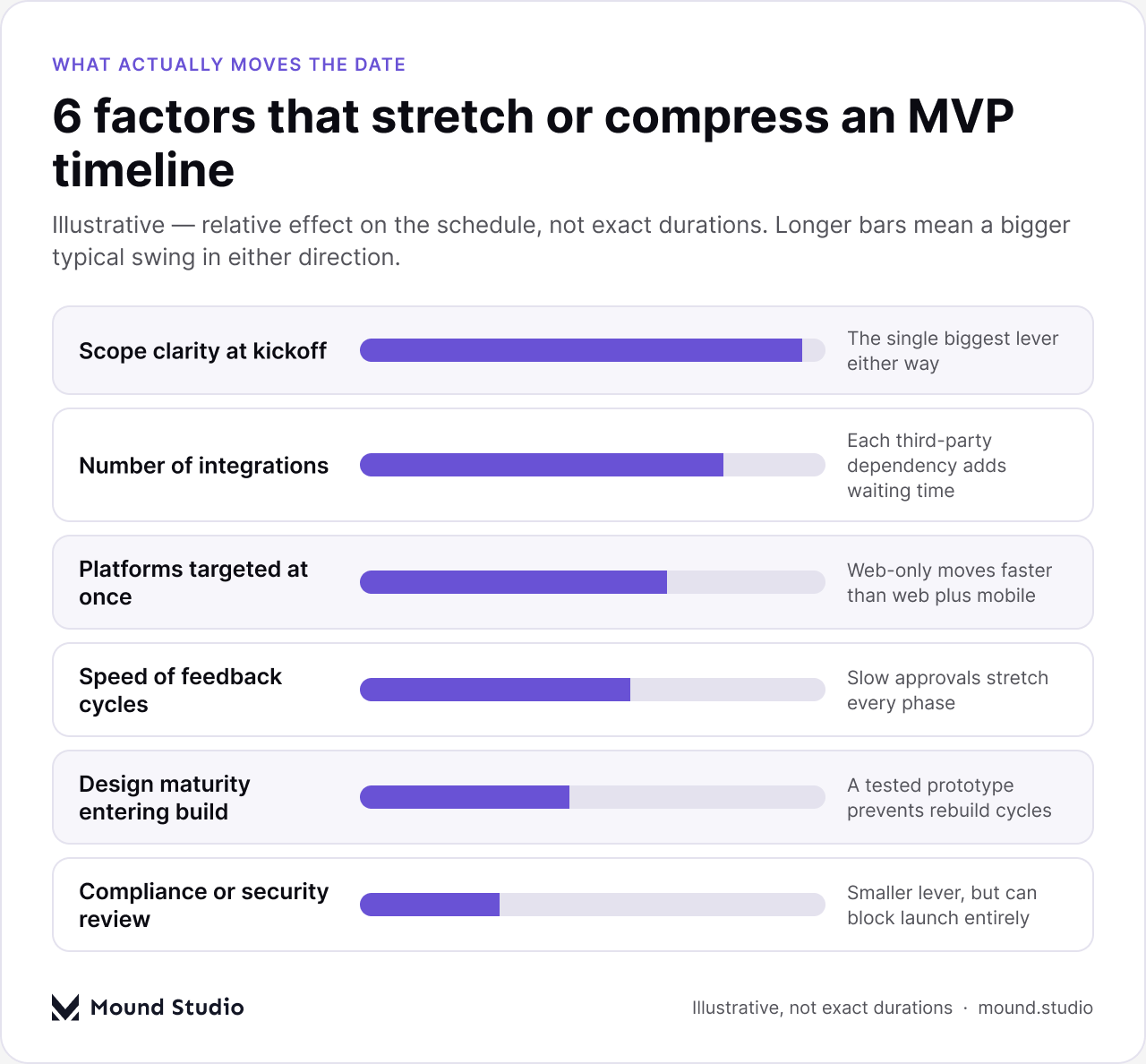
Scope clarity at kickoff has the biggest effect of any single factor, because every hour spent debating what is in scope during build is an hour the team is not shipping. Integrations come next on the list: every third-party service adds a dependency you do not fully control, from access and documentation gaps to the other company's own release schedule. Targeting more than one platform at once adds real work rather than doubling it cleanly, since shared components still need platform-specific testing and polish. The speed of feedback cycles compounds across every phase that follows it, too. A team that gets same-day answers moves through design and build noticeably faster than one waiting several days for sign-off on each round. Design maturity entering build matters as well: a flow that was tested as a prototype rarely needs the expensive kind of rework that an untested one does once it is already built. Compliance or security review is usually the smallest of these factors day to day, but it can block a launch entirely regardless of how fast everything else moved.
A SaaS product and a single consumer app can both be MVPs, but they rarely move at the same pace. A SaaS MVP typically introduces accounts, roles, and a dashboard before a single feature even ships, because the product has to support ongoing use by returning customers, not just a first visit. That groundwork takes real time, but it also tends to pay off, since later features build on an architecture that already understands users, permissions, and billing. For teams weighing this tradeoff, reviewing SaaS UX design best practices early, before the architecture is locked in, is one of the cheaper ways to avoid redesigning core screens after launch.
Most MVP delays do not come from one dramatic event. They come from a handful of avoidable habits that each add a few days, until the launch date has moved without anyone deciding to move it.
| Mistake | Why it delays launch |
|---|---|
| Treating "MVP" as "whatever fits the deadline" | Scope keeps expanding mid-build because nothing was deliberately cut |
| Skipping a clickable prototype | Problems a few days of testing would catch get discovered in production instead |
| Designing every screen before building any of them | Feedback from the build surfaces design issues too late to fix cheaply |
| Running feedback rounds in parallel, not in sequence | Conflicting notes from different stakeholders send the same screen back more than once |
| Adding integrations after the architecture is set | Retrofitting a dependency usually costs more time than planning for it from the start |
| Skipping user testing before launch | Confusing flows ship, and the fixes happen in public instead of in design |
None of these mistakes are unusual, and none of them require a bigger budget to avoid. What they require is deciding, before kickoff, what is actually in scope and what every stakeholder's role is in reviewing the work. Teams that are still working out what a UI/UX design engagement should include often find that research, testing, and handoff, not just screens, are exactly the line items that protect a timeline too.
Before asking anyone for a launch date, it helps to check your own answers to a few questions first.
The more of these you can answer before the first design file opens, the more reliable your timeline will be. Not because the work itself gets faster, but because fewer decisions get made mid-build, and mid-build decisions are where most timelines quietly slip.
There is no universal number that answers "how long does MVP development take," because the real answer depends on what you are actually building, not on what the label promises. A tightly scoped, single-platform product moves fast. A multi-role product with integrations and a review process moves slower, no matter which team builds it. What you can control is scope clarity, how many systems you depend on, and how fast your team turns feedback around, and all three of those are decided well before a single screen gets designed.
Planning an MVP and want a realistic timeline instead of a guess? Tell us what you are building and we will walk you through what it actually takes to get it live.
It depends mainly on scope and complexity rather than a fixed timeline. A single-platform product with one clear user flow typically moves faster than a multi-role SaaS product with integrations and a compliance review, since each addition multiplies the screens and states that need to be built and tested.
Build and integration is usually the longest phase, because every screen state sketched in design has to actually work in software, including edge cases that only surface once real code is written. Design is often the second longest, especially when the core flow needs several rounds of testing to get right.
Yes, usually by more than expected. Each added feature, user role, or integration does not simply add its own time. It also adds new interactions with everything already in scope, which is why a tightly defined list of must-have features is one of the most effective ways to protect a launch date.
Only to a point. Adding people helps with parallel work, but it does not fix an unclear scope or shorten a third-party review cycle, which are often the actual source of a delay. A clearer brief usually moves the date more than extra headcount.
Unclear scope at kickoff. When the core flow and the must-have features are not written down and agreed on before design starts, decisions that should have happened on day one get made mid-build instead, which is where most timelines quietly slip.