










Agency
How to Choose a Web Design Agency in 2026: 12 Questions to Ask
A retainer buys ongoing capacity: a recurring block of design or development time you can point at whatever comes up each month. A project-based engagement buys a fixed outcome: an agreed scope, delivered once, for an agreed price or set of milestones. The real difference isn't the paperwork — it's how work gets prioritized. On a retainer, priorities reset every cycle and scope stays flexible. On a project, scope is locked before work starts and the agency stays accountable to that fixed target until it ships.
Both models solve real problems, and most agencies offer both for a reason. The mistake is picking one because it's the one an agency happened to offer first, or the one a previous vendor used, rather than because it matches how your work actually shows up week to week.
A retainer is a standing agreement for a set amount of capacity — usually a number of days or hours per month — that renews on a fixed cycle. You are not buying a single deliverable. You are buying access to a team's time, which you and the agency then fill with whatever is most useful that cycle. That makes a retainer less like a purchase order and more like an ongoing working relationship, with a rhythm of planning, execution, and review that repeats every month or quarter.

Retainer scope is defined by capacity and category, not by a deliverable list. A design retainer might cover ongoing UI work, small feature design, design system upkeep, and one-off requests as they come in. A development retainer might cover bug fixes, small builds, integrations, and performance work. What changes month to month is which of those gets picked up first.
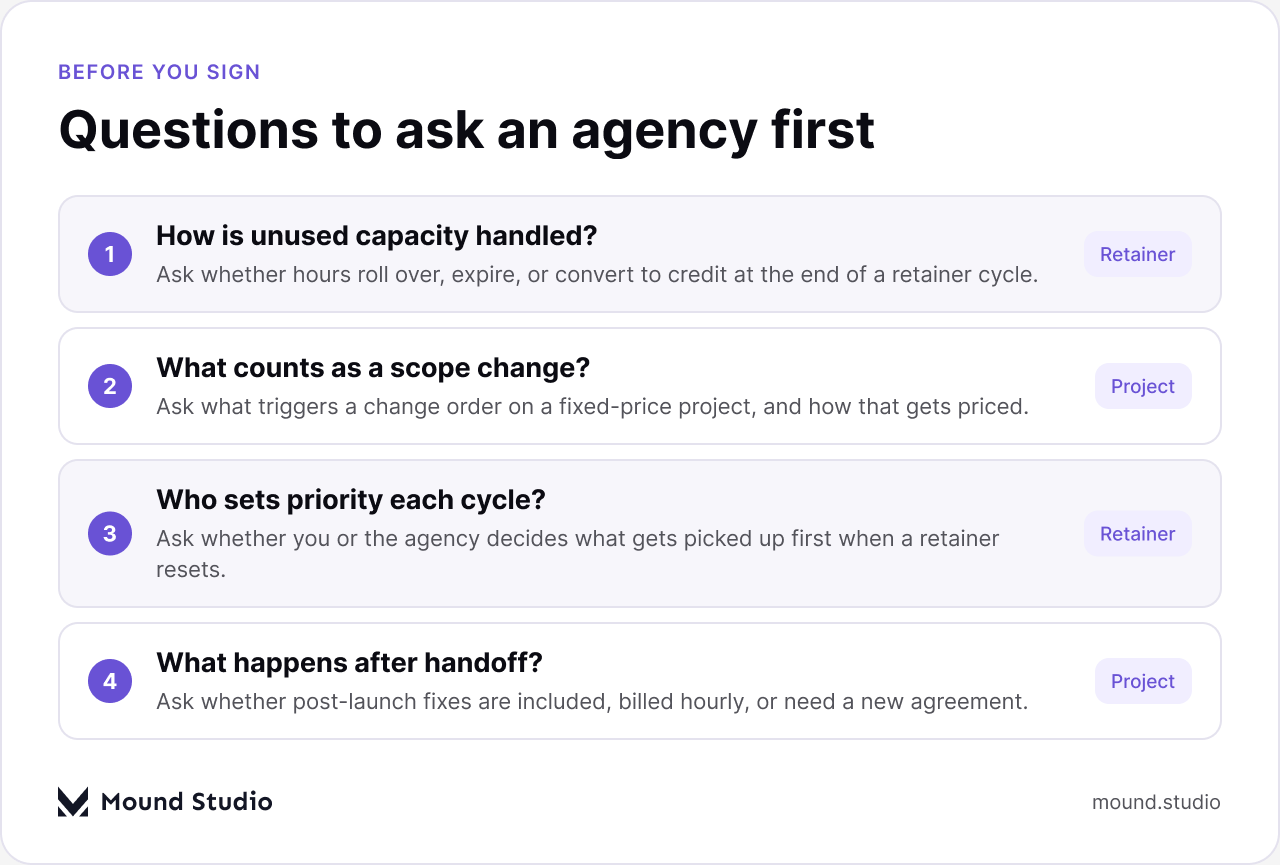
This is usually the real reason teams choose a retainer in the first place. A fixed-scope project has no natural way to absorb an urgent fix or an unplanned request without a change order. A retainer does, because the priority list is never locked more than one cycle out. Something urgent can simply move to the top of the next planning conversation instead of triggering a separate negotiation. The trade-off is that anything not urgent can keep sliding down the list if the agency and the client never agree on what actually counts as a priority, which is why a shared planning process matters more on a retainer than on almost any other part of the agreement.
Retainers are typically billed as a recurring fee for a set amount of capacity, renewing monthly or quarterly. The price maps to time available, not to a specific list of outputs — our guide on what actually drives design pricing covers how agencies think about scope and cost more broadly. Because the fee is tied to capacity rather than a fixed deliverable, the value of a retainer depends heavily on how clearly unused time and rollover are defined upfront, and on how disciplined both sides are about using the planning cadence instead of letting requests pile up unsorted.
A project-based engagement starts with a defined scope: a set of deliverables, a timeline, and either a fixed price or a milestone-based payment schedule. The agency is accountable to that scope until it's delivered, and the relationship has a natural end point once the work ships. Compared with a retainer, a project trades flexibility for certainty — you know roughly what you'll get, roughly when, and roughly what it will cost, before any design work begins.
Project scope is usually captured in a proposal or statement of work before anything is designed or built. It names the specific deliverables — pages, screens, a design system, a launch — along with what's explicitly out of scope. That boundary is what makes a fixed price possible in the first place, and it's also the part clients tend to skim past, which is where most disputes later start.
Most fixed-scope projects move through the same broad phases, even though the names and lengths vary by agency and by how big the project is.
Each phase is usually a milestone tied to an approval and, often, a payment — which is part of why scope changes mid-project are hard to absorb cleanly. Moving a deliverable in or out after a phase is approved tends to ripple into every phase after it.
Most project-based work is priced as a fixed fee for the agreed scope, sometimes split across milestones, or occasionally billed hourly against a capped estimate. Because the price is set against a specific scope, anything added afterward needs its own conversation — that's the change order, and it's worth asking how an agency handles it before you sign anything, rather than discovering the process for the first time mid-project.
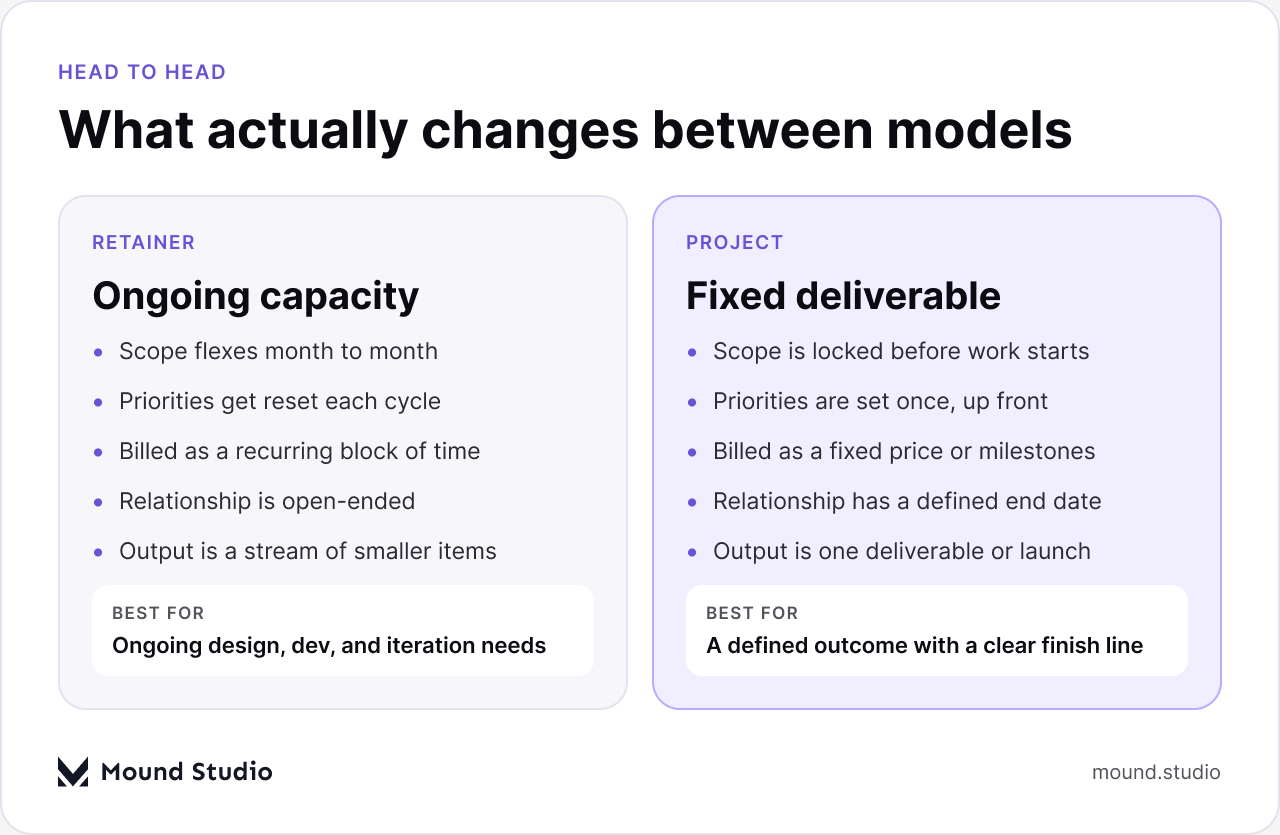
| Factor | Retainer | Project-based |
|---|---|---|
| Scope | Flexes month to month within a category of work | Locked before work starts |
| Pricing shape | Recurring fee for a block of capacity | Fixed price or milestone payments |
| Pace | Ongoing, in short cycles | Linear, toward one delivery date |
| Priorities | Reset at the start of each cycle | Set once, up front |
| End point | Open-ended, runs until either side cancels | Defined, ends at delivery |
| Best output type | A stream of smaller, ongoing items | One larger deliverable or launch |
A retainer generally asks for lighter, more frequent involvement: a short planning check-in at the start of each cycle, quick answers to questions as work moves, and a review at the end. Because scope resets often, there's rarely a long stretch where your input isn't needed somewhere.
A project asks for the opposite pattern: long stretches where the agency works largely on its own, punctuated by concentrated review moments at each milestone. Those review windows matter more on a project, because sign-off at one phase is usually what allows the next one to begin — a slow approval can push the entire timeline back in a way that a retainer, with its shorter cycles, is less exposed to.
A retainer fits work that doesn't have a natural finish line: ongoing product design, a design system that needs regular upkeep, a marketing site that needs small updates every week, or a backlog of fixes and improvements that never fully empties. It also fits teams that want a design or development partner on call without re-scoping a new project every time something small comes up. If your list of requests keeps growing faster than any single project could absorb, that's usually a sign the work has outgrown a project shape.
A project-based engagement fits work with a clear finish line: a new website, a rebrand, a product launch, an app redesign. If you can describe the deliverable and roughly when you need it, a fixed scope gives you price certainty and a defined timeline — two things a retainer, by design, doesn't offer. It also suits situations where budget has to be approved as a single number upfront, since a fixed price is easier to plan around than an open-ended monthly fee.
Yes, and it's common. Many engagements start as a project — a new site, a redesign — and move into a retainer once the deliverable ships, to cover ongoing updates and small requests. The reverse also happens: a retainer surfaces a bigger initiative, like a full rebrand or platform migration, that gets pulled out and scoped as its own fixed-price project so it has a dedicated timeline and budget instead of competing with everything else in the monthly queue.
The switch works best when it's treated as a real scoping exercise rather than a label change. Write down what the new engagement covers, even briefly — our guide to writing a design brief covers what to include, and the same structure works whether you're scoping a first project or converting a retainer into one. Skipping this step is the most common reason a switch causes friction: the old assumptions from one model quietly carry over into the other, where they no longer apply.
| Your situation | Better fit |
|---|---|
| You have a single launch or deadline in mind | Project-based |
| Your needs shift week to week with no clear end | Retainer |
| You need price certainty before committing budget | Project-based |
| You want a design or dev partner on call without re-scoping each time | Retainer |
| You're maintaining or iterating on something already live | Retainer |
| You're building something that doesn't exist yet | Project-based |
The contract type matters less than the details underneath it. Before signing a retainer or a project agreement, ask how the specific model you're considering actually gets managed day to day — our guide on questions to ask before hiring a web design agency covers the broader vetting process; the questions below are specific to the engagement model itself.
A retainer and a project-based engagement are both normal ways to work with a design or development agency, and neither one is the default choice. The right one comes down to whether your work has a finish line: build toward one with a project, or keep a partner on call with a retainer when the work doesn't stop. If you're not sure which fits what you have in mind, talk it through with us before you scope anything.
Not inherently — the two are priced differently, not necessarily higher or lower. A retainer is billed as a recurring fee for a block of capacity, while a project is priced against a specific, fixed scope. Which one costs less depends on how much ongoing work you actually have versus how well-defined a one-time deliverable is.
It can, but it usually isn't the best way to run one. A large initiative competes with everything else on the monthly priority list, which tends to slow it down. Most agencies pull a large deliverable out of a retainer and scope it as its own fixed-price project with a dedicated timeline.
There's no fixed length — retainers are open-ended by design and typically run month to month or on a short renewal cycle, continuing as long as both sides find the arrangement useful. Either side can usually end it at the start of a new cycle.
That depends entirely on what was agreed upfront. Some agencies let unused hours roll over for a limited time, some convert them to credit, and some treat unused capacity as forfeited at the end of the cycle. This is worth confirming before you sign, not after the first month.
Yes, it's one of the most common paths. A project builds the initial deliverable — a site, a product, a rebrand — and once it ships, a retainer picks up ongoing updates, small requests, and iteration without needing a new scoping exercise every time something comes up.