









SEO & AEO
How to Optimize Your Website for AI Search in 2026 (AEO Guide)
SEO (search engine optimization) is about ranking well in a list of links on a search results page. AEO (answer engine optimization) is about being the source an AI system pulls from when it generates a direct answer. SEO measures success in clicks and ranking position. AEO measures success in whether your content gets cited, quoted, or summarized inside an AI-generated response. They are related disciplines built on a lot of the same fundamentals, but they optimize for different outcomes, and understanding that difference changes how you prioritize your content work.
The terminology can be confusing, since both acronyms describe optimizing content for how it gets found, and the practices behind them overlap more than they conflict. The clearest way to think about it is that SEO earns you a place in the list, while AEO earns you a place in the answer itself, sometimes without a click ever happening. Both are worth understanding, because most websites now need to perform in front of both kinds of audiences: people scrolling through search results, and AI systems synthesizing a response on their behalf.
SEO grew up around a specific model of search: you type a query, you get a page of ranked links, and you click through to the one that looks most useful. Everything about classic SEO practice, from keyword targeting to backlink building, is built to win a spot in that list. AEO exists because that model is no longer the whole picture. A growing share of searches now resolve into a direct, synthesized answer, sometimes with no links at all, which means winning a top ranking position does not guarantee visibility anymore.

Search engine optimization is built around ranking in a list of links, and its success is measured in clicks and position, using keywords and backlinks as the main levers. Answer engine optimization is built around becoming the answer itself, measured by whether your content is cited or quoted, and it relies more heavily on clarity, structure, and trust signals than on link volume. Neither replaces the other. A page that ranks well and gets cited in AI answers is doing both jobs at once, and that is the goal worth aiming for.
| Aspect | SEO | AEO |
|---|---|---|
| Goal | Rank near the top of a search results list | Be cited or quoted in a generated answer |
| Success metric | Clicks, position, and traffic | Citations, summaries, and mentions |
| Primary levers | Keywords, backlinks, page speed | Answer clarity, structure, source trust |
| Content shape | Longer pages built to hold attention | A complete, extractable answer near the top |
The two disciplines influence different surfaces, though there is real overlap between them.

Traditional search results pages are still shaped mainly by SEO fundamentals: ranking position and the snippet text shown under each link. AI chat and assistant answers depend more on clarity and structure than on backlink volume, which puts more weight on AEO practices. Zero-click answer boxes sit in the middle, where both disciplines overlap: structure matters, and so does the topical authority that traditional SEO has always rewarded. Voice search responses lean AEO, since they favor short, direct answers pulled from pages that state things plainly rather than pages built for scanning on a screen.
| Surface | Driven mainly by SEO | Driven mainly by AEO |
|---|---|---|
| Search results pages | Ranking position, meta title and description | Featured snippet eligibility |
| AI chat answers | Overall site authority | Clear, citable passages and structured data |
| Voice assistants | Local and factual accuracy signals | Short, direct answer phrasing |
Understanding the mechanics behind an AI-generated answer makes it easier to see why AEO practices work the way they do.
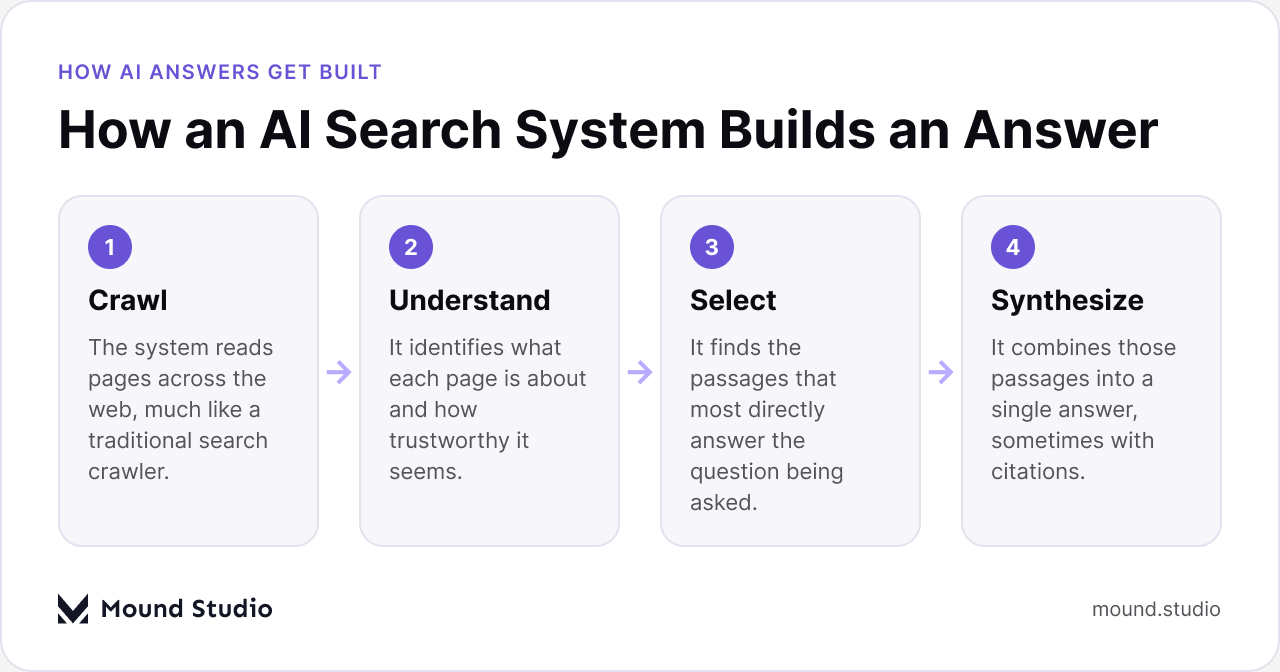
The system starts by crawling pages across the web, in a process that resembles traditional search indexing. It then works to understand what each page is actually about and how trustworthy it appears, drawing on much of the same signal traditional SEO already tracks: structure, clarity, and credibility. From there, it selects the passages that most directly answer the question being asked, which is where an answer-first, well-structured page has a real advantage. Finally, it synthesizes those passages into a single response, sometimes citing sources directly. Every stage in this pipeline rewards the same qualities good SEO has always rewarded, applied with a sharper focus on extractable, direct answers.
The practical reason to understand the difference between SEO and AEO is that they call for slightly different priorities when you are deciding where to spend limited content time. A page optimized purely for traditional SEO might still rank well while being effectively invisible inside AI-generated answers, because its opening paragraph never states a clean, standalone answer. A page optimized purely for AEO, with almost no attention to keyword relevance or site structure, might get cited occasionally but struggle to build the broader traffic and authority that supports long-term visibility. The strongest content strategy treats both as inputs to the same page: a page built to rank, built to be clicked, and built to be quoted, all at once.
This also affects how you think about content planning. Topics worth covering in depth are worth covering with both disciplines in mind from the outset, rather than writing for one and adjusting for the other after the fact. It is far easier to build a page that does both jobs well from the first draft than to retrofit an existing page that was written with only one audience, human readers scanning a results page, in mind.
Consider a page answering a specific product or service question. Under a purely SEO-first approach, the page might open with a broad introduction to the topic, work through supporting context, and arrive at the direct answer several paragraphs in, all while targeting a specific keyword phrase throughout. Under an AEO-first approach, the same page opens with the direct answer in the first two sentences, uses headings phrased as the actual questions people ask, and backs the answer with structured data. In practice, the strongest version of this page borrows from both: it opens with a direct answer, keeps the keyword-relevant language a reader would expect, and still builds out the deeper context and examples that make it useful to someone who wants more than a quick answer. Getting this balance right does not require abandoning either approach. It requires reordering the same substance so it serves both audiences.
It is worth being specific about what SEO and AEO share, since the overlap is larger than the differences suggest. Both reward pages that are well organized, since a system trying to understand a page's structure benefits from the same clean headings and logical flow that a human scanner does. Both reward credibility signals: a clear author, a trustworthy publisher, and content that does not contradict itself. Both reward relevance to the actual question being asked, rather than content padded out to hit a length target. The place they diverge is mainly in what happens after that foundation is in place: SEO layers on technical and link-based signals to win a ranking position, while AEO layers on answer-first structure and machine-readable markup to win a citation.
This overlap is good news in practice. It means a team investing in useful, well-structured content is already building the foundation both disciplines need. The additional AEO-specific work, restructuring openings and adding structured data, is a smaller, more targeted layer on top of content that is already doing its job well, rather than a separate strategy built from scratch.
A practical way to check where a page stands on both fronts is to read it with two different questions in mind. First, from an SEO perspective: does the page target a clear, relevant keyword phrase, is it reasonably fast to load, and does it fit naturally into your site's internal linking structure? Second, from an AEO perspective: does the opening paragraph state a complete answer on its own, are the headings phrased as real questions, and is structured data present and accurate? A page that passes both checks is well positioned for both traditional rankings and AI-generated answers. A page that passes only the first usually needs a restructured opening and clearer headings. A page that passes only the second may need more attention to keyword relevance, internal linking, or basic technical performance.
Running this audit on your highest-traffic or highest-intent pages first tends to produce the clearest return, since those are the pages most likely to be seen by both a person scanning results and a system building an answer. Lower-traffic pages are worth revisiting too, but the payoff is usually smaller and slower to show up, so it makes sense to work through your content in roughly that order rather than tackling everything at once.
Neither discipline is going away, and neither one is a passing trend. SEO and AEO are not competing strategies. SEO gets your content ranked and found. AEO gets it cited and quoted once an AI system is building an answer. The strongest approach treats them as two connected layers of the same overall content strategy: solid fundamentals, an answer-first structure, and clear signals of credibility running throughout. Building for both from the start is far simpler than treating them as separate projects later. If you want help auditing where your content stands on both fronts, get in touch with us.
SEO optimizes content to rank in a list of search results, measured by clicks and position. AEO optimizes content to be cited or quoted inside an AI-generated answer, measured by citations and mentions.
No. AEO builds on top of SEO fundamentals like structure and credibility. Both are worth investing in, since they influence different but overlapping surfaces.
They crawl pages, assess what each page is about and how trustworthy it seems, then select the passages that most directly answer the question before synthesizing a response.
AEO tends to matter more, since voice queries are phrased as full questions and favor short, direct answers over content built for scanning on a screen.
Check whether it targets a relevant keyword and loads quickly (SEO), and whether its opening paragraph states a complete answer with clear headings and structured data (AEO).