










Agency
Bringing Claude Into Your Design Agency's Workflow

A competitor teardown earns its place in a pitch when it turns scattered screenshots and half-formed notes into a clear story before the deadline hits. Most of that time is not spent forming opinions about competitors. It is spent typing up what someone already noticed, in a consistent format, competitor after competitor, page after page. That is exactly the kind of first-pass work Claude can take off a team's plate, which frees up hours for the judgment calls a client is actually paying for.
This matters more for an agency than it might for an in-house team, because an agency's teardown usually has to work for a client who has never seen any of these competitors before. It cannot lean on shared context the way an internal note might. Every observation has to stand on its own, which is part of why the formatting work takes as long as it does, and part of why it is worth handing that formatting work to a tool that is good at consistency.
Claude will not run a teardown for you. It can turn organized screenshots and notes into a structured first-pass comparison, summarize what several competitors have in common, and draft the plain-language observations that usually eat an afternoon. A person still has to verify every claim against the live site, decide which gaps matter to this particular client, and write the strategic read that turns a comparison into a pitch. Skip that last part and you have a summary, not a pitch.
We treat this as a five-step pass rather than a single prompt. Each step has a clear owner: either the research gets gathered, Claude structures and drafts, or a person checks and shapes. Keeping those roles separate is what stops the process from turning into unverified copy-paste sitting inside a client deck.
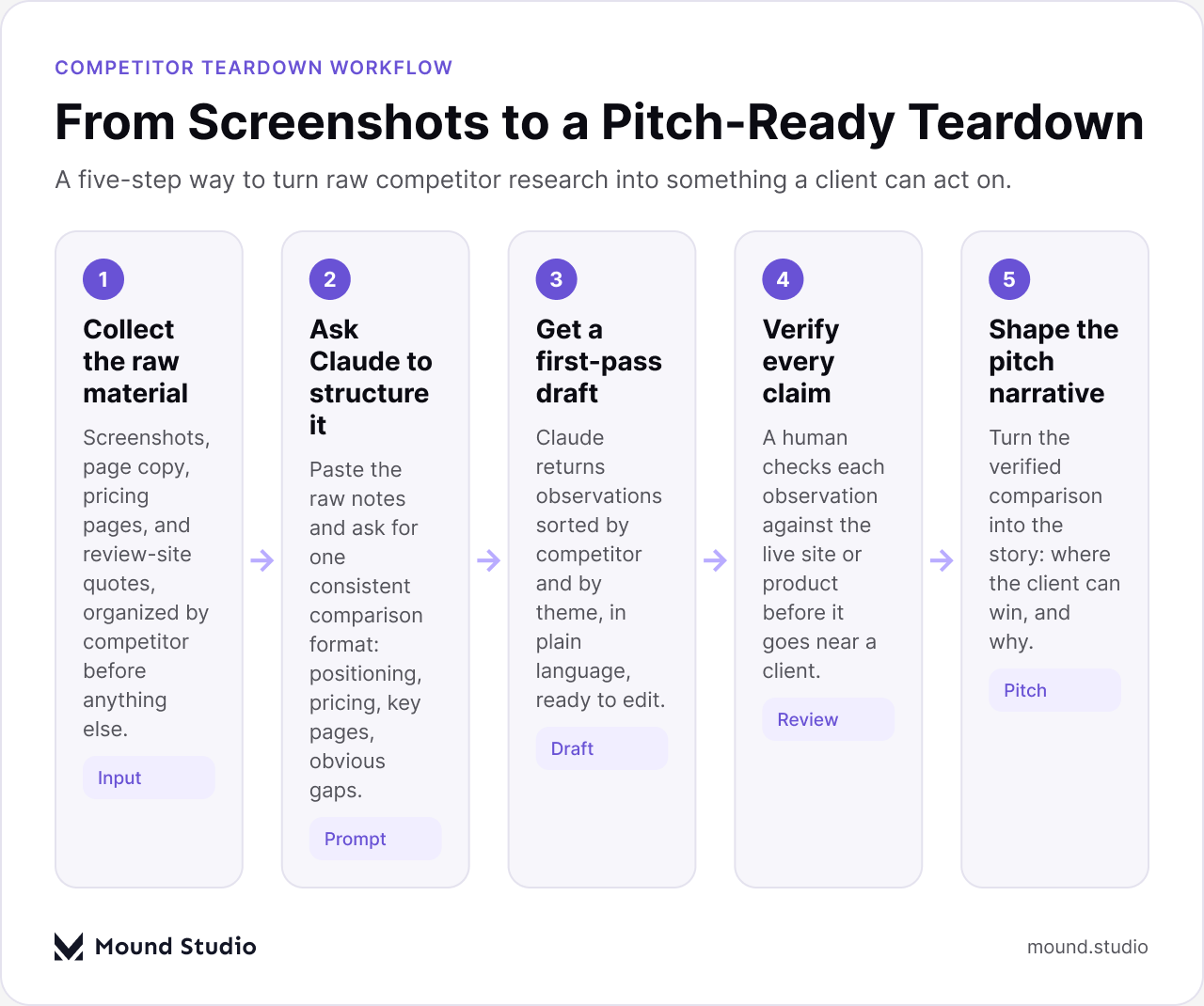
Step one is the part teams most often shortcut, and it is the one that matters most. If the screenshots, pricing pages, and review quotes are not organized by competitor before anything else, every later step inherits that mess. We keep a simple folder or doc per competitor and drop raw material in as it is found, with a source link next to each item so it can be checked later. Step two is where Claude enters: it takes that folder's contents and returns a first pass sorted into the categories the team has already agreed on, rather than whatever order the notes happened to be taken in. Steps three through five are where the actual pitch takes shape, and none of them can be rushed without the finished document showing it.
A teardown reads as credible when every competitor gets assessed against the same categories, in the same order, with the same level of detail. This is where a lot of first drafts fall apart: one competitor gets three paragraphs and another gets one sentence, and the client notices. Asking Claude to fill in a fixed structure, rather than free-write per competitor, keeps the density even.
| Category | What to capture | Prompt cue to use |
|---|---|---|
| Positioning | The one-line promise on their homepage | "State their core promise in one sentence" |
| Pricing model | Tiers, what's gated, what's not | "List pricing tiers and what changes between them" |
| Key flows | Signup, onboarding, checkout | "Summarize the steps in this flow" |
| Visible gaps | Anything confusing, missing, or dated | "Note anything that looks unfinished or unclear" |
We keep this structure short on purpose. A category with too many sub-fields invites Claude to fill gaps with guesses instead of leaving them blank, which is the opposite of what a first-pass draft should do. If a competitor's pricing page is gated behind a form, the honest answer in that cell is "not public," not an estimate dressed up as a fact.
The useful way to work with Claude here is to be specific about the boundary, not vague about it. Draft organizing and language-smoothing are squarely in its lane. Deciding what a specific client should actually worry about is not, because that decision depends on context Claude was never shown: the client's budget, their appetite for risk, and what they have already tried before calling an agency.

This is also where a lot of the value shows up in how an agency brings Claude into its day-to-day workflow more broadly: the tool compresses the parts of the job that are mechanical, and leaves more room for the parts that require someone who has actually talked to the client and understands what they are trying to protect or win.
A vague prompt like "compare these competitors" produces a vague draft. A useful prompt gives Claude the same four things every time: the raw material, the fixed categories from the table above, the audience for the document, and an explicit instruction to flag anything it cannot verify from the material provided.
That last instruction matters more than it looks. Without it, a model will smooth over a gap in the source material with a plausible-sounding sentence, and that sentence is the one most likely to embarrass an agency in front of a client. It is also worth running the same prompt structure across every competitor in one sitting rather than spreading it out over days, because the categories and tone drift the longer the gap between drafts.
A structured comparison is not the same thing as a pitch. A pitch has a point of view: here is where this client can win, here is why, and here is what it would take. Once the verified comparison exists, we ask Claude to help draft that narrative too, but with a different kind of prompt than the one used for the comparison itself. Instead of asking for structure, we describe the client's actual situation and ask Claude to connect specific rows from the comparison to specific opportunities, in plain language a non-technical stakeholder could follow in a meeting.
This is also the point where a teardown starts to overlap with drafting the proposal and scope document that usually follows it. The gaps a teardown surfaces often become the first draft of a project's scope, so it helps to write the teardown with that next document already in mind rather than treating the two as unrelated deliverables.
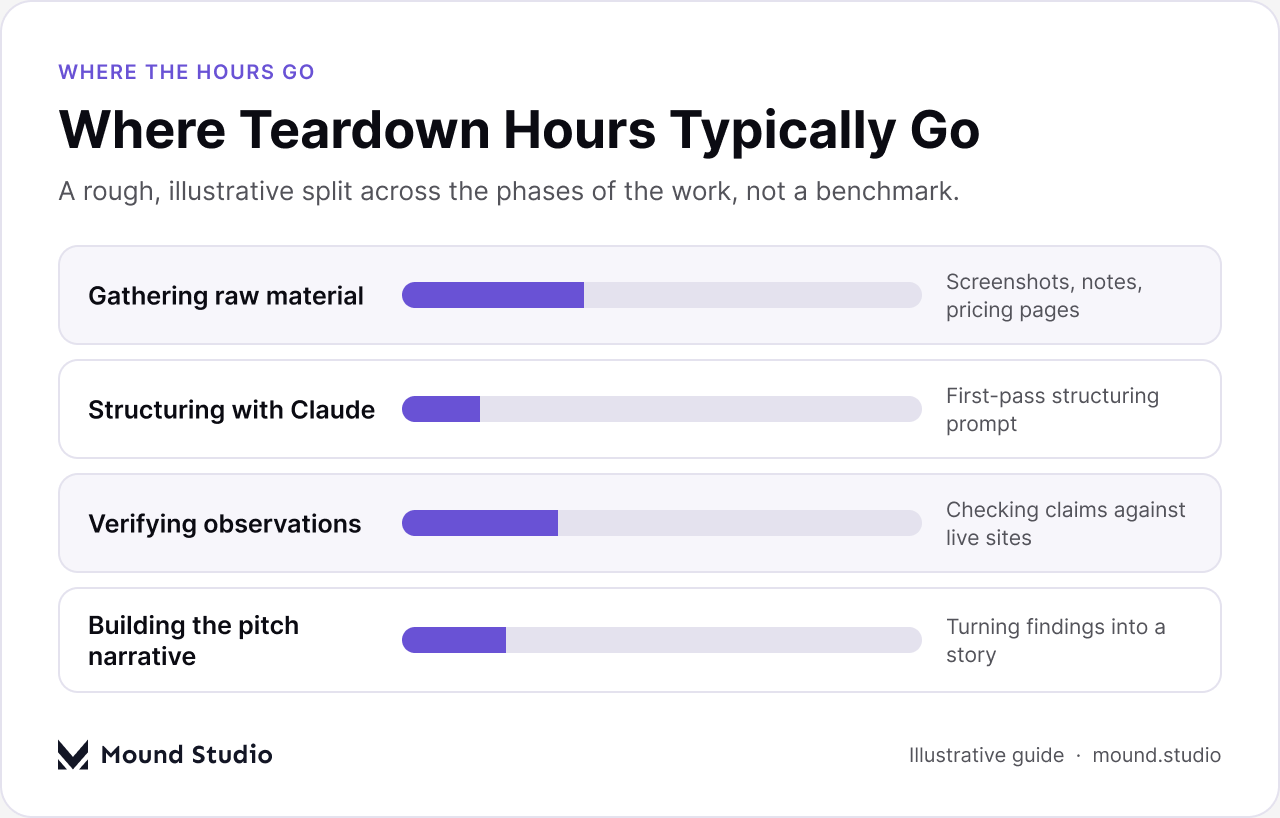
Gathering raw material usually takes the largest single share of the time, simply because it means visiting sites, taking screenshots, and reading pricing pages one by one. Structuring with Claude is comparatively quick once the material is organized. Verification takes real time too, because it means someone actually re-checking claims rather than skimming them. Building the pitch narrative is where the strategic thinking happens, and it deserves whatever time it needs.
Once several competitor drafts exist side by side, patterns show up that were not obvious looking at one site at a time. Asking Claude to read across all the drafts and summarize what repeats is a different task from writing the individual comparisons, and it is worth doing as its own step rather than trying to spot patterns manually while still drafting the first pass.
| Pattern | What it usually means for the pitch |
|---|---|
| Most competitors gate pricing behind a form | Transparent pricing can be a real differentiator to propose |
| Onboarding flows are long across the board | A shorter flow becomes a concrete pitch angle, not a vague one |
| Everyone uses near-identical homepage language | Plain, specific positioning stands out by contrast |
| Mobile experience trails the desktop site | Worth flagging even if it sits outside the current scope |
None of these patterns are conclusions on their own. They are prompts for a conversation with the client about what actually matters to them, which is a step Claude cannot take for you. A pattern that would matter enormously to one client might be irrelevant to another with a completely different set of priorities, and only a person in the room can tell the difference.
Before a teardown goes anywhere near a client, we run it against a short list rather than trusting a general sense that it "looks done."
If any of those are missing, the draft is still useful internally. It is not ready for a pitch deck yet, and sending it out before it clears that list is how a useful process turns into a liability during the meeting where it matters most. The fix is rarely more Claude time. It is almost always more of the verification pass that a tight deadline tempts a team to shorten.
Not every pitch needs the full five-step process. A quick informal pitch to a warm lead might only need the structured comparison and a short list of gaps, without a full narrative pass. A competitive proposal against two or three other agencies is a different situation entirely, and that is where the extra hour spent on verification and on shaping the pitch narrative tends to pay for itself. We size the process to the stakes of the pitch rather than running the same heavy process every time, since a teardown built for a thirty-minute call does not need the same depth as one built for a formal RFP response.
The same logic applies to how many competitors get a full teardown. Three or four well-verified comparisons usually make a stronger pitch than eight thin ones, because a client can only absorb so much in one meeting, and a shallow comparison of eight competitors reads as padding rather than insight. Picking the right competitors to feature is itself a judgment call worth making before any drafting starts, not something to decide after the fact by seeing which drafts turned out best.
Claude is a useful part of a competitor teardown for the parts of the job that are mechanical: organizing raw material into a consistent structure, drafting first-pass observations, and summarizing what repeats across several competitors. It is not a substitute for someone checking the work and deciding what actually matters to the client in front of you. Used that way, it turns a slow, uneven process into a faster one without lowering the bar on what goes into the pitch — and if you would rather have a team run that process for you, get in touch with Mound Studio.
Claude can't browse a live site on its own within this workflow. It works from screenshots, page copy, and notes a team feeds it, and turns that material into a structured first-pass comparison. Checking that the material still matches the live site is a separate, human step.
Not without a verification pass first. A Claude draft reads fluently, but every observation still needs to be checked against the actual competitor site or product before it goes into a client deck.
Three or four well-verified comparisons usually make a stronger pitch than eight thin ones. Fewer, deeper comparisons are easier for a client to absorb in one meeting than a long, shallow list.
A teardown compares competitors and surfaces gaps. A proposal turns those gaps into a scoped plan of work with a recommendation. The two often feed into each other, but they answer different questions.
It can help draft that narrative once the comparison is verified, but the point of view, where this specific client can win and why, still comes from the team that understands the client's situation.