








Branding
8 Brand Identity Elements Every Business Needs

Brand strategy is the thinking: the positioning, the audience, the voice, and the reason a business is different from the alternative someone could pick instead. Brand identity is the visual system that makes that thinking visible — the logo, the color palette, the typography, the imagery, and the rules that keep all of it consistent. Strategy answers what a brand stands for and who it's for. Identity answers what the brand looks and feels like. Neither one replaces the other, and a brand only really works when both are built, and built in the right order.
The confusion between the two is understandable. Most people encounter a brand through its identity first — a logo on a homepage, a color scheme on a product screen, a font choice on a business card — so it's natural to assume that identity is the whole job. In practice, identity is the last visible layer of a much longer set of decisions. When a business asks for "branding," what they usually need is both a strategy conversation and a design process, even if only the design process feels tangible. Understanding where one ends and the other begins makes it much easier to brief a designer, evaluate a proposal, or work out why an existing brand doesn't feel right.
Brand strategy is the set of decisions a business makes before a designer opens a file. It's less about how something looks and more about how the brand is positioned in a market and remembered by the people it's trying to reach.
None of this is visual. A strategy document can exist with no logo attached and still be complete. It's the foundation everything else gets built on, and it's usually the part that gets skipped when a business is in a hurry to "get a logo made."
Brand identity is what strategy looks like once it's translated into something people can see, click, and scroll through. It's the visual system a team actually uses day to day, and it's what most of our brand identity element work covers.
Identity is what most people mean when they say "branding," but on its own it's decoration. It needs strategy behind it to know what it's actually supposed to communicate, which is why a good design process asks strategy questions before it asks color questions.
| Aspect | Brand strategy | Brand identity |
|---|---|---|
| Job | Decides what the brand stands for | Shows what the brand stands for |
| Output | Positioning, voice, messaging | Logo, colors, type, imagery |
| How often it changes | Rarely, unless the business itself changes | Can be refreshed more often than strategy |
| Usually owned by | Leadership and marketing | Design and brand teams |

They need each other because identity without strategy is guessing, and strategy without identity never gets seen. A logo, color palette, and type system with no strategy behind them can still look polished, but there's nothing steering the choices — the colors get picked because someone liked them, not because they support a position in the market. On the other side, a sharp strategy that never gets translated into a consistent look stays stuck in a document. Nobody outside the leadership team ever experiences it, because a website, a product, or a social feed is where people actually meet a brand.
The two are meant to work as one system. Strategy sets the direction; identity carries that direction into every place someone encounters the business. When they're aligned, a homepage, a proposal, and a product screen can all feel like they belong to the same company without anyone having to explain why.
On a typical rebrand, the strategy questions usually surface before anyone touches a design tool. A business will come in wanting a new look, and the first working sessions end up being about audience and positioning rather than color: who buys from you now versus who you actually want to reach, what competitors already own visually, and what the business wants to be known for in a year. Those answers shape everything that follows — which typefaces feel right, which colors are already claimed by competitors, and which imagery style will read as credible to the audience the brand is trying to reach.
Skipping that step doesn't save time, it just moves the cost later. We've seen projects where a logo gets approved, applied across a website and marketing materials, and then reworked a few months later once the actual positioning becomes clear — usually because a founder or a marketing lead is finally able to answer "what do we do differently" in one sentence. Doing that work first, even briefly, means the identity only has to get built once.
Yes — strategy should come first, even if it's a short, working version rather than a polished document. Building identity before strategy means making permanent visual decisions with no criteria to judge them against, and it's one of the most common reasons a rebrand feels wrong within a year. Building strategy first gives a designer something to design toward instead of guessing at what a business "feels like."
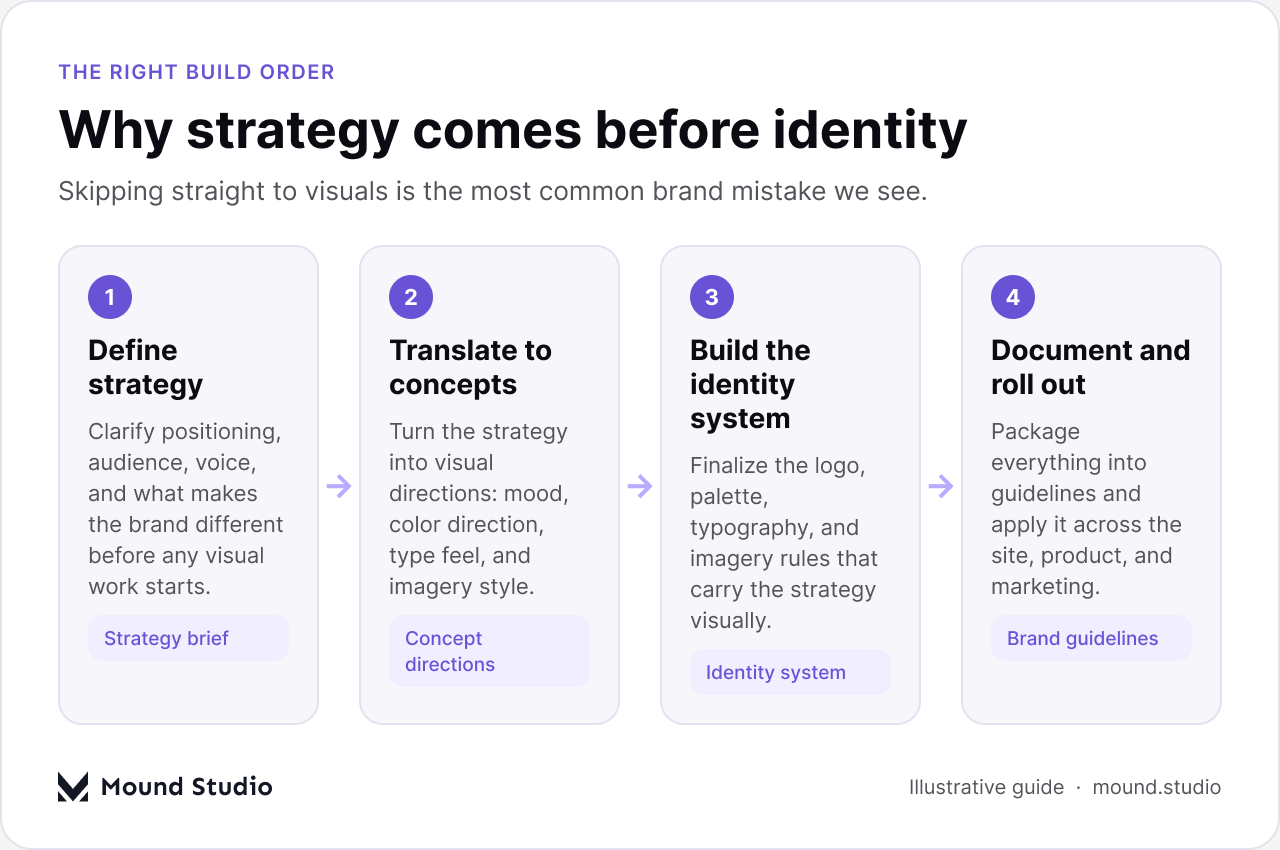
This doesn't mean strategy has to be a long process. For a small business, a working strategy can be a page of answers to a handful of direct questions: who is this for, what do we do differently, and how do we want to sound. That's enough to start designing against. The goal isn't a perfect document — it's having something concrete before colors and fonts get chosen.
The order matters slightly differently depending on whether you're starting a brand from nothing or updating one that already exists. A brand new business has no visual baggage at all, so strategy work can happen in a clean, deliberate way before a single color is chosen. An existing business usually already has an identity people recognize, even if it's inconsistent, so the strategy conversation has to account for what's worth keeping — a color people already associate with you, a tone that already works — alongside what needs to change. Either way, the sequence is the same: decide, then design.
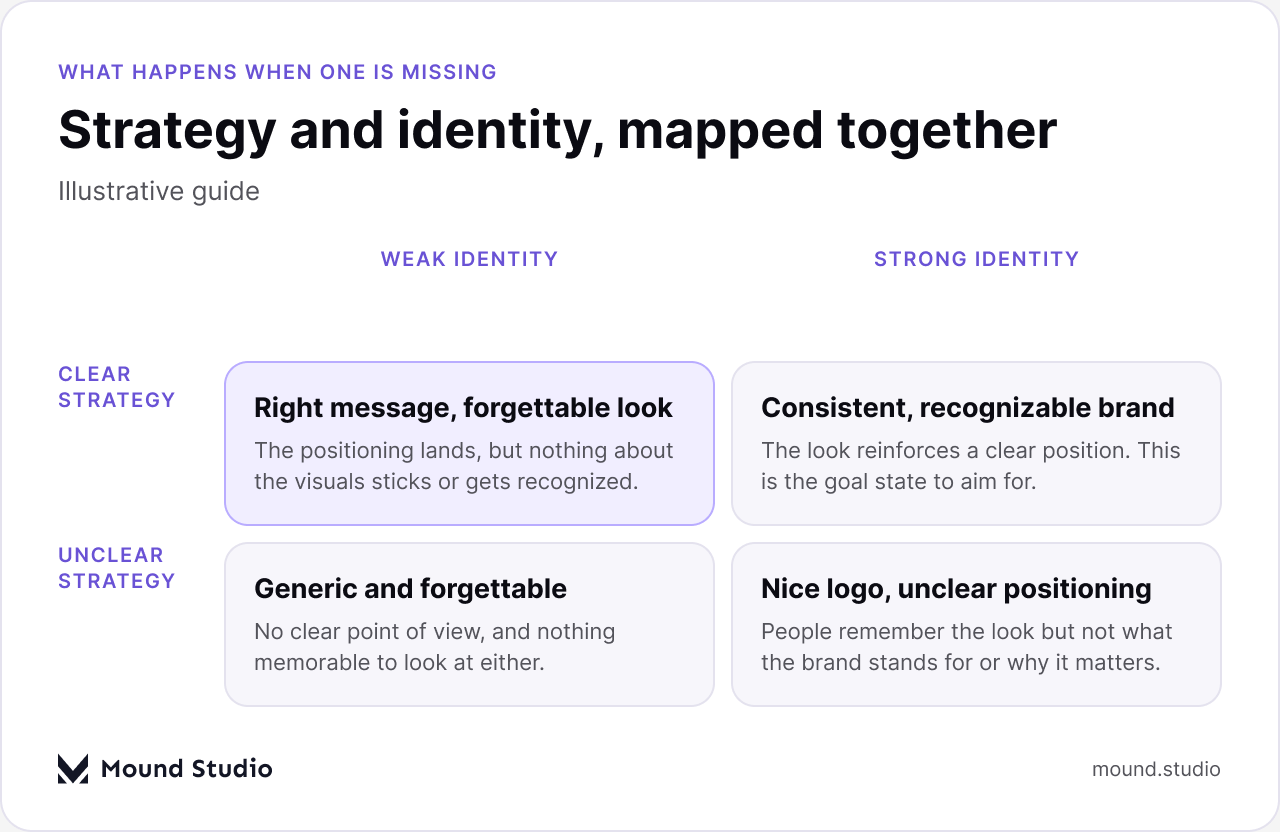
A brand with strategy but no real identity usually reads as inconsistent: the message is right, but nothing about the way it looks sticks in anyone's memory. A brand with identity but no strategy usually reads as generic: it might look sharp, but people can't say what the business actually stands for or why they should pick it. The strongest brands have both — a clear position and a visual system that reinforces it everywhere it shows up.
| Signal you notice | What's usually missing |
|---|---|
| Every page or post feels like a different brand | Identity |
| The team can't agree on what makes the business different | Strategy |
| Marketing keeps rewriting the message every quarter | Strategy |
| There's a logo, but nobody can explain the color choices | Strategy |
| The visuals look dated next to competitors | Identity |
Start with strategy if any of the following are true:
Move straight to identity work if strategy is already solid — you have a clear audience, a clear position, and a consistent message — and what's missing is simply a visual system that reflects it. This is also the right starting point for a business that's rebranding around a strategy that hasn't actually changed, just the look that represents it.
If you're not sure which camp you're in, a quick test helps: try writing one sentence that explains who the brand is for and what makes it different, without mentioning colors, fonts, or the logo at all. If that sentence comes easily and everyone on the team would write something similar, strategy is in good shape and the identity work — logo, palette, colors, typography — can move forward with real direction. If the sentence is hard to write, or if it changes depending on who's answering, that's the clearest signal to slow down and settle the strategy questions before spending time or budget on the visual system.
Brand identity and brand strategy solve two different problems, and mixing up the order is one of the easiest ways for a rebrand or a new brand to fall flat. Strategy decides what a business stands for and who it's speaking to; identity turns that decision into something people can see and remember. Get the strategy right first, even in a simple form, and the identity work that follows has something real to express instead of a set of choices nobody can defend. Treat the two as connected steps in the same process rather than two separate purchases, and the resulting brand will hold together far longer than one built visuals-first. If you want a second opinion on which one your brand actually needs right now, reach out to our team and we'll help you figure out where to start.
No. Brand strategy is the set of decisions about positioning, audience, and message; brand identity is the visual system — logo, colors, typography — that expresses those decisions.
Brand strategy comes first. Even a short, working version gives a designer clear direction before colors, typography, or a logo get chosen.
Yes, but it usually reads as generic — the visuals can look sharp while nobody can explain what makes the business different or who it's actually for.
Not always. If the new strategy still fits the existing colors, typography, and logo, often only the guidelines and messaging need to change. A bigger shift in positioning usually calls for a matching update to the identity.
It depends on the size of the business and how much research is involved, but strategy work typically happens before, and separately from, the identity design phase, not in parallel.