








Branding
What Is Included in a Brand Identity Package? A Clear Breakdown for 2026

Companies usually start thinking about a rebrand when something feels off. The website looks dated next to competitors, the logo does not work on small screens, or the sales team keeps explaining what the company "really does now". Sometimes the business has changed faster than the brand.
A rebrand can fix that, but it is expensive, visible, and easy to get wrong. Done for the wrong reasons, it confuses existing customers and throws away recognition you spent years building. Done well, it helps people instantly understand who you are and why you are different. This guide covers how to decide, the seven steps we follow, a launch checklist, and the mistakes to avoid.
To rebrand your business, first decide whether you need a full rebrand or a lighter refresh. Then audit your current brand, define your new positioning and message, design the identity system, test it with real people and real use cases, prepare every asset, and launch it internally before you launch it publicly.
These terms are often used as if they mean the same thing, but they are different projects with different budgets and risks.
A brand refresh updates how the brand looks and sounds without changing what it stands for. Think of a cleaner logo, a modern type pairing, an updated color palette, or tighter messaging. The strategy is right, but the execution has aged.
A rebrand changes the strategy itself: who you serve, what you offer, how you are positioned, and sometimes your name. It is a reset rather than an update. For large organizations, a full rebrand can take a year or more to roll out.
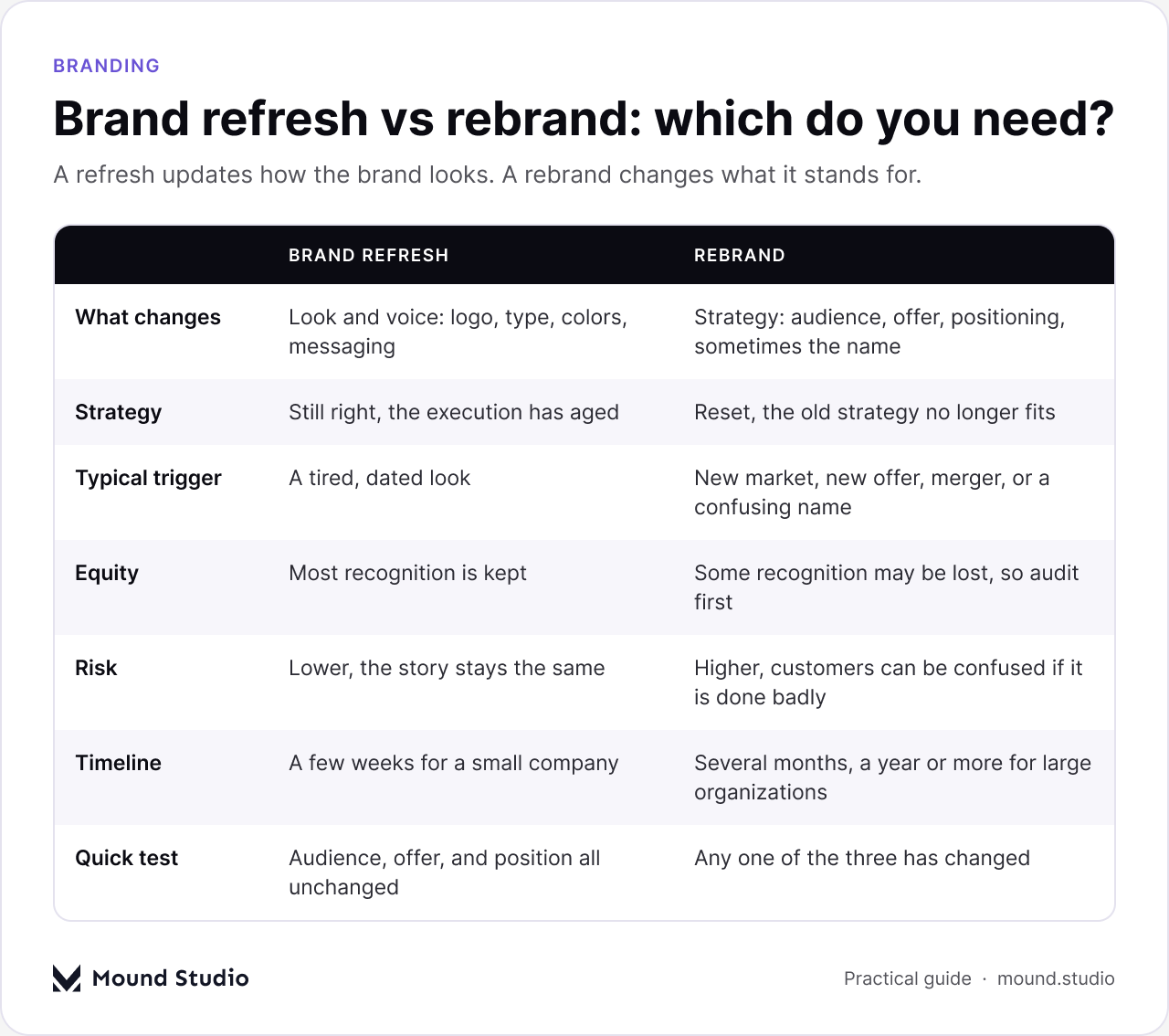
Ask three questions. Has who you serve changed? Has what you sell changed? Has your position against competitors changed? If the answer to any of them is yes, a refresh will probably not be enough. If all three are no, and the look is simply tired, refresh.
Picture a small consultancy that started by serving local startups. Over a few years its clients became larger companies with bigger budgets. The brand still looks playful, the website talks about quick fixes, and the proposals feel light for the projects being sold. The audience has changed, and so has the offer. That points to a rebrand, not a refresh.
The work would start with a short list of interviews with recent clients, then a check of what the current brand still does well. Perhaps the name is respected and the color is remembered, so both stay. The tone, the story and the visual system move up to match the new buyer. The lesson is to keep the equity and change the position.
Rebrands stall when leaders disagree about the reason. Before any design starts, hold one short working session with the people who own the decision. Ask each person to write down, alone, why the company is rebranding and who the brand is for. Compare the answers. Differences show up quickly, and it is far cheaper to settle them now than after a logo has been shown.
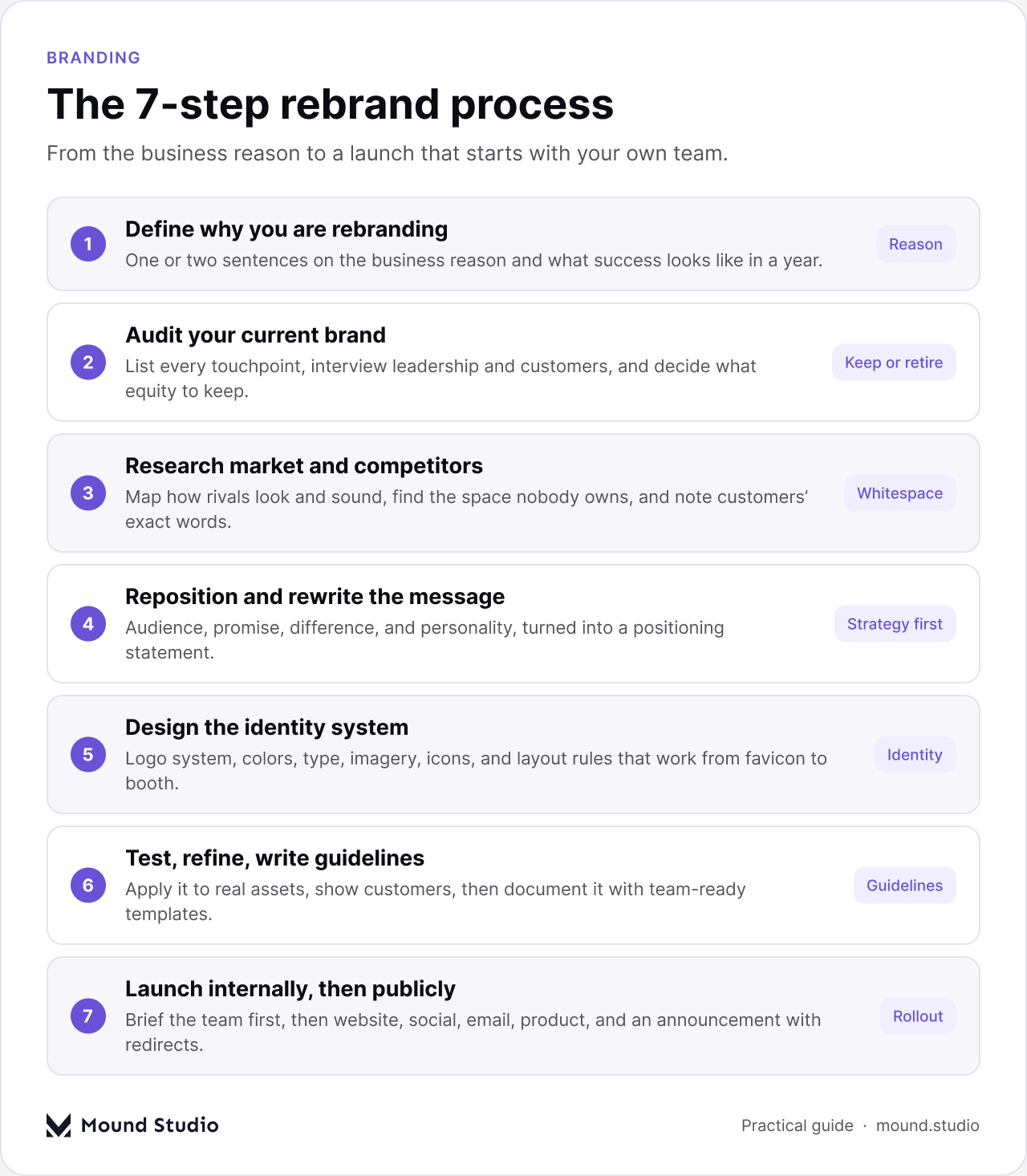
Write the business reason in one or two sentences, and what success looks like in a year. For example: "We now sell to mid-size companies, and our brand still looks like a startup tool. We want enterprise buyers to take us seriously in the first meeting." Every later decision gets checked against this.
List every touchpoint: website, product, sales decks, social profiles, email, packaging, signage, and documents. Interview leadership, a few employees, and some of your best customers. Ask what the brand gets right today. The goal is to know what equity to keep, such as a color people recognize or a name customers love, before you change anything.
| Touchpoint | Questions to ask | Owner |
|---|---|---|
| Website and product | Does it say what we do now? Which pages carry search traffic? | Marketing and product |
| Sales and pitch material | Do reps still explain the brand away in meetings? | Sales |
| Social and email | Which profiles, handles, and templates need changing? | Marketing |
| Physical items | Signage, packaging, uniforms, print: what has a long lead time? | Operations |
| Legal and admin | Trademarks, contracts, invoices, and licenses that carry the name | Legal and finance |
Once you have the list, score each item on two questions: do customers recognize it, and does it fit the new strategy? The result is a simple map of what to keep, evolve, retire, or build new.

Map how competitors position themselves and how they look. Look for the space nobody owns. If every company in your category uses blue and says "simple", that tells you where not to go. Talk to customers who chose you and customers who chose someone else, and note the exact words they use.
Define your audience, your promise, what makes you different, and your personality. Turn that into a short positioning statement, a few key messages, and a tagline if you need one. Strategy comes before design, because designers need something to express.
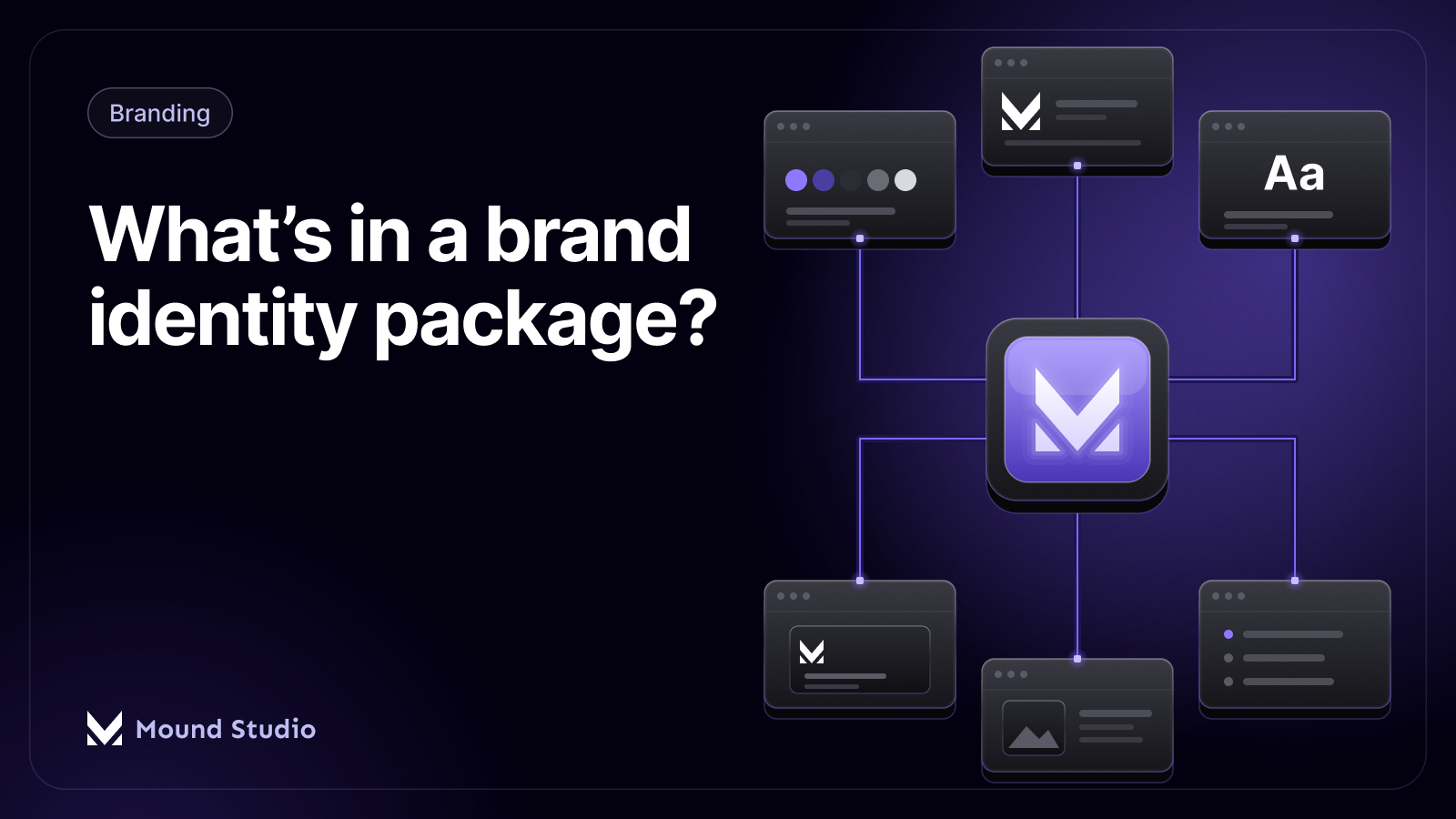
Now create the visual identity: logo system, color palette, typography, imagery style, iconography, and layout principles. Design it as a system that works across real use cases, from a favicon to a trade show booth. If you want to know what a full identity package should include, read what is included in a brand identity package. For the palette itself, see how to choose brand colors.
Apply the new identity to real assets: the homepage, a sales deck, a social post, an email, and product screens. Show them to a few customers. Refine what does not work, then document everything in brand guidelines with templates your team can use without a designer.
Your team should understand the new brand before customers see it. Brief everyone on why it changed and how to talk about it. Then plan the public launch: website, social profiles, email signature, product, documents, and an announcement that tells the story. If you change your domain or URLs, set up redirects to protect search rankings.
Design is only part of the work. The rollout has phases of its own, and each one has a different audience.
| Phase | Audience | What happens |
|---|---|---|
| Prepare | Leadership and core team | Guidelines, templates, and assets are finished and approved |
| Internal launch | All employees | Briefing on the why, the new story, and how to use the brand |
| Public launch | Customers and the market | Website, social, email, and announcement go live together |
| Long tail | Everyone who still sees the old brand | Print, signage, partner listings, and old documents are replaced |
Old brand material keeps turning up for months. A partner site still shows the old logo, a printed brochure sits in a drawer, an old profile lists the previous name. Keep a running list of these items, give each one an owner, and work through it after launch. Small, steady cleanup beats a rush before the announcement, and it keeps customers from seeing two versions of the company at once.
Most rebrands include a website update, so pair this list with our website redesign checklist. If you are not sure the site needs work yet, when to redesign your website helps you decide.
It does not have to. The risk comes from changing URLs, titles, and page content without a plan. Keep existing URLs wherever you can. If a page moves, add a permanent redirect from the old address to the new one. Review title tags and descriptions so the new name appears without dropping the terms people search for. If you change your domain, tell search engines through your search console and keep the old domain redirecting for as long as you can.
It depends on scope. A focused refresh for a small company can take a few weeks. A full rebrand with research, naming, and a large rollout can take several months, and much longer in big organizations with many touchpoints. The rollout is often longer than the design work, so plan it early.
A new identity is only as strong as the habits that follow it. Guidelines that nobody reads do not protect anything. Keep them short, put them where the team already works, and add real examples of the brand in use. Our guide to what to include in brand guidelines lists the parts worth writing down.
For teams that build digital products or large websites, a shared library of components keeps the brand intact in every screen. If that sounds useful, read what a design system is. Review the brand every few months at first. Note what people ask about, and add those answers to the guidelines.
If you work with an agency, a few questions will show how they think.
Strong answers start with strategy and end with usable files. If you are comparing studios, how to choose a web design agency gives a wider set of questions, and brand identity elements explains the parts of an identity you should expect.
If your strategy is sound and the look is dated, choose a refresh and keep the name, story, and most of the equity. If your audience, offer, or position has shifted, choose a rebrand and start with the audit. If you are not sure, run steps one and two of the process first. They cost little, and they usually make the answer obvious.
A rebrand lives or dies on execution across every touchpoint, especially the website. At Mound Studio, brand identity and web design happen in one team, so the new identity arrives on your site intact. If you are weighing a refresh or a rebrand, talk to us and we will help you decide which one your business actually needs.
A brand refresh updates how your brand looks and sounds without changing its strategy. A rebrand changes the strategy itself, such as your audience, positioning, offer, or name. A refresh is an update. A rebrand is a reset.
Consider a rebrand when your audience, offer, or market position has changed, after a merger, or when your name or identity causes confusion. If the strategy is still right but the look has aged, a refresh is usually enough.
A focused refresh can take a few weeks. A full rebrand with research, positioning, identity design, and rollout usually takes several months, and longer for large organizations. The rollout is often longer than the design work, so plan it early.
Define why, audit your current brand, research the market, reposition and rewrite your message, design the identity system, test and build guidelines, then launch internally before launching publicly.
It does not have to. Keep or redirect existing URLs, update titles and descriptions carefully, and if you change domains, set up 301 redirects and update your search console properties before launch day.