








SEO & AEO
How to Do an SEO Content Audit (Step-by-Step Guide)

A meta title and description that rank are built around one idea: make the match between what someone typed and what this page actually delivers impossible to miss, in the space of a single line each. The title needs the primary keyword close to the front and a length search engines will display in full, not truncate. The description needs to state the page's value in its first sentence, work the keyword in the way a person would actually say it, and give a reason to click this result over the three others on the page that look almost identical. None of that is a trick. It is accurate, specific writing that happens to also be what both ranking systems and the people scanning results reward.
Meta titles and descriptions are small pieces of copy, but they carry a disproportionate amount of the work in search. The title is often the first thing a person reads about a page before seeing a single pixel of the page itself, and in an AI-generated overview or answer, the title and surrounding snippet are sometimes the only part of the page that gets quoted at all. Getting this copy right is not a finishing touch added after the page is built — it deserves the same attention as the page's own headline.
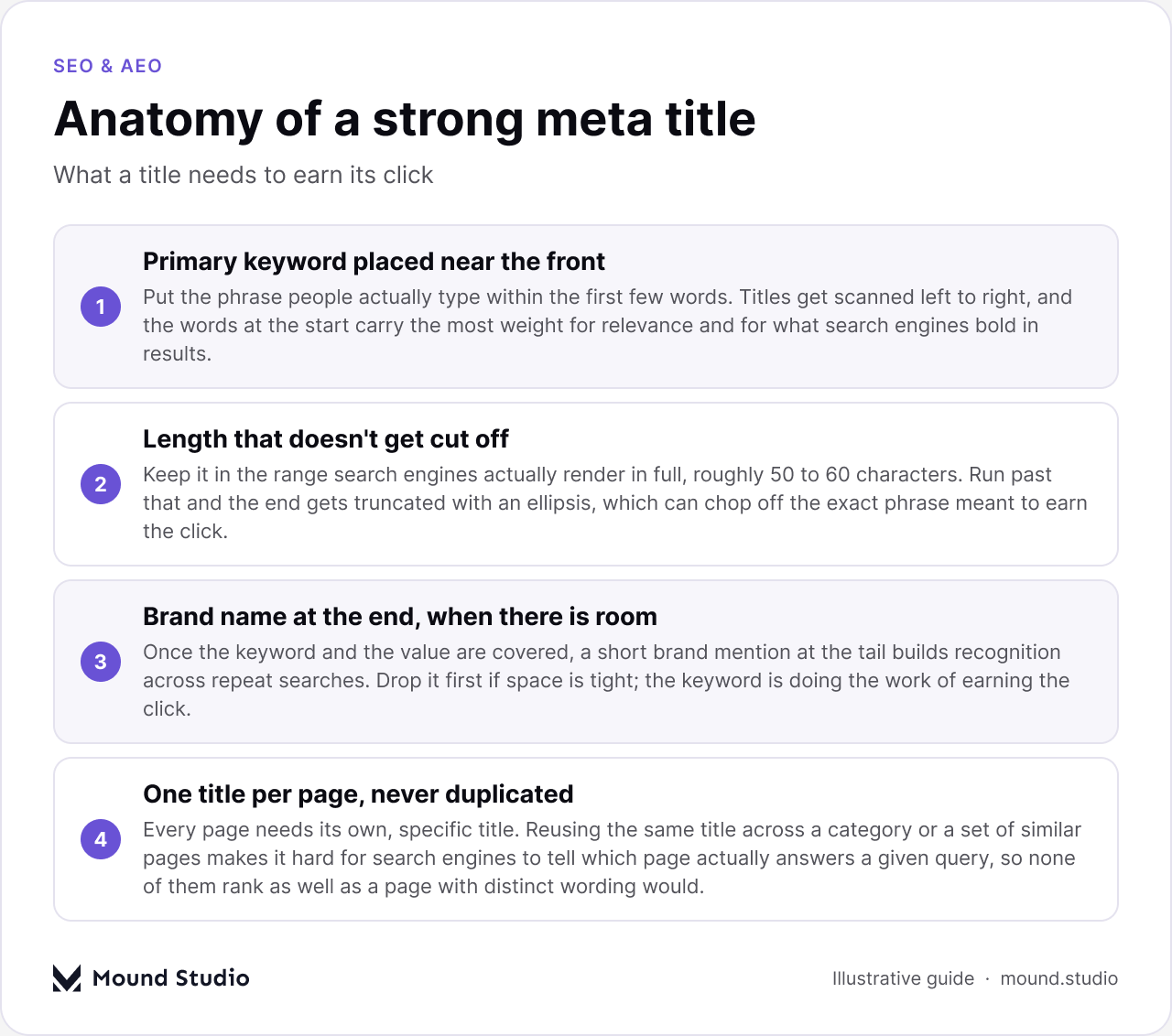
A strong meta title follows a short set of rules that hold up across almost any page type: a landing page, a blog post, a product page, a location page. Four things matter most.
First, the primary keyword needs to sit near the front of the title, inside the first handful of words. Search engines weight the earlier words in a title more heavily when judging relevance, and readers scanning a results page do the same thing without thinking about it. A title that opens with the exact phrase someone searched for signals an immediate match; a title that buries that phrase after a string of adjectives does the opposite, even if the keyword is technically present somewhere in the string.
Second, the title needs to stay inside the length search engines will actually render. Titles are measured in pixels on the results page, not strictly in characters, so a title full of wide capital letters will get cut off sooner than one in lowercase. As a working guideline, staying in the range of roughly 50 to 60 characters keeps almost any title intact. Go past that and the tail of the title gets replaced with an ellipsis, which is a real problem when the differentiating detail — the one reason to click this result — happens to live in the part that gets cut.
Third, a brand name earns a spot at the end of the title when there is room left after the keyword and the value proposition are both covered. A short, consistent brand mention across a site's titles builds recognition over repeat searches, which matters for anyone who searches a topic more than once before deciding where to click. If the title is already tight, drop the brand name first. The keyword and the specific value of the page are doing the actual work of earning the click.
Fourth, and most overlooked, every page needs a title of its own. Reusing the same title template across a category of near-identical pages — service areas, product variants, paginated listings — makes it difficult for a search engine to tell which of those pages is the best answer to a given query, and the practical result is usually that none of them rank particularly well. If a site redesign or a technical SEO checklist is already in progress, auditing titles for duplication is one of the highest-value items on that list.
There is no single hard character limit, because the cutoff depends on pixel width and the specific characters used, but roughly 50 to 60 characters is a safe practical target for most titles. Shorter titles are not automatically better — a title that is unnecessarily short wastes space that could carry useful context, like a product category or a location. The goal is not brevity for its own sake. It is using the full available space without running the risk of truncation.
| Element | Typical display length | What happens if you exceed it |
|---|---|---|
| Meta title | Roughly 50–60 characters | The end gets cut off and replaced with an ellipsis, often hiding the exact detail meant to earn the click |
| Meta description | Roughly 150–160 characters | The extra text is truncated, or the result is dropped in favor of a snippet search engines pull from the page content instead |
| URL slug | Roughly 3–5 readable words | Long, parameter-heavy slugs get shortened or hidden in the display, and the structure becomes harder for both search engines and visitors to read |
A meta description does not directly influence rankings the way a title does, but it influences something just as important: whether someone who sees the page in results decides to click it. Writing one that earns the click comes down to four steps, done in order.
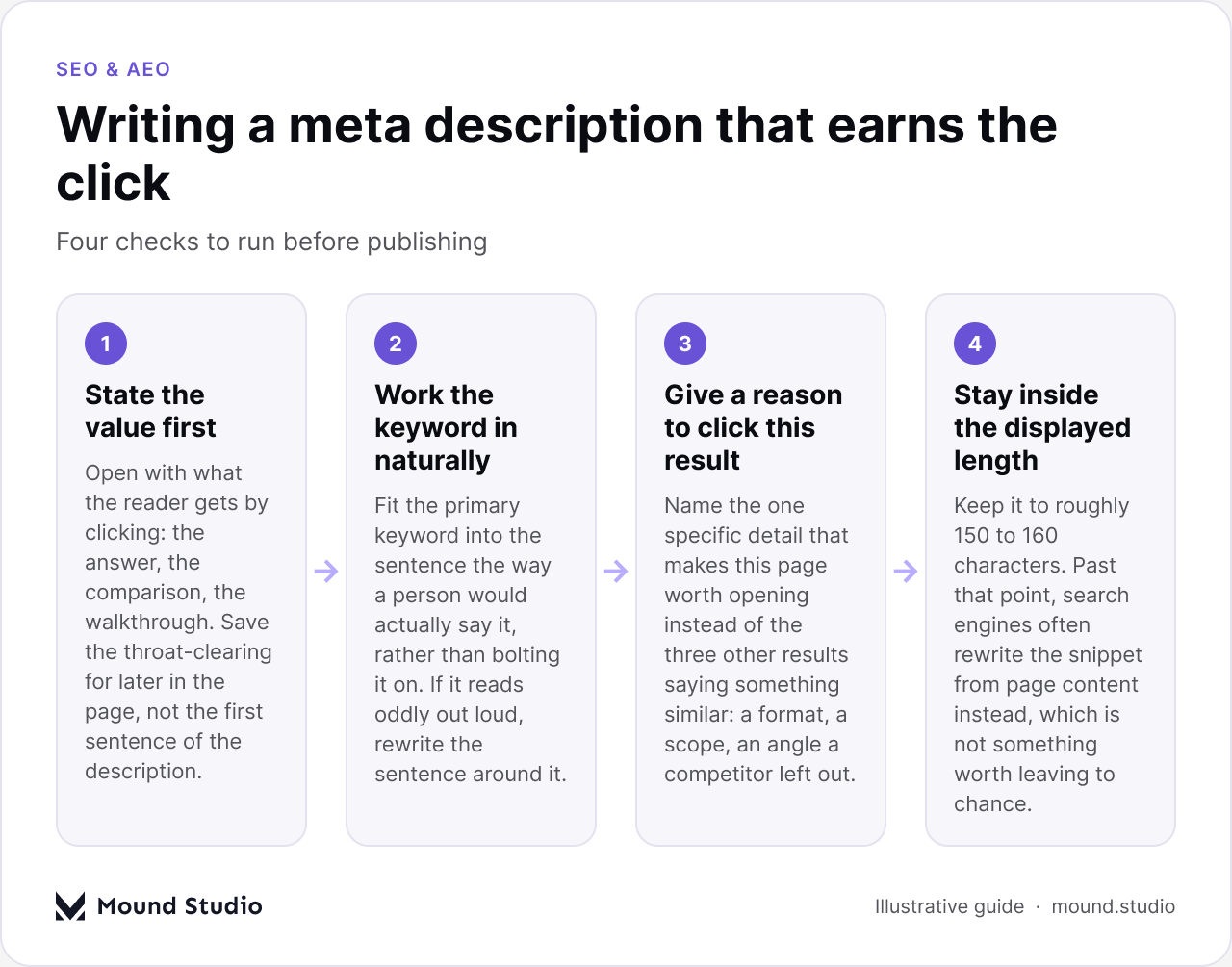
The first step is stating the page's value in the very first sentence. Readers scanning a results page decide within a second or two whether a result is worth opening, and that decision is almost always made from the opening words of the description, not the whole thing. Lead with what the reader gets — an answer, a comparison, a step-by-step process — rather than a generic introduction to what the page is about.
The second step is working the primary keyword into that sentence naturally. This is different from stuffing the keyword in as a disconnected phrase. A description should read the way a person would actually say the sentence out loud. If the keyword placement makes the sentence sound stiff or repetitive, rewrite the sentence around the keyword instead of forcing the keyword into the existing sentence.
The third step is giving the reader a specific reason to click this result instead of a competitor's. This is the step most descriptions skip entirely, and it is usually the difference between a description that performs and one that does not. Naming an angle, a format, or a scope the page covers — a checklist, a comparison of specific options, a step-by-step process — gives the reader something concrete to decide on, rather than another generic sentence about the general topic.
The fourth step is a length check. Keep the description to roughly 150 to 160 characters. Past that point, search engines frequently rewrite the snippet using text pulled directly from the page instead of the written description, which means the careful work of steps one through three never actually shows up in results. Writing a tight, well-ordered sentence within that limit is worth more than writing a longer, more thorough one that gets discarded.
The first sentence carries almost all of the weight, because many readers never get to the second one before deciding to click or scroll past. It should answer, as directly as possible, the implicit question behind the search: what will I get if I open this page? A first sentence that describes the page itself — "this page covers meta titles and descriptions" — is weaker than one that describes the outcome for the reader — "a practical guide to writing titles and descriptions that match what searchers actually look for."
Seeing the difference side by side makes the pattern easier to apply than a list of rules on its own. The core distinction is specificity: a weak description could sit on almost any page on the internet without anyone noticing it was generic, while a strong description could only belong to the page it is actually describing.
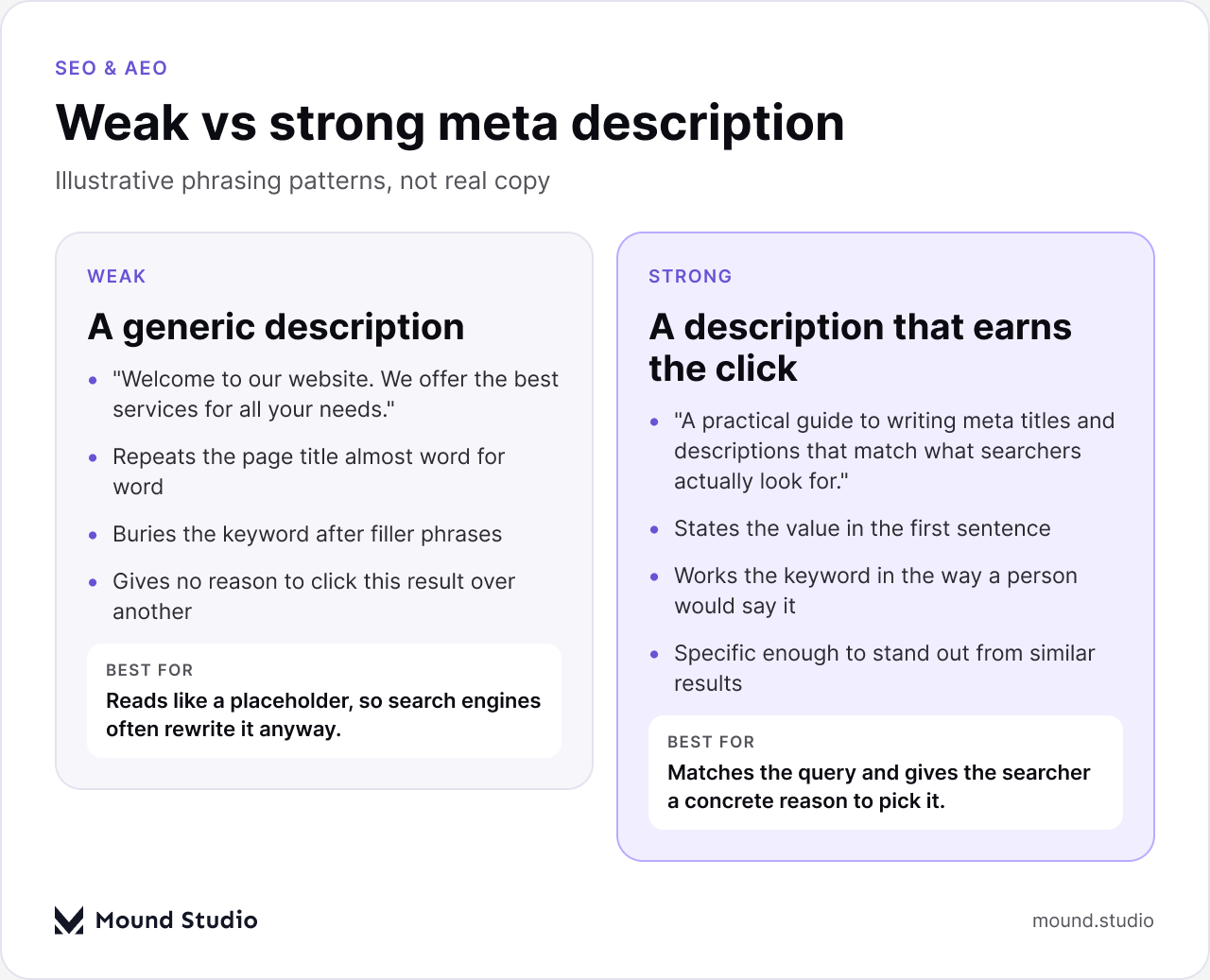
A weak description tends to repeat the page title almost word for word, bury the keyword after several words of filler, and close without giving the reader any particular reason to prefer this result. A strong description states the value immediately, works the keyword into a sentence that reads naturally, and includes one concrete detail — a scope, a format, an outcome — that a generic description never would. The difference rarely comes down to length. It comes down to whether the sentence could have been written about any page on the topic, or whether it could only describe this one.
Most meta tag problems on an existing site fall into a small number of repeating patterns. Catching these during a content audit is usually faster and more valuable than writing new titles and descriptions from scratch for every page.
| Mistake | Why it hurts | Fix |
|---|---|---|
| Duplicate titles across pages | Search engines cannot tell which page best answers a query, so ranking signals get split across pages instead of concentrated on one | Give every page a title built from its own specific content, not a shared template filled in with a variable |
| Keyword stuffing | Repeating the same phrase multiple times reads as manipulative to both algorithms and people, and it crowds out room for anything that would actually earn the click | Use the primary keyword once, placed near the front, and spend the rest of the space on genuine differentiation |
| Missing or auto-generated description | Search engines fall back to pulling a snippet from the page content, which is rarely as compelling or as targeted as a written description would be | Write a specific description for every page that is meant to rank, even if it takes longer than leaving the field blank |
| Title unrelated to page content | A title that overpromises or drifts from what the page actually covers increases bounce rates and teaches search engines the result does not match the query | Write the title after the page content is final, and check it against the page itself before publishing |
A simple way to split the work is to treat the title and the description as two different jobs rather than two places to repeat the same information. The title's job is matching: it needs to say, as plainly as possible, what this page is and what someone would be searching for to land on it. The description's job is persuading: once the match is already clear from the title, the description explains why this particular page is worth opening over the other matches on the same results page.
A practical checklist for writing or reviewing a page's meta tags:
Running through that list before publishing, and again periodically for older pages, catches most of the problems covered above before they become a pattern across the site.
AI-generated answers and overviews tend to pull from the clearest, most directly worded part of a page, and a meta title and description that are specific and accurate make that extraction easier rather than harder. A title that states the topic plainly and a description that states the value in its first sentence give an AI system a clean summary to work from, in much the same way they help a person scanning results decide where to click. Pages whose structured data reinforces the same clear topic as the title and description tend to be easier for both traditional and AI search systems to represent accurately. Vague, duplicated, or keyword-stuffed meta tags create the same confusion for an AI system that they create for a human reader.
A meta title and description that rank are not a separate SEO task bolted onto a finished page — they are the shortest, most honest summary of what that page already delivers, written with enough specificity that a reader can decide, in one glance, whether to click. If writing or auditing these across an entire site feels like more than there is time for, get in touch with Mound Studio and we can help you get it right.
Roughly 50 to 60 characters is a safe target, since titles are measured by pixel width rather than a strict character count, and longer titles risk getting cut off with an ellipsis before the end.
Roughly 150 to 160 characters. Past that point, search engines often rewrite the snippet using text pulled directly from the page instead of the written description.
Not directly — they are not a ranking factor the way page content and links are, but they strongly influence click-through rate, which affects how a page performs in practice.
Yes. Reusing the same title across a category or a set of similar pages makes it difficult for search engines to tell which page is the best answer to a query, so none of them tend to rank as well as a page with distinct wording.
Search engines generate one automatically from the page content, which is rarely as specific or as persuasive as a description written for that exact page, so writing one is almost always worth the extra few minutes.