







Ai
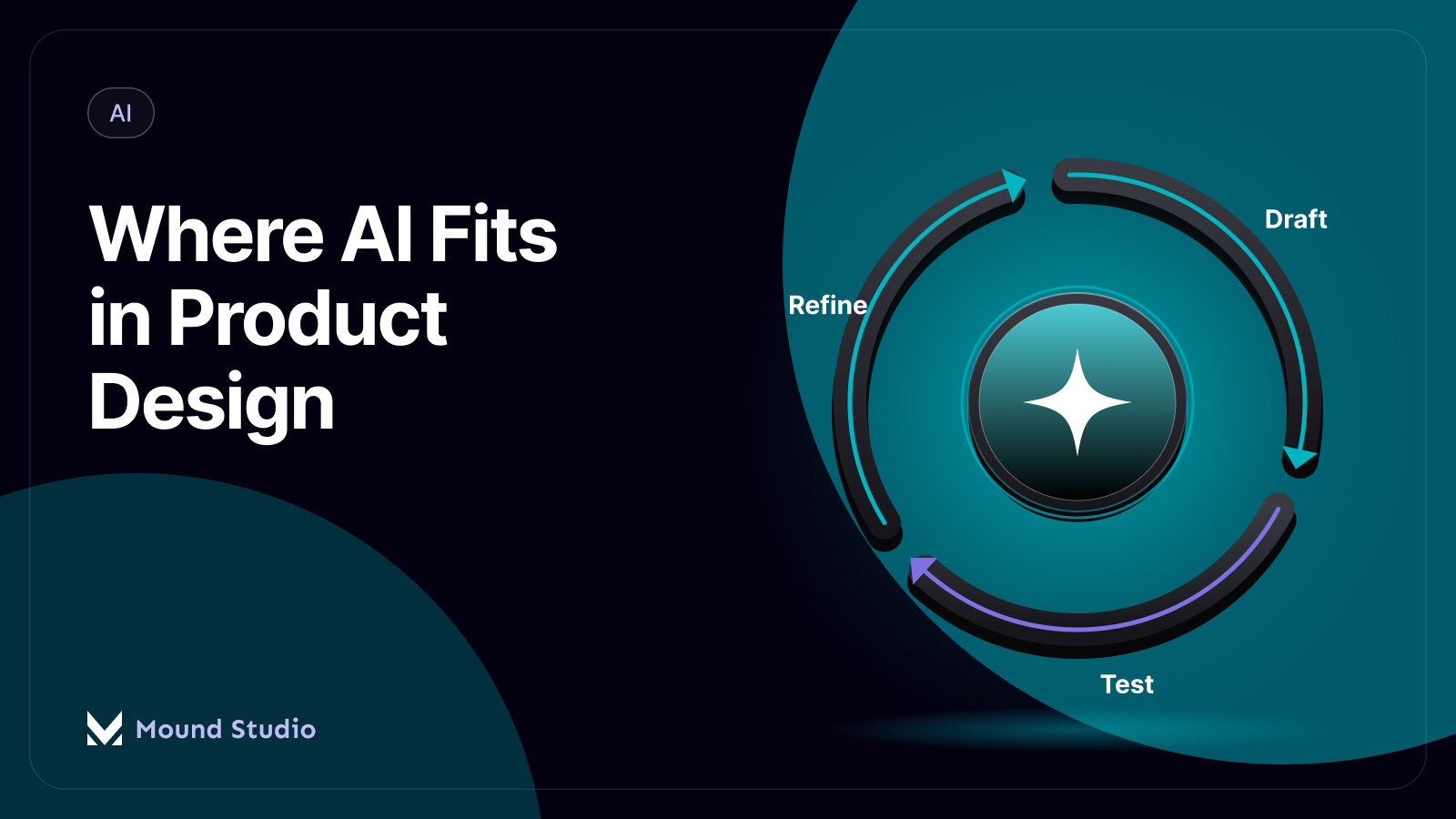
How AI Fits Into a Modern Product Design Workflow
Because audiences and platforms have gotten better at spotting content that has no real point of view behind it, and that gap now costs brands trust rather than just clicks. AI writing and imagery tools have become a normal part of marketing production, and that is not the problem. The problem shows up when a brand publishes copy or visuals that sound and look like everyone else's AI output: the same flattened phrasing, the same generic stock-photo-style renders, the same claims with nothing specific behind them. People notice, and increasingly they say so in comments and shares. Platforms are adjusting too, favoring content that reads like it came from someone who actually knows the subject. None of this means AI tools are the enemy of a brand's credibility. It means the tools need a clear role, and a brand needs a real editorial and design point of view sitting on top of whatever they produce.
We work with founders and marketing teams who use AI tools every day, and the pattern is consistent: the brands that keep trust are the ones that treat AI as a production aid, not as the author. The brands that lose it are the ones that let a tool's first draft go out unchanged, again and again, until the whole feed reads like nobody is home.
This has become more visible over the past year as more AI-generated text and imagery has moved into everyday marketing content. It shows up in comment sections calling out an obviously synthetic product photo, and in the quiet way an audience stops engaging with a feed that always sounds like a template. None of that means the tools are getting worse. It means audiences are getting better at telling the difference between content with a real point of view and content that is filling space.
It means a piece of content still carries a distinct point of view, a specific voice, and claims that are actually true for that brand, even though AI tools were involved somewhere in making it. Authenticity was never really about whether a human typed every word. It is about whether the content reflects real expertise, a real opinion, and language that sounds like this brand and not a template. A blog post drafted with AI help can be completely authentic if a person with real knowledge shaped the argument, checked the claims, and rewrote it in the brand's voice. A blog post typed entirely by a human can feel just as hollow as AI output if it is generic, hedge-everything copy with no actual point of view.
The table below is a quick way to spot the difference between content that reads as generic AI output and content that reads as an authentic brand voice, regardless of how much AI was used to produce it.
| Signal | Reads as generic AI output | Reads as authentic brand voice |
|---|---|---|
| Claims | Vague statements that could apply to any company in the category | Specific claims the brand can actually back up |
| Structure | Same five-point listicle shape every time, no matter the topic | Structure follows the actual argument being made |
| Voice | Neutral, hedge-everything tone with no strong opinions | Recognizable phrasing and a clear point of view |
| Visuals | Smooth, generic renders with no product or brand detail | Imagery tied to the actual product, team, or work |
AI tools earn their place in the early and repetitive stages of content work, where speed matters more than final judgment. We use them constantly for research summaries, first-draft outlines, headline options, and resizing an already-approved asset for a different channel. None of that work needs a brand's full editorial weight behind it yet, because nothing has gone out under the brand's name.
The flow below shows how a piece typically moves from a first AI pass to something a brand can stand behind publicly.
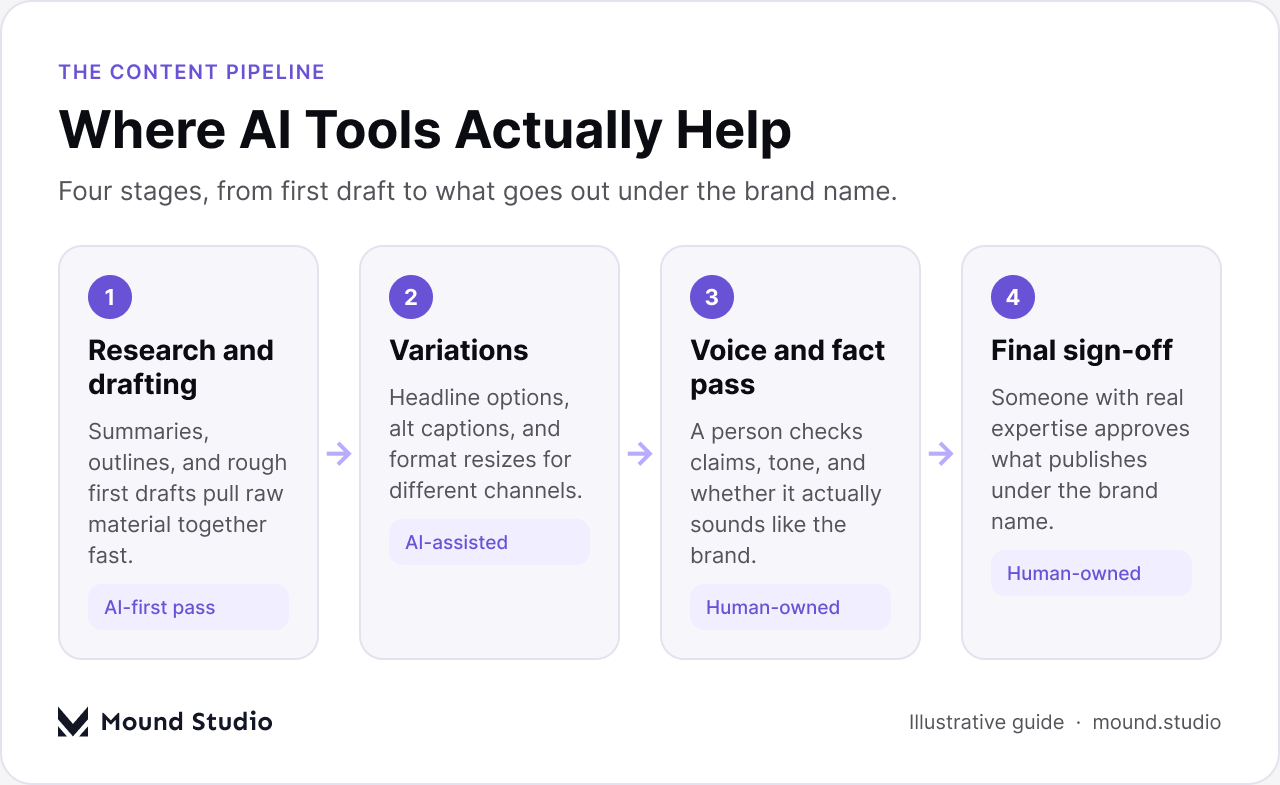
Some concrete places where AI tools help in practice, based on what we see across client work:
In every one of those cases, the AI output is a starting material, not a finished asset. That distinction is the whole game, and it applies just as much to how AI shows up in design work as it does to writing.
Anywhere a customer might act on what they read, and anywhere the content makes a claim about the brand's expertise, results, or point of view. That includes product pages, pricing pages, anything with a statistic or outcome attached to it, and any piece meant to establish the brand as knowledgeable in its field. It also includes visuals meant to represent the brand itself, like team photography, product shots, or hero imagery on a homepage, since obviously synthetic imagery in those spots tends to undercut the very credibility the page is trying to build.
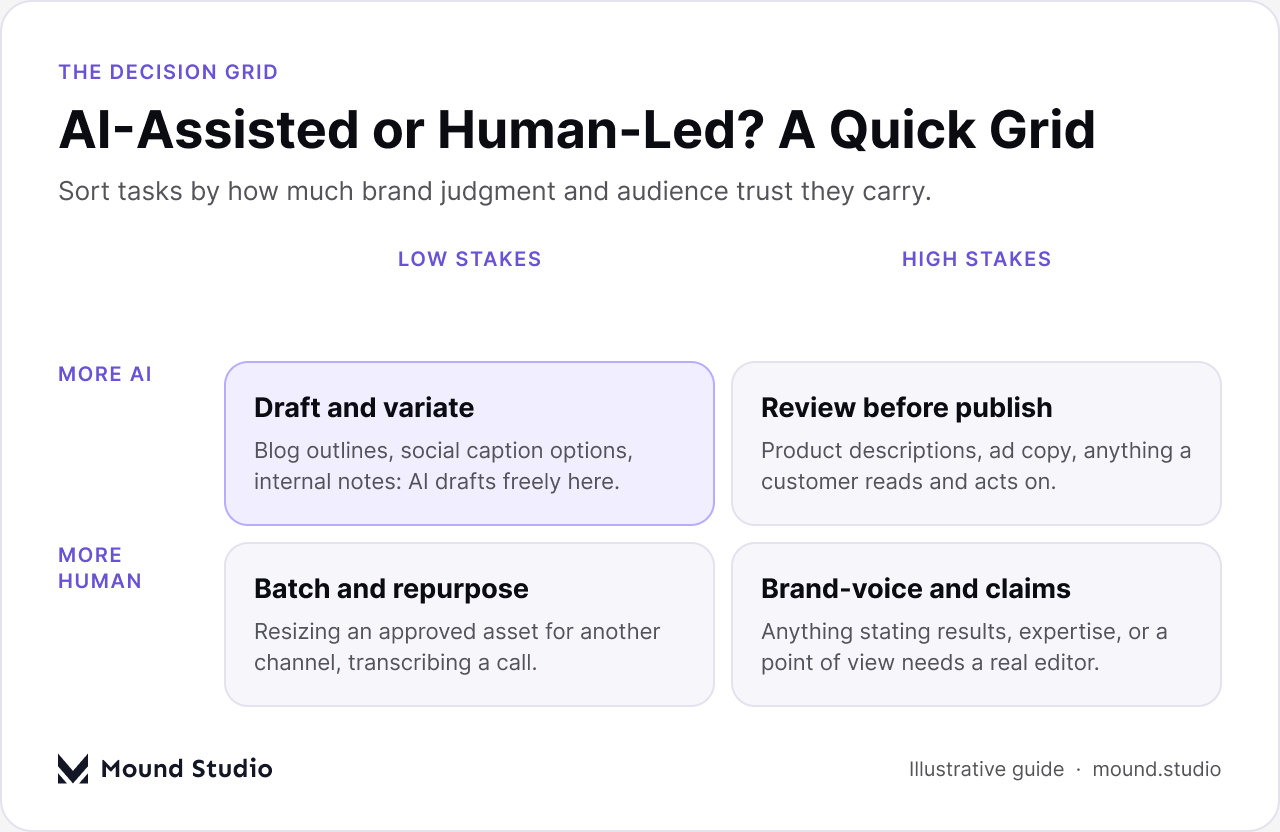
A simple way we sort this with clients is by asking two questions about a piece before it publishes: how much does this shape what someone believes about us, and how much would it embarrass us if a reader or a competitor pointed out it was generic AI output with no real substance behind it. High-stakes, high-visibility content gets a full human pass. Low-stakes, internal, or easily corrected content can lean on AI more freely.
A homepage hero image is a good example of where this plays out. It sits in one of the highest-visibility spots on a site, and it is exactly where an AI-generated render of a generic office or a stock-style person tends to read as hollow next to real photography of the actual product or team. The same logic applies to a case study or results page: a claim that is not backed by a real client and a real outcome undercuts the very credibility the page is trying to build.
You write the voice down as a real reference document, feed AI tools real examples of it, and keep one person accountable for the final read on every piece. Most brand inconsistency we see does not come from AI tools themselves. It comes from a team that never wrote down what the voice actually is beyond a color palette and a logo file, so every AI prompt produces a slightly different tone and every writer fills the gap differently.
A voice reference does not need to be long. It works best as a short, specific document: sentence length preferences, words the brand never uses, a few examples of copy the team is proud of, and a few examples of copy that missed the mark and why. This is really an extension of the brand strategy work a team has already done, applied to day-to-day content instead of a one-time brand launch. When that document exists, prompting an AI tool becomes much more reliable, because there is something concrete to point it at instead of a vague "sound professional but friendly" instruction.
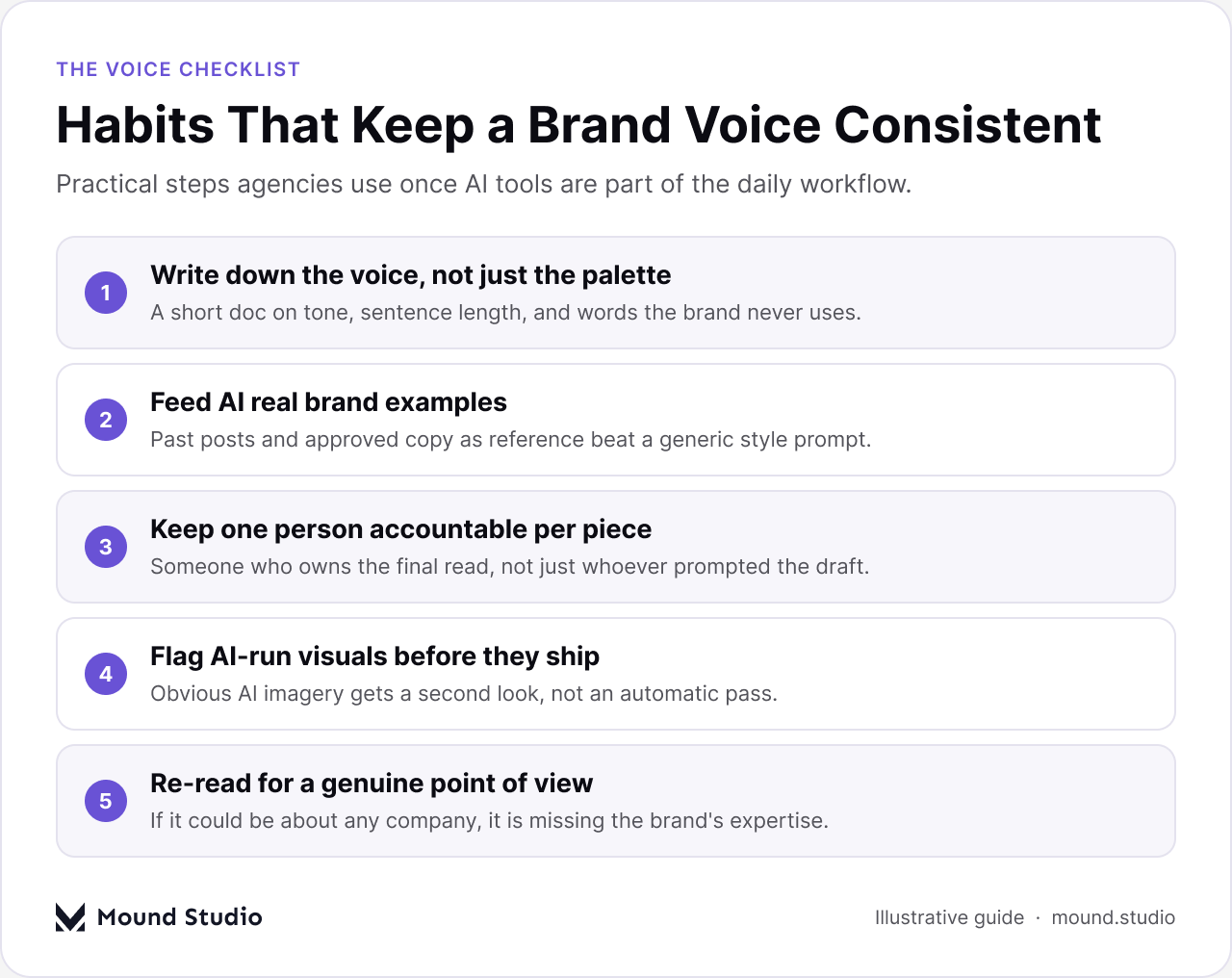
Beyond the reference document, a few operational habits matter more than any tool setting:
The biggest one is publishing the first AI draft without a real pass, simply because it reads fluently and fluent is mistaken for finished. AI output almost always reads smoothly, which makes it easy to skip the editorial step that used to be forced by a rougher first draft. A few other patterns we see often:
None of these mistakes require abandoning AI tools. They require treating the output as a draft with a known origin, not as a finished, brand-approved piece. The same discipline is worth applying to content written for AI search, where a thin, generic answer tends to get skipped in favor of a source with real expertise behind it.
Fixing these mistakes rarely requires new tools or a new policy document. It usually just requires slowing down at exactly the point most teams speed up: the moment content is technically finished and ready to publish.
Use a short checklist before anything publishes, rather than a blanket rule for every piece of content. A blanket "no AI" or "AI is fine everywhere" policy tends to break down quickly, because the actual risk depends on what the content claims and where it will be seen.
| Question | If yes | If no |
|---|---|---|
| Does it make a claim about results, expertise, or a product fact? | Requires a human fact and voice check | Can lean on AI drafting more freely |
| Will it represent real people, products, or the brand's actual work? | Use real photography or footage, not AI-generated visuals | AI-generated visuals are lower risk here |
| Would it read the same if a competitor's name replaced the brand's? | Needs a rewrite for a real point of view before it ships | Likely already carries enough brand voice |
| Is this customer-facing and hard to quietly correct later? | Full editorial pass required before publishing | Lower-stakes, internal-use tolerance is fine |
Running new content through those four questions takes a few minutes and catches most of the problems before they ever reach an audience. It also gives a team language to explain, internally, why one piece got a light touch and another got a full rewrite.
Teams that run through a version of this list consistently tend to keep their AI-assisted output indistinguishable, in the good sense, from anything written entirely by hand. The tool disappears into the process, and what is left is just the brand's own thinking, produced a little faster.
AI content tools are useful for drafts, variations, and first passes, and risky when they are allowed to speak for a brand without a real editorial or design pass checking the result. The brands that keep audience trust in 2026 are not the ones avoiding AI. They are the ones who know exactly where its output ends and their own expertise, voice, and judgment begin. If your team wants a second set of eyes on how AI fits into your content and design workflow without diluting your brand voice, talk to us about your project.
No. Authenticity depends on whether the finished piece carries real expertise and a distinct brand voice, not on which tools were involved in producing a draft. A heavily AI-assisted piece that gets a real editorial pass can be more authentic than a fully human-written piece with no actual point of view.
It depends on the format and the claim being made. For everyday marketing copy, most brands focus on making sure the content is accurate and sounds like them rather than labeling every AI-assisted draft. For anything making a factual or expert claim, being able to stand behind that claim matters more than labeling the process behind it.
Read it and ask whether a direct competitor's name could replace the brand's without anyone noticing a difference. If the answer is yes, the piece is missing a specific point of view, regardless of whether AI was involved in drafting it.
It can work well for illustrative, conceptual, or background visuals where nothing is claiming to represent a real person, product, or result. It becomes a trust problem specifically when it stands in for something that should be real, like team photography or an actual product screenshot.
Whenever the team notices a piece that landed unusually well or unusually poorly, or when the brand's positioning shifts. A voice document that never changes tends to drift out of sync with how the brand actually talks over time.