









Product
How Much Does Mobile App UI/UX Design Really Cost?
The right mobile app design agency is the one whose portfolio matches your platform and complexity, whose handoff process hands your developers dev-ready specs instead of static screens, and whose contract includes a clear answer for what happens after launch. Picking a partner on visual style alone is how most mismatched engagements start.
Mobile app design covers more ground than a marketing site. A single flow touches onboarding, permissions, offline states, push notifications, and platform-specific patterns that iOS and Android handle differently. The agency you choose needs to have actually shipped work at that level of detail, not just produced polished mockups for a pitch deck.
Most mismatched engagements trace back to the same root cause: a decision made on gut feel in the first conversation, before scope, process, or support were ever put in writing. A structured evaluation does not need to take weeks. It needs four specific questions, asked in the right order, with answers that go into the contract rather than staying as a verbal promise from the first call.
Evaluating an agency comes down to four checks: what you are building, what they have built before, how they hand off work, and what happens once the app is live. Each one surfaces a different kind of risk, and skipping any of them tends to show up later as rework, delays, or a product that does not quite match what developers needed.
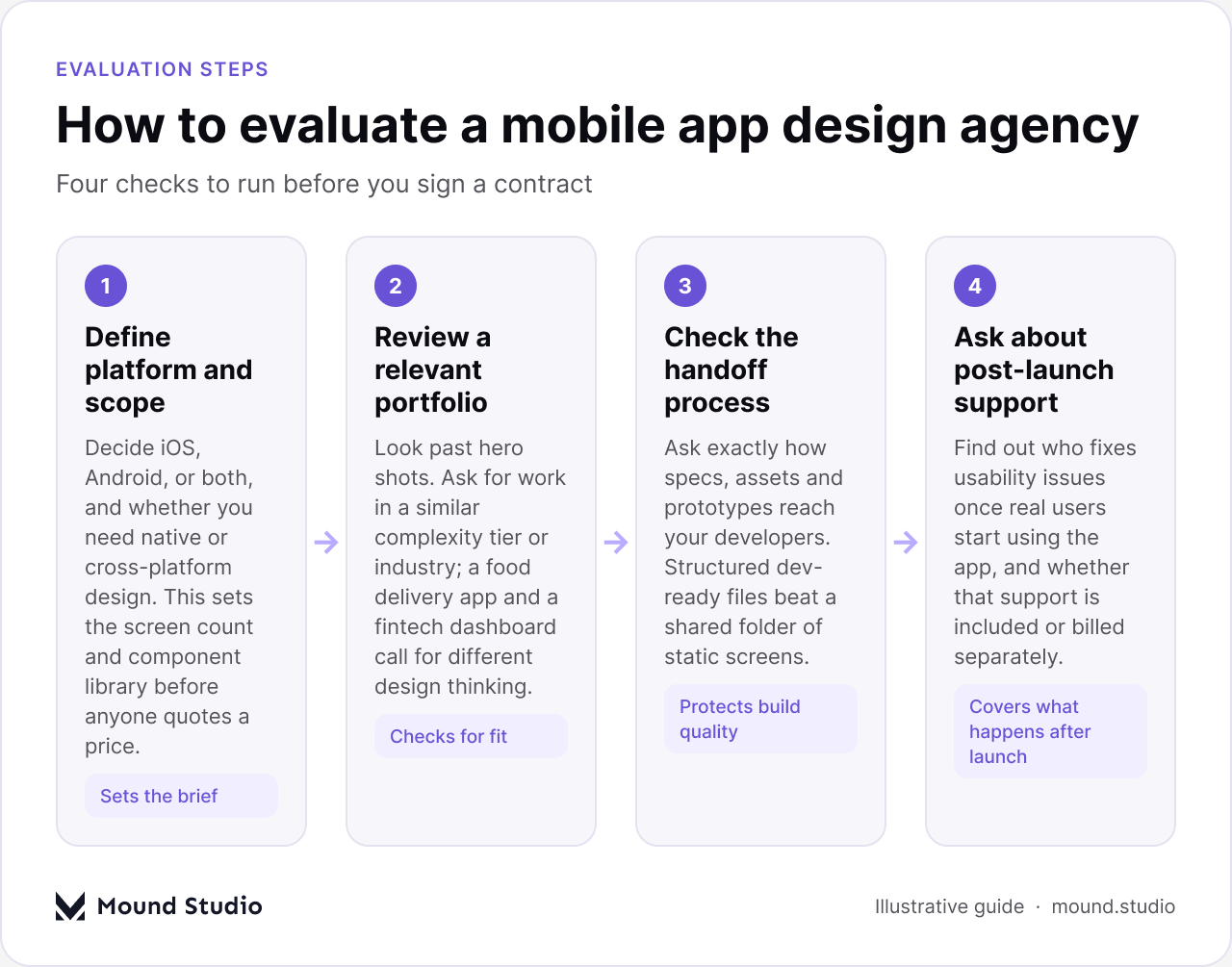
Before you talk to any agency, decide whether you are building for iOS, Android, or both, and whether the app will be native or cross-platform. This decision changes almost everything downstream: the number of screens, the component library, the review cycles, and the realistic timeline. An agency that designs primarily for iOS may default to patterns that feel out of place on Android, and the reverse is just as true. If you already know you will use a cross-platform framework, say so early. Agencies that design generic screens without platform awareness tend to produce interfaces that need significant rework once a developer tries to build them against real platform constraints.
A large portfolio is not the same as a relevant one. Ask to see work in a similar complexity tier and, where possible, a similar industry. A simple content app and a multi-step checkout flow for a marketplace call for different design thinking: one is mostly about navigation and readability, the other is about trust, error states, and edge cases. When you review a portfolio, look past the hero screens and ask to see a full flow, from first open to the task actually getting done. If an agency can only show single static screens with no flow or prototype attached, that is worth asking about directly. If you want a sense of what that process looks like in practice, our mobile app design process walks through it step by step.
It also helps to ask for a short walkthrough call on one or two relevant projects, rather than reviewing the portfolio alone. A walkthrough reveals how the agency talks about tradeoffs: why a particular onboarding flow was shortened, why a certain permission request was delayed until the user reached a relevant screen, or how they handled a platform constraint that did not show up in the original brief. That kind of reasoning is a better predictor of future work than the finished screens on their own.
Design quality only matters if it survives the handoff to development. Ask exactly how specs, assets, and prototypes get delivered: structured, developer-ready files with documented spacing, states, and components are a different thing entirely from a folder of exported images. Ask whether the agency works directly with your developers during the build, or whether the relationship ends the day files are delivered. A good handoff process reduces the number of follow-up questions your engineering team has to ask, and a poor one turns into weeks of back-and-forth clarifying what a hover state or an error message was supposed to look like.
Launch day is not the finish line. Real users will find flows that feel confusing, buttons that are too small to tap reliably, or screens that do not account for how people actually use the app one-handed on a bus. Ask upfront who addresses usability issues once the app is live, whether that is included in the engagement or billed as additional work, and how quickly the agency can turn around a fix. Agencies with no answer to this question usually mean the relationship ends at delivery, which can leave you without design support exactly when real usage data starts showing where the app falls short.
Mobile app design agencies typically price work one of three ways: hourly, as a fixed-scope project, or as a monthly retainer. None of these is inherently better; the right one depends on how defined your scope is and how long you expect the design relationship to last. A tightly scoped MVP with a known screen count usually fits a fixed-scope project. An app that will keep evolving after launch, with new features shipping regularly, tends to work better on a retainer. Hourly billing suits smaller, open-ended tasks where the scope cannot be defined upfront, such as ongoing design support layered on top of a development sprint. For a closer look at how these numbers come together, see how much mobile app design actually costs.
| Model | How it works | Best for |
|---|---|---|
| Hourly | Billed for actual time spent, tracked against an estimate | Small, open-ended tasks with unclear scope |
| Fixed-scope project | One price for a defined set of screens and deliverables | MVPs and projects with a known screen count |
| Monthly retainer | A set number of hours or deliverables each month | Apps with ongoing feature work after launch |
Whichever model you choose, ask what counts as a revision versus new scope. Fixed-scope projects in particular can turn into disputes if "revisions" and "new requests" are not defined in the contract. A retainer should spell out expected hours or deliverables per month, not just a flat monthly fee with no defined output, so you can tell whether you are getting consistent value as the engagement continues.
Ownership of files is worth confirming as well. Most agency contracts transfer design files to the client once the project is paid in full, but the terms differ on whether that includes source files, component libraries, or only exported assets. If you plan to bring design work in-house later, or move to a different agency for future phases, confirm upfront that you will walk away with editable files rather than flattened exports you cannot reopen.
Payment schedules also matter. A deposit followed by milestone payments tied to specific deliverables, such as completed wireframes or a finished prototype, keeps both sides accountable to a timeline, more than a single upfront payment with no checkpoints along the way.
The agency route is not the only option, and it is not always the right one. In-house teams, freelancers, and agencies each suit a different shape of project. The deciding factors are how long the design work will continue, how much variety of skill the project needs at once, and how much management overhead you are willing to take on directly.
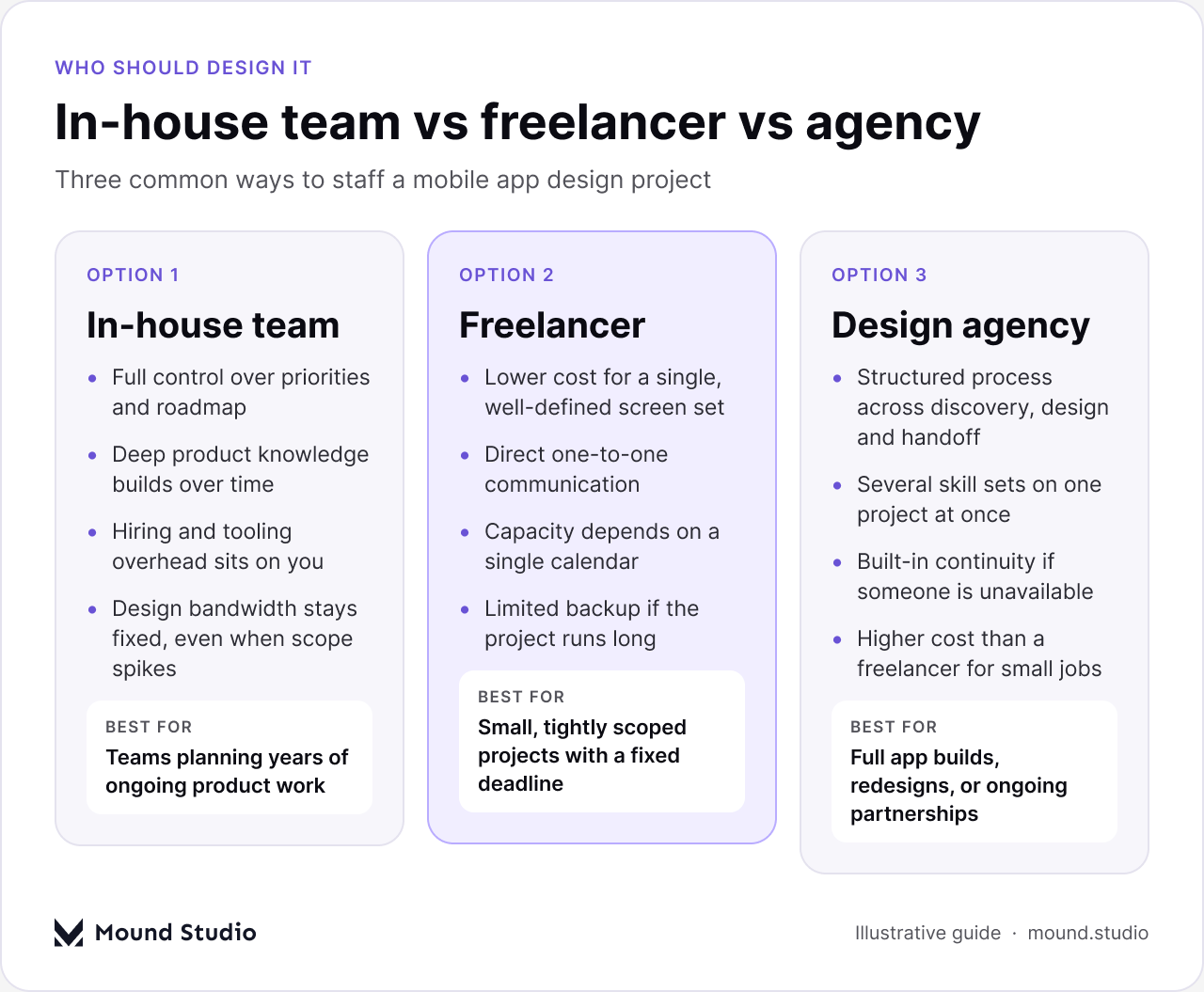
An in-house team makes sense once a product has enough ongoing design work to keep someone busy full time, and once the company is ready to own hiring, management, and tooling directly. A freelancer is often the fastest way to get a small, well-defined set of screens done, provided the project does not need research, content strategy, and prototyping all running at once. An agency sits in between: it brings a structured process and several skill sets to a single project, with continuity built in if the engagement needs to scale up or down. For a first mobile app build with unclear internal design capacity, an agency engagement is usually the lower-risk starting point, and a short list of questions to ask before you hire a design agency can help you compare options quickly.
These options are not always exclusive. A common pattern is bringing in an agency for the initial build, when the project needs research, UI design, and prototyping running in parallel, then transitioning to a smaller in-house team or a single freelancer for incremental updates once the app has launched and the design system is established. Planning for that handoff from the start, rather than treating it as an afterthought, makes the transition between design partners much smoother on both sides.
Different questions matter at different points in the relationship. Asking about post-launch support during discovery, before any design work has started, gets a more direct answer than asking after the contract is signed. The table below breaks down one question to lead with at each stage.
| Stage | Key question |
|---|---|
| Discovery | What platforms and complexity tier have you designed for before? |
| Design | How will you show flows, not just individual screens, as work progresses? |
| Handoff | What exact files and documentation will my developers receive? |
| Post-launch | Who addresses usability issues once real users start using the app? |
These questions are starting points, not a full checklist. The goal is to get the agency talking specifically about your project rather than giving a generic answer about their process. A vague response to any of these four questions is itself useful information about how the engagement is likely to go.
Some warning signs show up before you sign anything, if you know what to listen for. The patterns below come up often enough in practice that they are worth asking about directly rather than assuming they will not apply to your project.
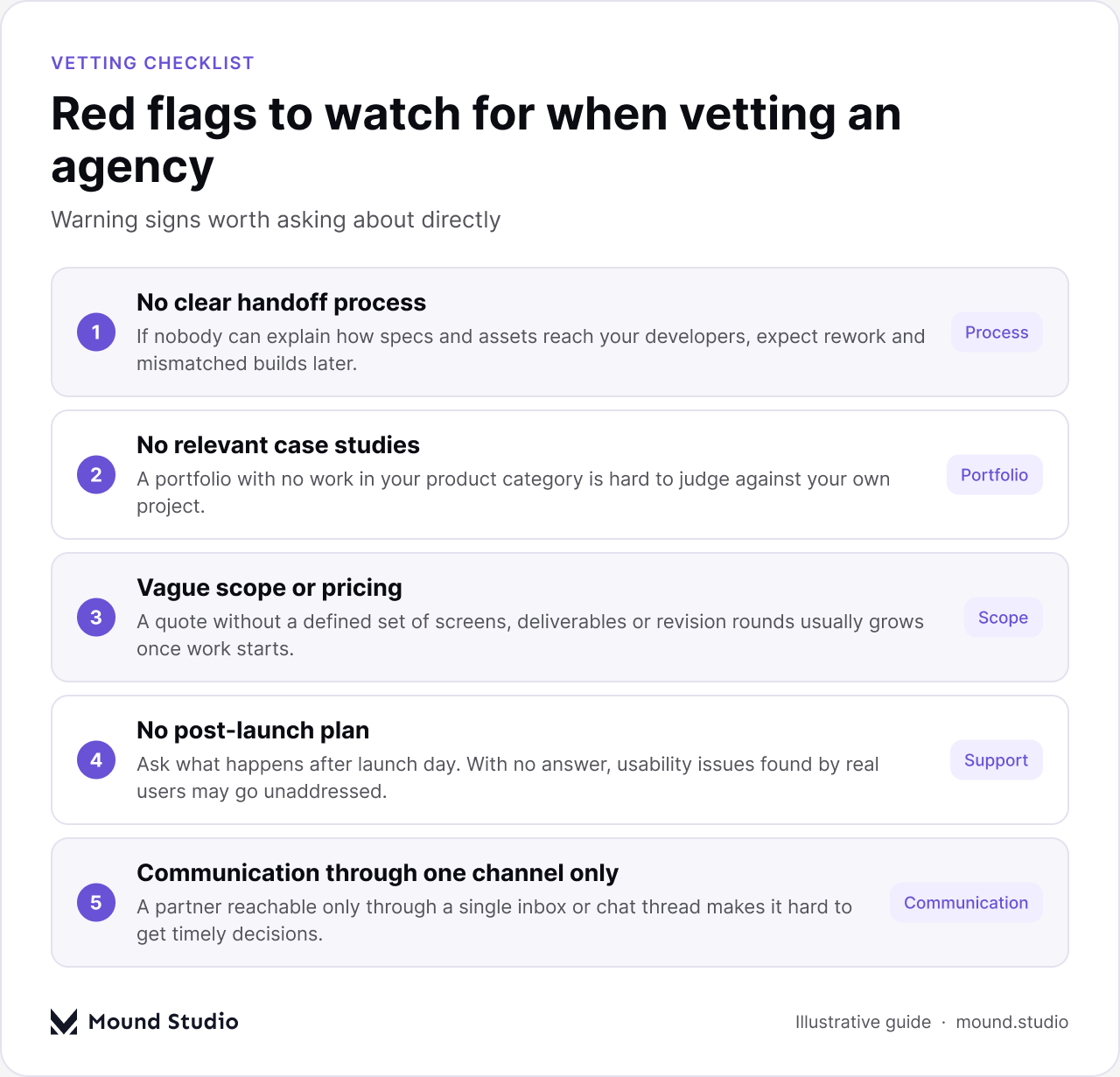
Vague scope and pricing deserves particular attention because it is the easiest red flag to miss. A proposal that lists "UI design" as a single line item, with no screen count, no number of revision rounds, and no defined deliverables, tends to grow once the project starts, because neither side agreed on where the boundaries sit. Ask for a scope document, not just a quote. Communication through a single channel is a smaller flag on its own, but it compounds with every other issue on this list: if a usability concern comes up two weeks after launch and there is only one inbox to reach, response time becomes the actual bottleneck, regardless of how good the original design work was. Ask who you will be talking to day-to-day, and what the response time looks like in practice.
Before signing with a mobile app design agency, confirm the following:
There is no single best mobile app design agency, only the one whose scope, process, and pricing model actually fit your project. Define your platform, ask to see a relevant portfolio and handoff process, and get post-launch support in writing before anything else. If you want to talk through what a mobile app design engagement would look like for your product, get in touch with our team.
Start by defining your platform and scope, then review a portfolio in a similar complexity tier, confirm the handoff process, and ask about post-launch support before signing anything.
Pricing usually follows one of three models: hourly for open-ended tasks, fixed-scope for a defined project, or a monthly retainer for ongoing work. The right model depends on how clearly your scope is defined.
A freelancer often works well for a small, well-defined set of screens. An agency is a better fit for full app builds or projects that need several skill sets working together at once.
It should include structured, developer-ready specs, labeled assets, and prototype access, documented clearly enough that your development team does not need to guess at spacing, states, or interactions.
Vague scope or pricing, no case studies relevant to your product category, no defined handoff process, and no plan for support after launch are the most common warning signs.