







Ai
Claude vs ChatGPT: Which AI Fits Your Design Workflow

It means giving Claude the raw material for a feature, a meeting transcript, a Slack thread, a half-formed idea, and getting back a structured first draft: a problem statement, goals and non-goals, scope, user stories, edge cases, and acceptance criteria, in your team's own format. Claude does the first pass of structuring and writing. Deciding what actually ships, what gets cut, and which tradeoff wins still needs a person who owns the product.
That split matters more than the tool itself. Claude is fast at turning notes into a shape engineers recognize. It has no opinion on your roadmap, your users, or what your team can build this quarter, and it should not be treated as if it does.
For a product or design team, the appeal is not that Claude writes better than a product manager would. It is that a blank spec document is one of the biggest reasons specs get written badly under deadline pressure. Give Claude something to react to, and it will always return a structure. Whether that structure is right for your team, your users, and this particular feature is a separate question, and it is worth asking every single time, not just the first time.
Paste your notes into a template that matches your team's spec format, and Claude will return a structured first draft with the standard sections filled in and the unclear parts flagged as open questions instead of quietly guessed at. It also speeds up two smaller but real problems: keeping every spec on the team in the same format, and turning a paragraph of "it should just work" into acceptance criteria engineering can actually check against. What it cannot do is decide what belongs in v1, weigh one tradeoff against another, or catch a business risk nobody mentioned in the meeting.
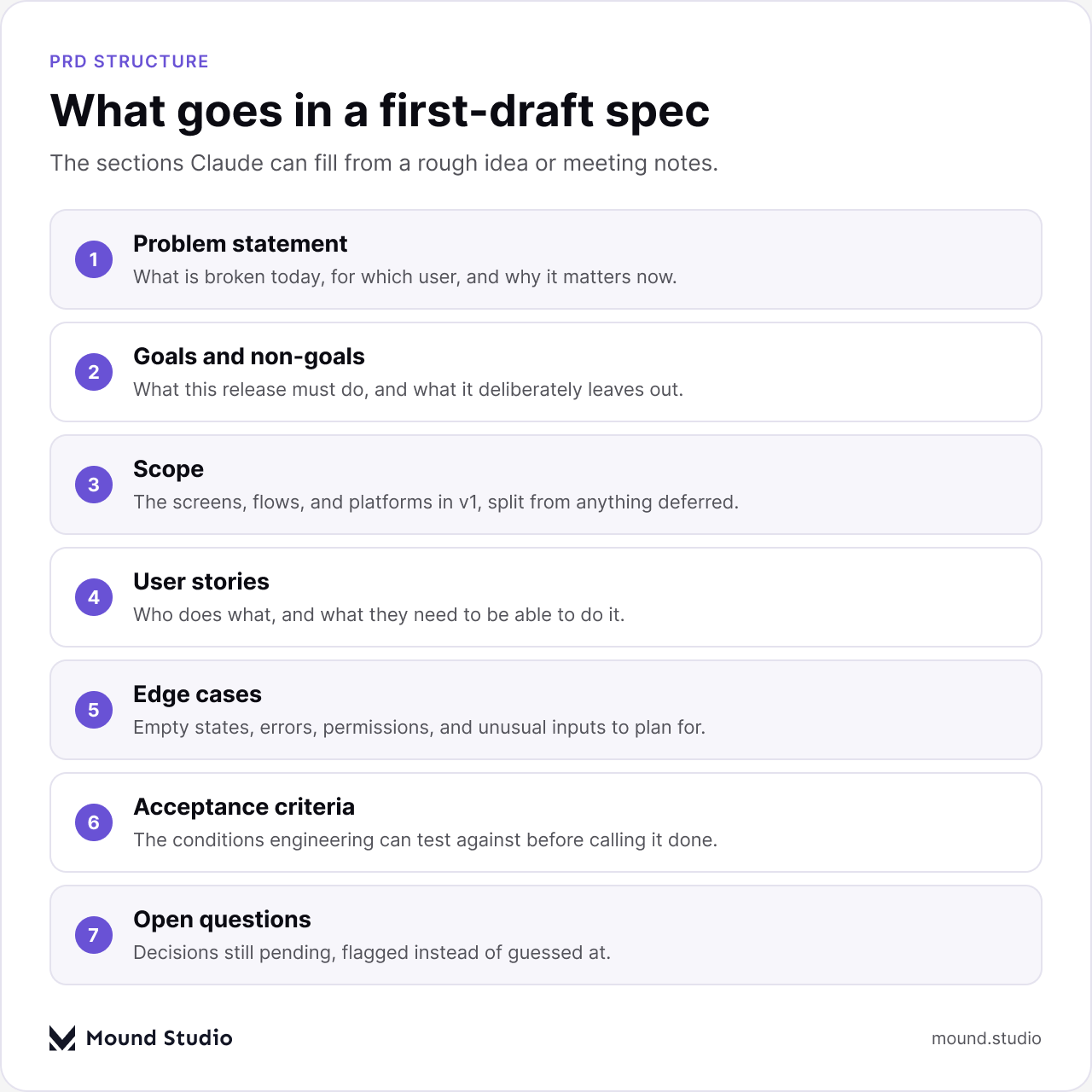
A good first draft is not a document, it is a checklist with paragraphs attached. Claude does well with each part of it once it has real input to work from, not just a feature name.
What is broken today, for which user, and why it is worth fixing now. Paste in the complaint, the support ticket, or the line from the meeting where someone said people keep doing this wrong, and Claude can turn it into two or three sentences that still hold up when someone reads them six months later. Vague problem statements are usually vague because nobody wrote down who the user actually is. Ask Claude to name the user type explicitly, and the rest of the paragraph tends to sharpen on its own.
What this release has to do, and just as important, what it deliberately will not do. Teams that skip the non-goals list end up relitigating scope in every stand-up, because nothing was ever written down that said otherwise. Claude is good at pulling out "we are not doing this yet" from a conversation where it was said once in passing and then never mentioned again.
The screens, flows, and roles involved, written as: as a certain user, I need to do this, so that this happens. This is mechanical work, and mechanical work is exactly where a first draft saves the most time. Where it gets more useful is in catching a role you forgot: paste in a description of three user types and Claude will often notice that stories only cover two of them.
Empty states, permission errors, slow networks, someone submitting the form twice. Claude tends to raise more of these than a first pass by a busy team would, mostly because it is not trying to hit a deadline while writing it. It has no reason to skip the boring cases the way a tired team sometimes does at the end of a long sprint planning session.
The conditions engineering can test against, plus a plain list of what is still undecided. We will come back to both of these, because they are where a spec either earns trust from engineering or loses it. A spec with clear criteria and an honest open-questions list gets estimated faster than one that reads confidently but hides its gaps.
The workflow that works is short: paste the raw input in as-is, let Claude draft against your team's template, read the draft specifically looking for the open questions it flagged, have the team correct and lock the scope, then send the acceptance criteria to engineering as a checkable list rather than a paragraph.
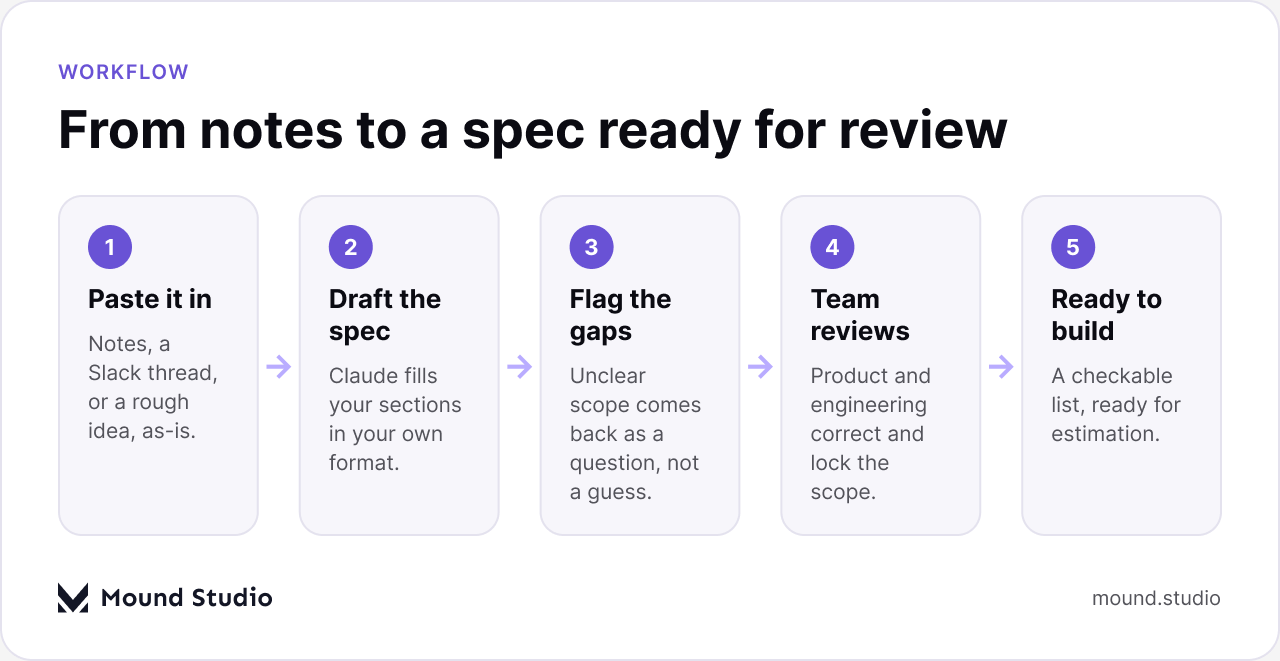
The part worth protecting in that workflow is the second-to-last step. It is tempting to skim a clean-looking draft and ship it. The value of asking Claude to draft is partly the structure, but it is also the list of things it could not figure out from your notes, and those are usually the exact things worth a two-minute Slack thread before anyone starts building. Skip that step, and the open questions do not disappear, they just show up later, mid-sprint, as a much more expensive interruption.
This workflow also holds up for smaller updates, not just new features. A one-line change to an existing flow still benefits from a quick pass: paste in the old behavior and the requested change, and Claude will usually flag at least one interaction the change affects that was not mentioned in the request.
Consistency comes from the template, not from the tool. If every writer feeds Claude the same section headings and the same level of detail per section, every spec comes back looking like it was written by the same person, even when three different product managers wrote the notes. Without a shared template, you get three different documents with three different ideas of what "scope" means.
| What you paste in | What comes back |
|---|---|
| Raw meeting notes | A rough problem statement and a list of loose scope items to confirm |
| A Slack thread debating a feature | Goals, non-goals, and the open questions the thread never resolved |
| A rough one-line feature idea | A skeleton draft, heavy on open questions, light on detail |
| An old spec plus "same shape, new feature" | A full draft matching your existing section order and tone |
The last row is the one worth setting up once. Keep a clean example spec on hand and reference it every time, and formatting drift across the team mostly disappears.
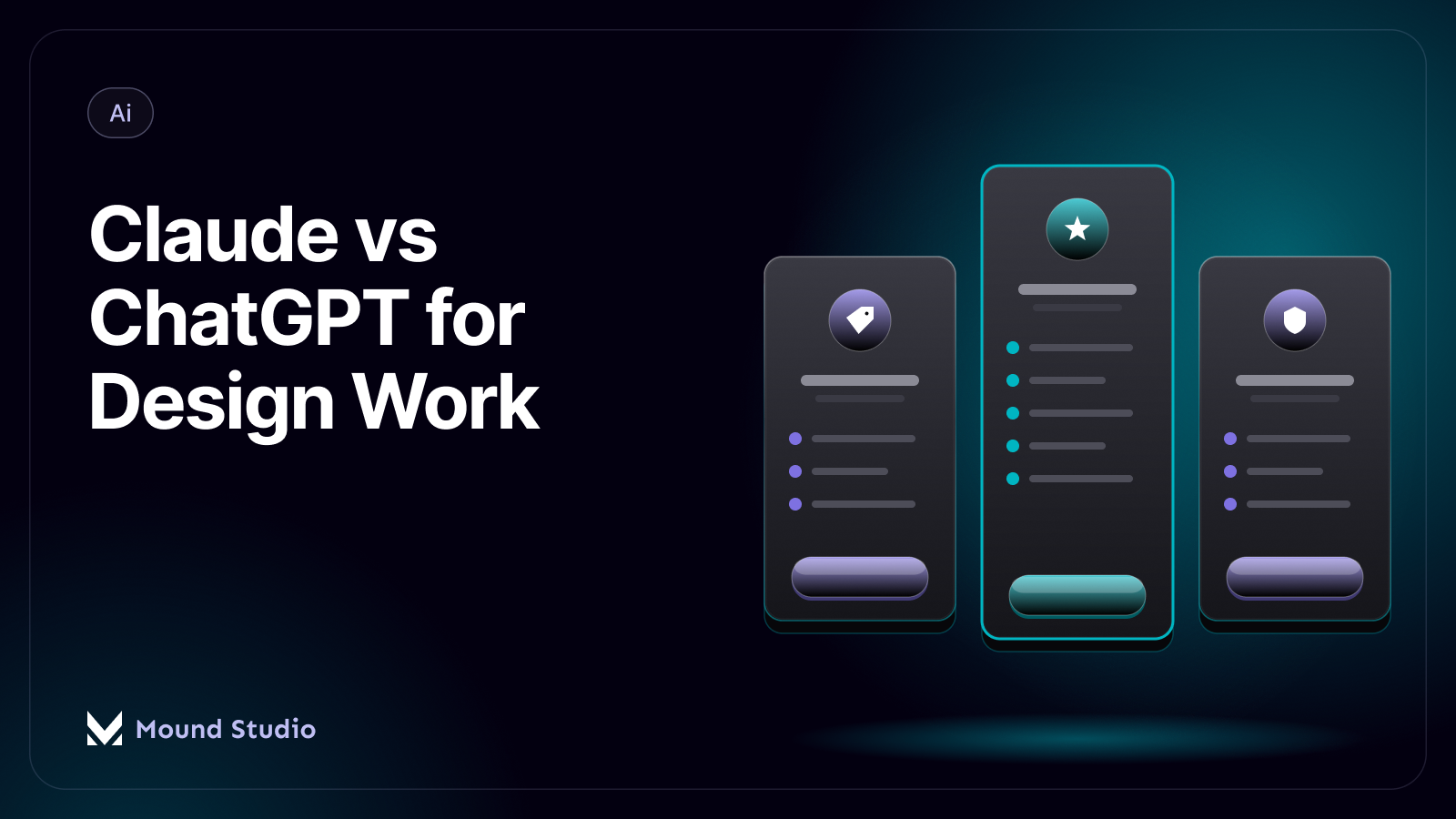
Teams that use Claude across the rest of the client workflow tend to get more consistency out of this step, simply because the same template and tone carries from proposals through to specs. If you are comparing tools for this kind of work, our notes on Claude versus ChatGPT for product teams cover where the differences actually show up.
Acceptance criteria fail most often because they are written as prose, such as "the form should validate properly." Ask Claude to draft them as a checkable list instead, in whichever format your engineering team already reads, and the gap between what the spec says and what gets built gets much smaller.
| Format | Good for | Example |
|---|---|---|
| Given / When / Then | Teams already writing test cases this way | Given an empty cart, when a user applies a promo code, then show an inline error |
| Plain checklist | Smaller features, fast review | Form blocks submission until all required fields are filled |
| Must / Should / Could | Separating v1 from nice-to-haves | Must: save draft on exit. Could: auto-save every 30 seconds |
Whichever format you pick, ask for one more pass afterward: list anything in this feature that is not covered by these criteria yet. That single follow-up question catches more gaps than a first read of the criteria usually does.
The structure of a spec is safe to hand over. The decisions inside it are not. Claude can format a tradeoff clearly; it cannot tell you which tradeoff to take, because it does not know your roadmap, your team's speed, or which stakeholder will actually block a launch over a missing edge case.
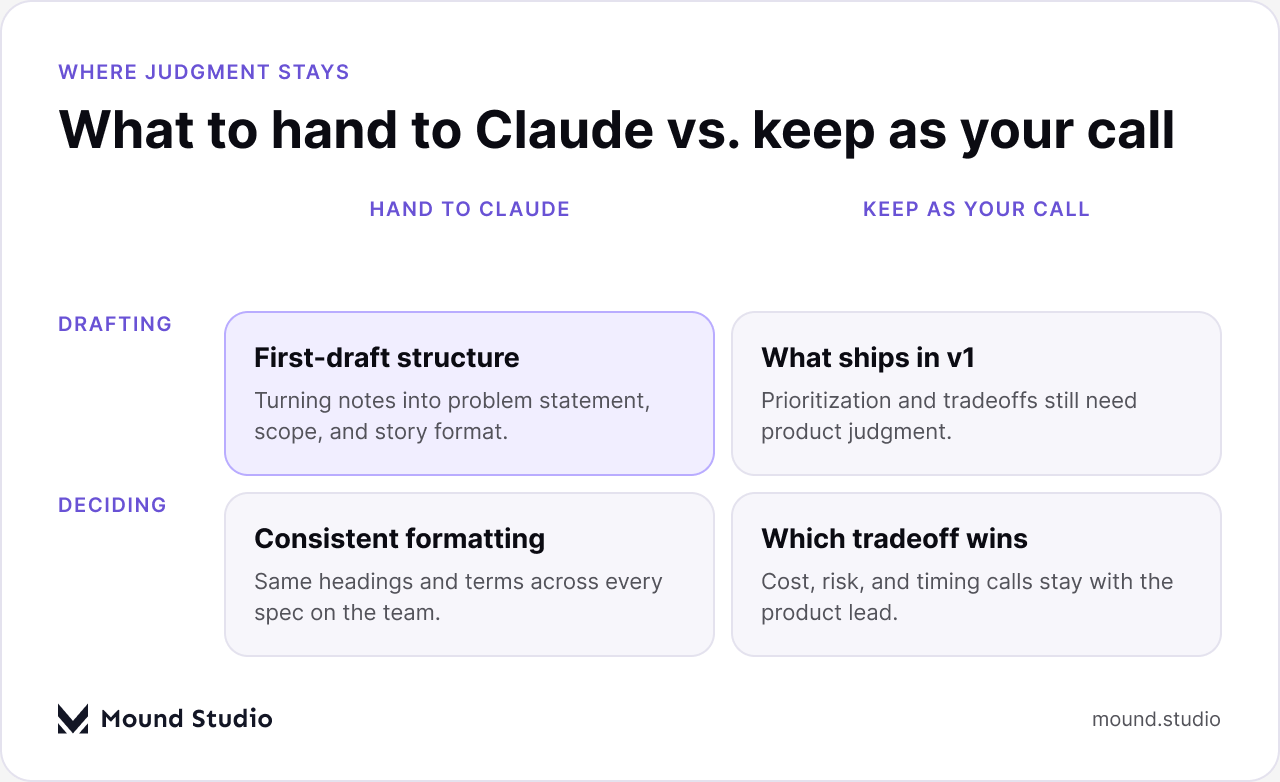
A useful habit: if a sentence in the spec starts with "we should" or "it would be better to," treat it as a judgment call and check it yourself, even if Claude wrote it in a confident tone. Confidence in the writing is not the same as correctness in the decision. This is the single biggest risk in using Claude for specs at all: a document that reads as settled can quietly carry a decision nobody actually made, and it takes a deliberate second read to catch that.
One practical guard is to ask a direct follow-up before the draft goes anywhere: "which parts of this spec are decisions, and which are just formatting?" Claude will usually separate the two cleanly, which makes it much easier for a reviewer to know exactly where their judgment is actually needed.
Before a draft leaves product's hands, check it against a short list.
If any of those are missing, send it back for another pass before engineering starts estimating. A spec that raises the right questions early is worth more than one that reads cleanly but hides its gaps. Engineering estimates are only as good as the spec they are estimating against, and a spec with hidden gaps produces an estimate that looks precise and is not.
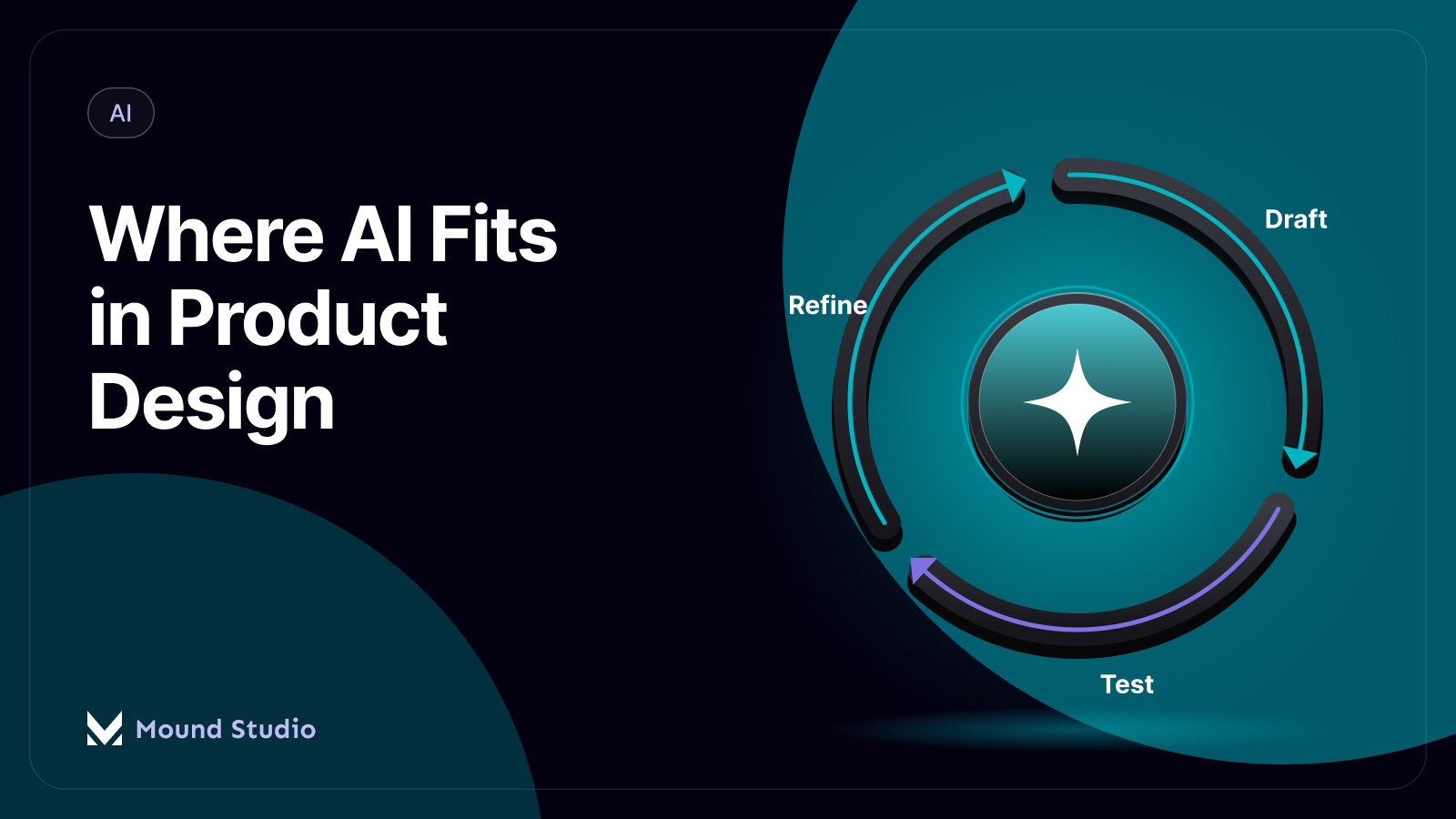
This kind of workflow tends to fit naturally alongside the rest of a product team's use of AI day to day. See our notes on where AI actually helps in a product design workflow for how it shows up earlier in the process, before a spec even exists.
Claude is fast at the part of spec writing that is mostly structure: turning notes into sections, formatting acceptance criteria, keeping every document on the team consistent. It is not a substitute for the judgment that decides what ships, what waits, and which tradeoff your team can live with. Used that way, it saves the hours spent on formatting and leaves the real decisions where they belong.
Want a hand setting up a spec template your whole team can draft against consistently? Tell us how your team writes specs today and we will help you tighten the process.
It can draft the structure and fill in sections from your notes, but someone on the team still needs to review it, fill gaps, and decide what actually ships.
Meeting notes, a Slack thread, or a rough feature idea work better than a bare feature name. The more real context Claude has, the less it has to guess.
Use the same template and section order every time you ask Claude to draft, and keep one clean example spec on hand to reference.
Whatever your engineering team already reads without friction, whether that is Given/When/Then, a plain checklist, or Must/Should/Could.
Prioritization, tradeoffs, and what belongs in v1. Those decisions need context about your roadmap and team that Claude does not have.