







Product
How Product Teams Use Claude for UX Writing and Microcopy
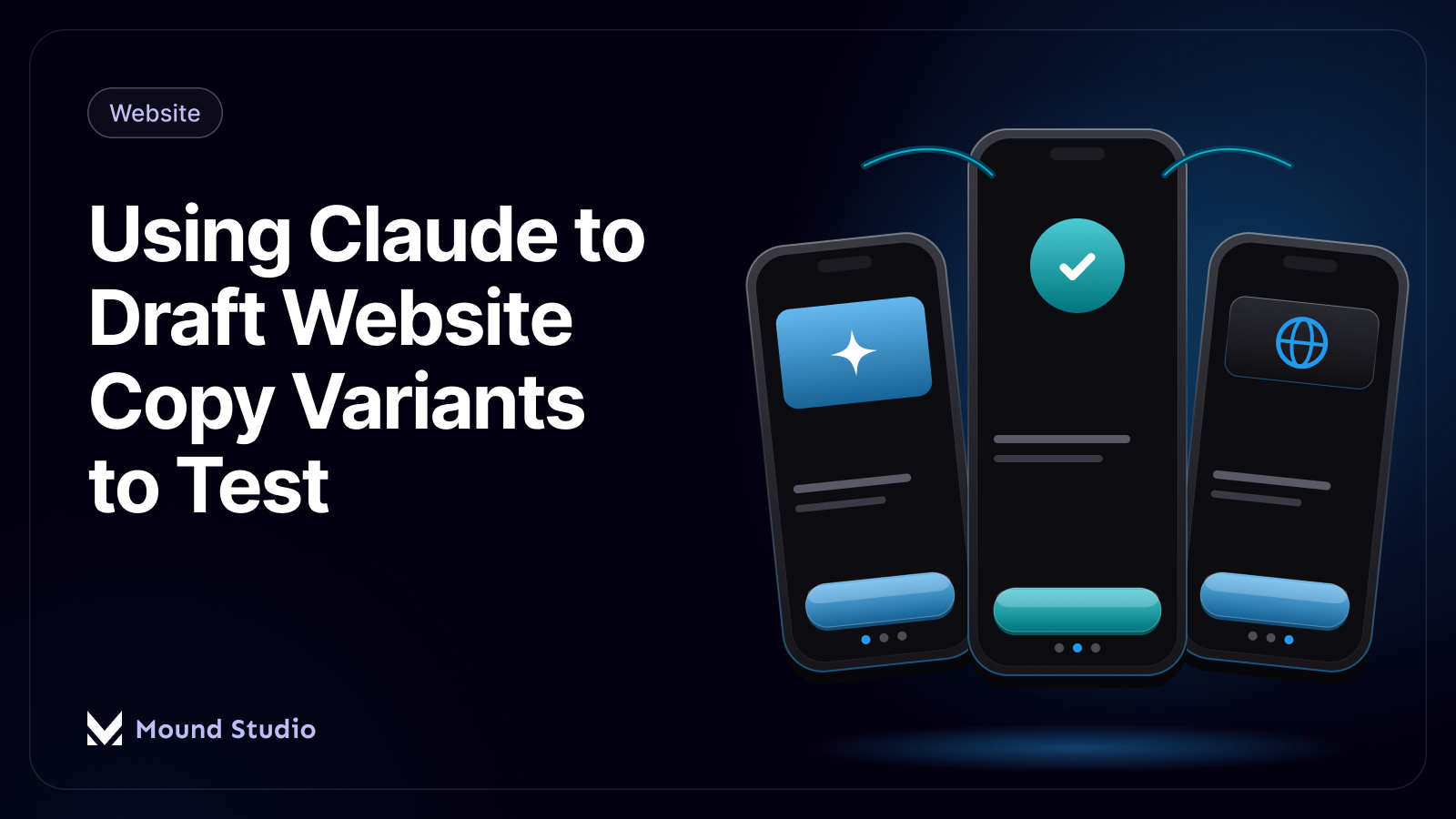
Yes. Give Claude a real brief and it will draft several distinct headline, subhead, and CTA options in the time it takes to write one good version by hand. That solves the actual bottleneck on most website projects: teams only ever test one version of a section because writing three convincing alternatives by hand takes an afternoon nobody has budgeted for. What Claude cannot do is tell you which variant will perform better on your site. That answer comes from a real test with real visitors, a sample size large enough to mean something, and a person who knows your brand checking the results before anyone calls a winner.
So the useful split is: Claude widens the pool of copy you have to choose from. Your team, your traffic, and your test tool decide what actually wins. That distinction matters more than it sounds, because most of the AI-written website copy that reads as generic got that way for the opposite reason: a draft went live without anyone screening it against a real brand voice or checking it against an actual test. The model did not fail. The step that was supposed to catch a flat draft before it shipped just never happened.
Use Claude to draft more headline, subhead, and CTA options than you would normally have time to write, screen those drafts against your brand voice, then load the survivors into a proper test and let real traffic decide. Skip the human screening step or skip the real test, and you have just replaced one guess with several guesses.
Writing one solid headline for a landing page section is hard enough. Writing three or four that are each meaningfully different, on brand, and worth testing against each other is a different amount of work, and it usually loses to a deadline. So most teams write a version they are reasonably happy with, ship it, and move to the next page. The site never finds out whether a different framing, a shorter CTA, or a reordered value proposition would have done better, because nobody wrote the alternative to compare it against.
This is not a research problem or a tooling problem. It is a writing-capacity problem. Claude changes the capacity side of that equation: drafting five headline directions costs about the same effort as drafting one, because the model does the first pass and a person edits from there.
The workflow that holds up in practice has four steps, and skipping any of them is where teams get copy they cannot trust.
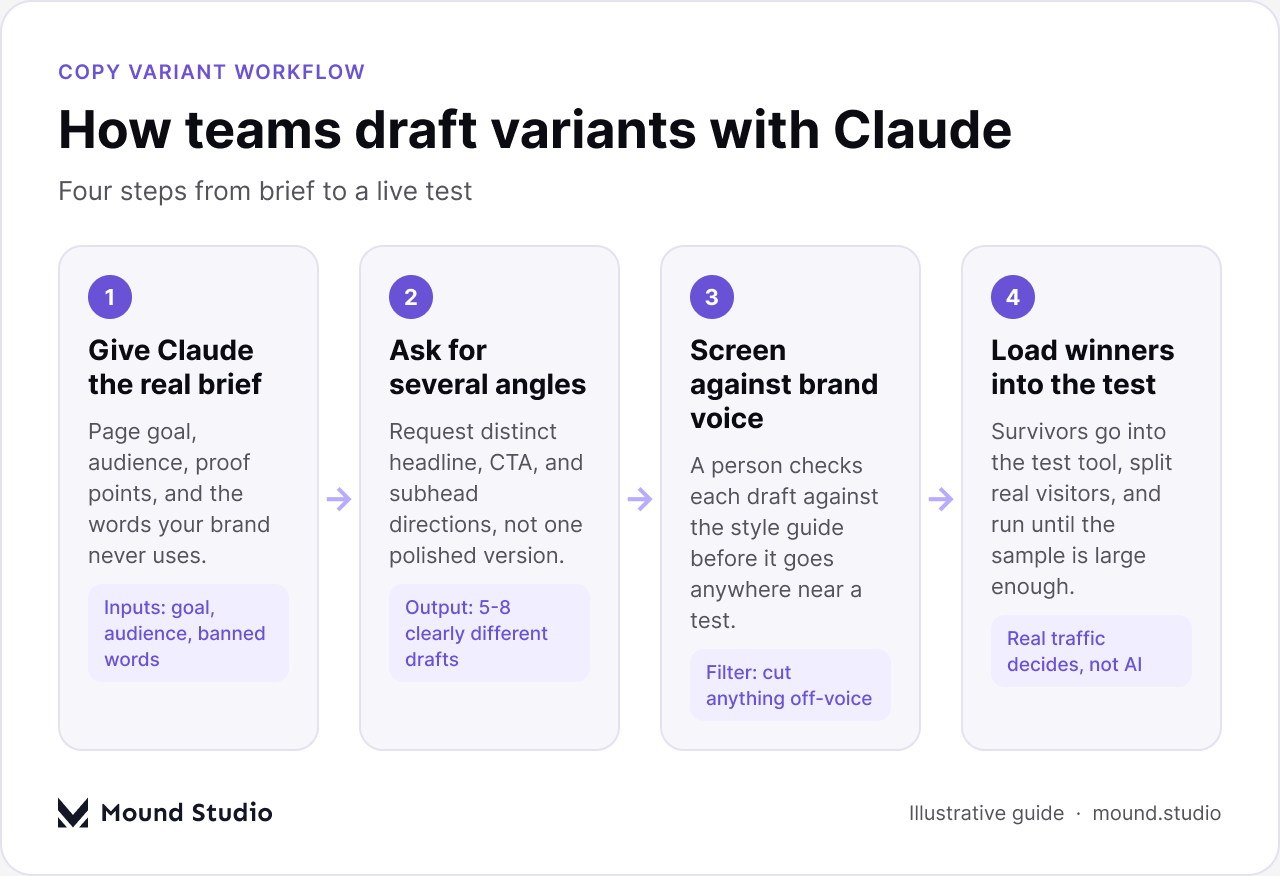
The brief in step one matters more than the prompt wording. A page goal, a clear read on the audience, a few real proof points, and a list of words your brand does not use will get you further than a clever instruction with none of that context. Step three is the step teams skip when they are in a hurry, and it is the one that protects the brand. A model has no memory of your last three campaigns or your client's actual tone, so a person still has to read every draft before it is allowed anywhere near a live test.
In step one, the brief goes to Claude roughly the way you would hand it to a new copywriter joining the account: what the page needs to do, who is reading it, what is true about the product, and what to avoid. In step two, ask for range on purpose. Request headline options that lead with different things, one on the outcome, one on the process, one on a specific detail, rather than five versions of the same sentence. In step three, whoever owns your brand voice reads every draft the way they would read a freelancer's first pass, cutting anything that sounds like it could belong to a different company. In step four, only the drafts that survived that read go anywhere near your test tool or your CMS, and the rest get discarded rather than saved for later.
The quality of the drafts tracks the quality of the input almost exactly. A vague prompt gets generic copy that could belong to any company in the category. A specific brief gets copy you can actually screen and test.
| Element | What to give Claude | Why it matters |
|---|---|---|
| Page goal | The one action this section should drive | Keeps every draft pointed at the same outcome |
| Audience | Who lands here and what they already know | Stops the model writing to the wrong reader |
| Proof points | Real details about the product or service | Keeps claims specific instead of generic |
| Banned words | Terms and phrases your brand never uses | Cuts an entire round of the screening pass later |
If your team does not have this written down anywhere yet, our guide on what a website design brief should include covers the same ground and doubles as a reusable input for prompts like this one.
The most common prompt mistake is asking for copy without saying who it is for or what the page needs to do. "Write five headlines for our homepage" gets you five generic headlines. "Write five headlines for a homepage aimed at operations managers at mid-size logistics companies, who land here from a Google search about reducing dispatch errors" gets you five headlines you can actually screen and test against each other, because each one is answering a real brief instead of guessing at one.
It helps to be specific about where the model's usefulness actually ends, because that is exactly where teams get overconfident.
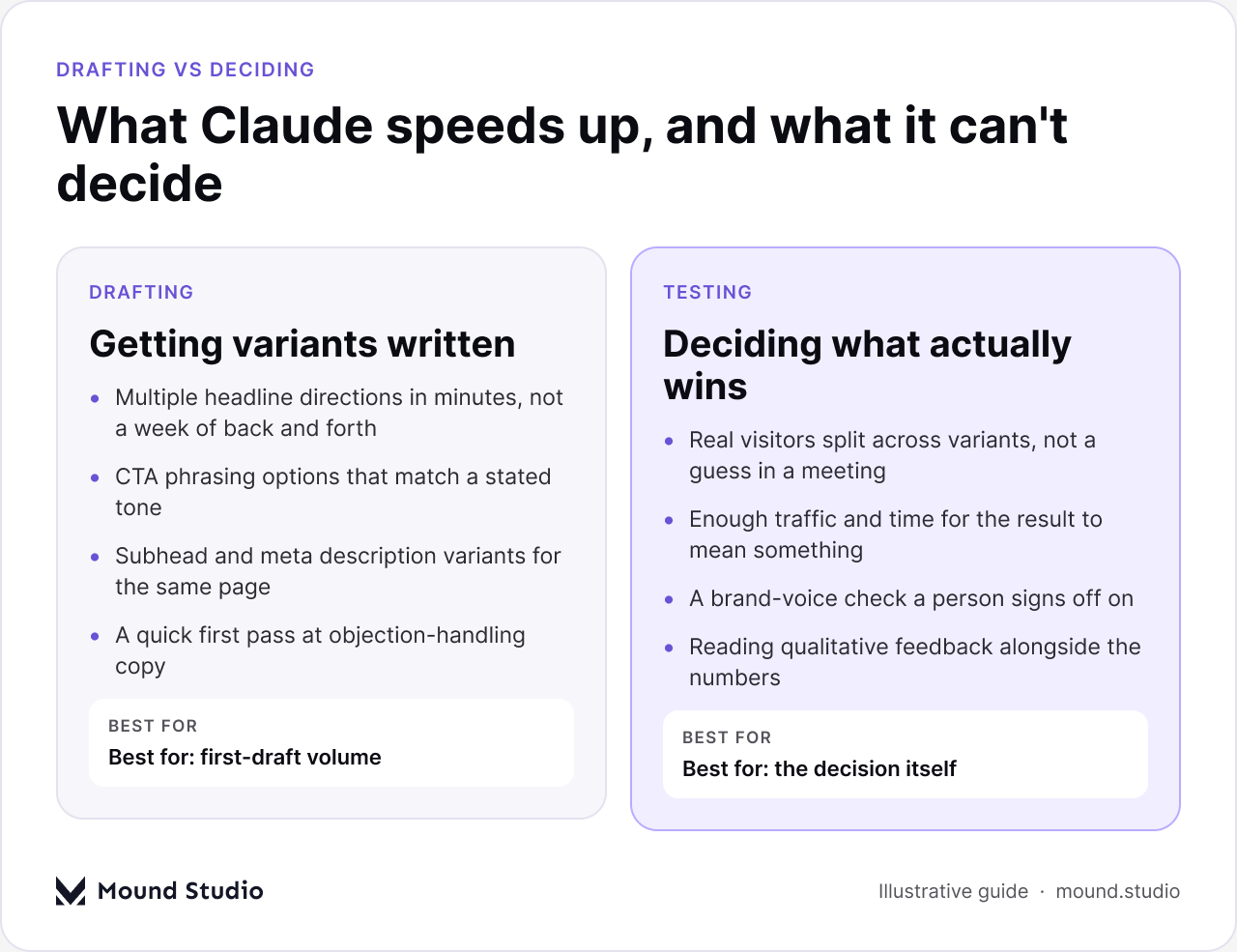
Everything on the left side of that comparison saves hours. Everything on the right side needs your actual visitors, not a model's read on what sounds persuasive. A draft that reads well in a document can still lose to a plainer version once real people are choosing between them on a real page, with real distractions and real intent. That is not a flaw in the drafting step. It is just a reminder that reading well and converting well are related but not the same thing.
This is worth remembering before a review meeting quietly becomes the decision: whichever headline the room prefers on a screen is not automatically the one that would come out ahead in front of real visitors. That is exactly why drafting and deciding need to stay separate jobs, done by different things, on purpose.
Not every difference Claude can generate is worth a dedicated test. Some changes are large enough that they might shift how a page reads. Others are so close to the original that visitors will never notice, and a test built around them just burns traffic and time.
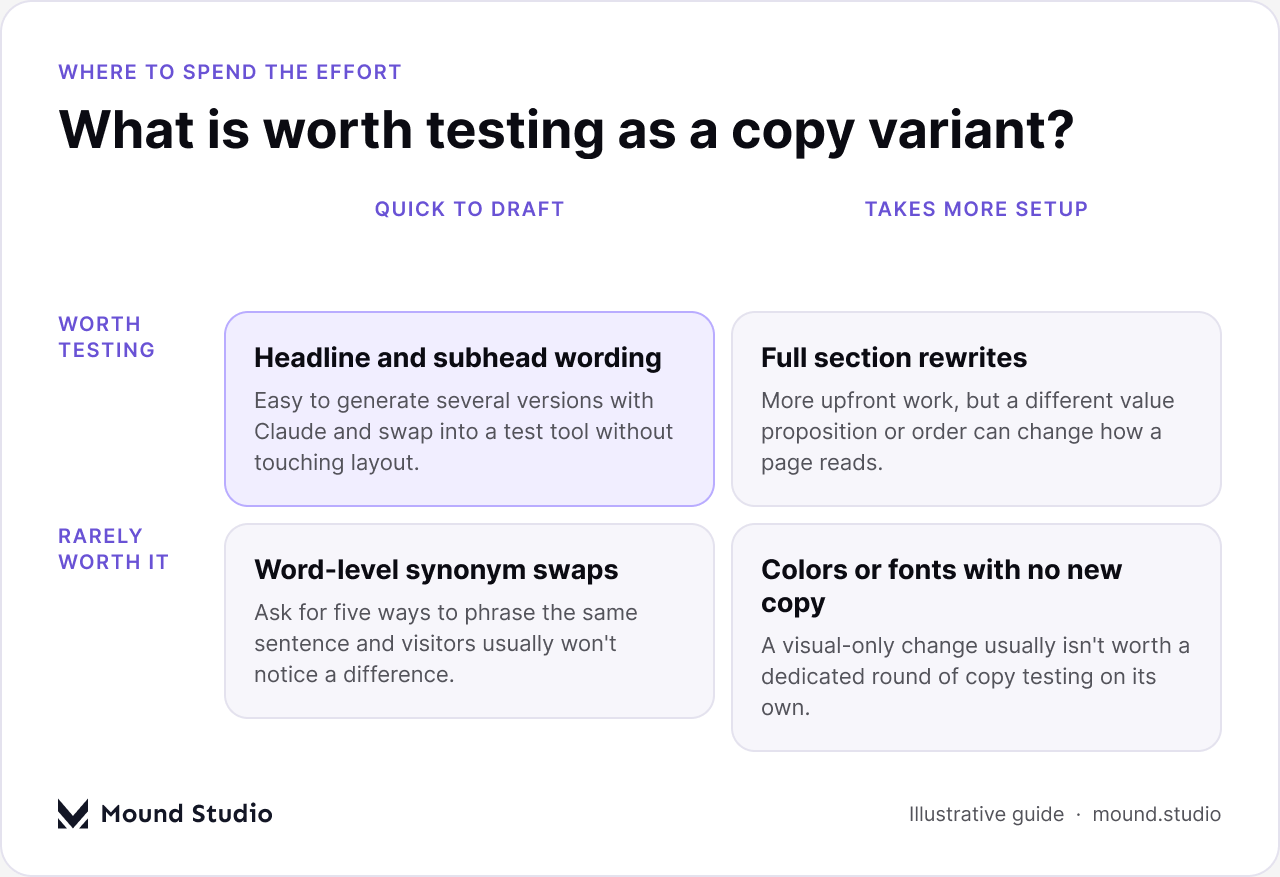
Headline and subhead wording sits in the sweet spot: quick to draft several versions of, and different enough that a test can tell them apart. Full section rewrites can matter too, though they take more setup since layout and supporting copy often need to move with them. Word-level synonym swaps are usually a waste of a test slot. If the two versions of a sentence mean the same thing and read almost identically, treat that as a copy-editing decision, not a testing decision.
For the wording choices themselves, things like button labels, form field hints, and error messages, our guide on using Claude for UX writing and microcopy goes deeper into that layer specifically.
More than one, and usually more than two, but there is a point of diminishing return. Asking Claude for four to six distinct directions per element, headline, subhead, or CTA, tends to give a brand-voice reviewer enough real spread to choose from without turning the screening pass into a chore. Past that point, the extra drafts are rarely different enough to be worth reading. It is also worth asking for structurally different drafts rather than tonal variations on one idea: a version that leads with the outcome, one that leads with the process, and one that leads with a specific detail will teach you more than three ways of saying the same sentence.
Drafting good variants does not automatically produce a fair test. A few basics decide whether the result means anything.
| Step | What it covers |
|---|---|
| Pick one metric first | Decide what "better" means before the test starts, not after you see early numbers |
| Split traffic evenly | Give each variant a fair, random share of visitors, not a convenience split |
| Run a full cycle | Let the test run long enough to cover normal swings in traffic and day of week |
| Read qualitative signals too | Session recordings and support messages catch things the topline numbers miss |
If your site already runs on Webflow, this fits alongside the rest of an AI-assisted Webflow workflow rather than replacing any part of it. The CMS and the test tool still do their jobs. Claude just means you walk into that stage with more than one option worth trying.
Sample size is the part teams most often skip over. A test that ends after a small handful of visitors have seen each version is not really a test, it is a coin flip with extra steps. If your page does not get much traffic, it is often more useful to run the test longer than to call it early just because one version is briefly ahead. A section on a high-traffic page can reach a trustworthy read much faster than a section buried three clicks deep, and that difference should shape how long you plan to leave a test running before anyone acts on it.
Most of these are not really mistakes about the AI part at all. They are the same testing mistakes teams have always made, just happening faster now because drafting is faster.
Claude is a fast way to get more than one good option on the table. It is not a way to skip the parts of testing that actually protect your brand and your conversion numbers: the human read for voice, the real traffic, and someone willing to sit with the results instead of picking whichever draft sounds best out loud. Used that way, it turns "we only had time to write one version" into a habit your site can keep, page after page, without adding much time to the schedule.
None of this requires new tools beyond what most teams already have: a CMS or test tool that can serve more than one version of a section, and someone on the team willing to own the brand-voice read before anything goes live. The drafting speed is the easy part to add. The discipline around screening and testing is the part that decides whether it actually helps.
Want help building that habit into your own pages? Tell us what you are testing next and we will help you get more than one option in front of real visitors.
No. Claude can draft several distinct options quickly, but only a real test with actual visitors can show which one performs better on your site.
Enough to give you real spread, usually four to six per element, then narrow to two or three after a brand-voice check before anything goes into a test.
Yes. Claude replaces the writing step, not the testing step. You still need a tool or CMS feature that splits traffic and reports results.
Skipping the human brand-voice check and calling a test before enough visitors have seen each version.
Usually not. Word-level synonym swaps rarely produce a difference visitors notice, save testing effort for headline, subhead, or CTA-level changes instead.