









SEO & AEO
AEO vs SEO: What Is the Difference and Why It Matters
GEO is the practice of structuring and writing website content so that generative AI tools like ChatGPT, Google AI Overviews, Perplexity, and Claude can read it accurately, trust it, and cite it in the answers they give people. It sits alongside SEO and AEO as a third label teams started using through 2026, and it covers a broader job: not just one answer box, but how an entire site gets parsed, understood, and quoted across every AI surface a visitor might use.
None of this is really new work. Clear writing, credible sourcing, and a sensible page structure have always mattered. What changed is the audience. A growing share of readers now meet a brand's content secondhand, through a chatbot's summary, before they ever land on the actual page. GEO is the name for making sure that summary is accurate and that your site gets named as the source.
GEO is best understood as an umbrella term rather than a single technique. It does not replace SEO's technical foundations, such as fast pages, clean site structure, and healthy crawlability, and it does not replace AEO's focus on winning individual answer boxes. It sits above both, describing the wider goal of being the source a generative engine reaches for, however that engine chooses to package the answer. Web teams that treat it as one more separate checklist to bolt on tend to burn effort chasing terminology. Teams that treat it as a lens on work they are already doing, writing clearly, structuring pages sensibly, and citing real sources, tend to make faster, calmer progress.
SEO optimizes a page to rank in a list of search results. GEO optimizes a site so a generative engine can extract, understand, and repeat its content correctly, whether or not the reader ever clicks through. The goal moves from "appear high on the results page" to "get quoted accurately inside the answer itself."
The two are not in competition. A page that ranks well in classic search is usually already halfway to being GEO-ready, because both disciplines reward clear structure, real expertise, and content that actually answers the question in the title. What SEO does not require, and GEO does, is writing so that a fact can be lifted out of context and still make sense on its own.
Picture two versions of the same pricing page. The SEO-only version is written to rank: a keyword-rich title, internal links, a paragraph of introductory copy before the useful information ever appears. The GEO-ready version keeps all of that, but moves the direct answer, what the service actually costs and what changes the number, into the first two sentences after the heading, then backs it up with a short table. A search engine can rank either version. A generative engine trying to summarize the page in one line has a much easier time with the second, because the fact it needs is not buried under three paragraphs of setup.
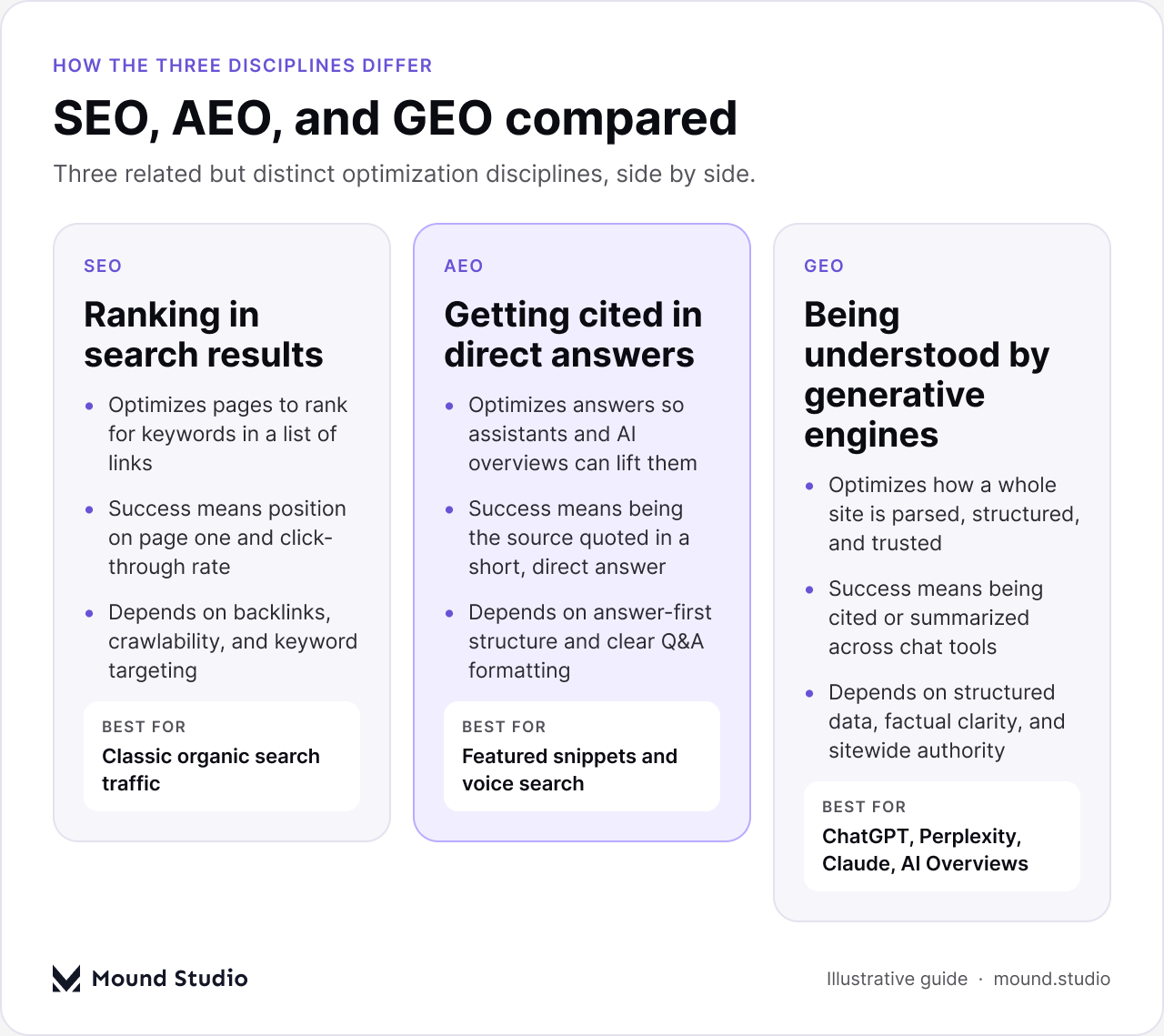
AEO (answer engine optimization) is about winning one specific answer, usually a featured snippet, a voice search result, or a short AI Overview box, by structuring a page around a single question and a direct response. GEO is the wider discipline sitting above it: it treats every page on a site as a potential source a generative engine might draw from, not just the ones written as explicit Q&A pairs.
We have covered the AEO side of this in more detail in our guide to AEO vs SEO. The short version for this article: if AEO is about winning a specific answer slot, GEO is about making an entire site trustworthy and legible enough that a generative engine reaches for it whenever a relevant question comes up, not only on the pages built for that purpose.
| Aspect | AEO | GEO |
|---|---|---|
| Primary target | One answer box, snippet, or voice result | How the whole site is read and cited across AI tools |
| Content shape | Direct question and answer pairs | Clear, well-sourced writing throughout every page |
| Typical fix | Rewrite a section as a tight Q&A | Add structure, sourcing, and structured data sitewide |
| Where it shows up | Featured snippets, voice assistants | ChatGPT, Perplexity, Claude, AI Overviews |
Before any writing or structuring work matters, a generative engine has to be able to fetch the page at all. This is a step teams skip because it happens outside the CMS, in the site's technical configuration.
Most AI providers crawl the web with named bots, such as GPTBot, ClaudeBot, PerplexityBot, and Google-Extended, and a site's robots.txt file can allow or block each one individually. A site that blocks every AI crawler by default, sometimes left over from an old security setting, cannot be cited no matter how well the content is written. Checking which bots are allowed is a five-minute task worth doing before anything else on this list. Some teams also publish an llms.txt file, a plain-text summary of a site's key pages aimed at AI systems rather than search engines. It is an emerging convention rather than a settled standard, so treat it as a helpful extra, not a requirement to chase before the fundamentals are in place.
A generative engine has to decide, in seconds, whether a passage is clear enough and trustworthy enough to repeat. Five practical things tip that decision in your favor, and none of them require rewriting your whole site from scratch.
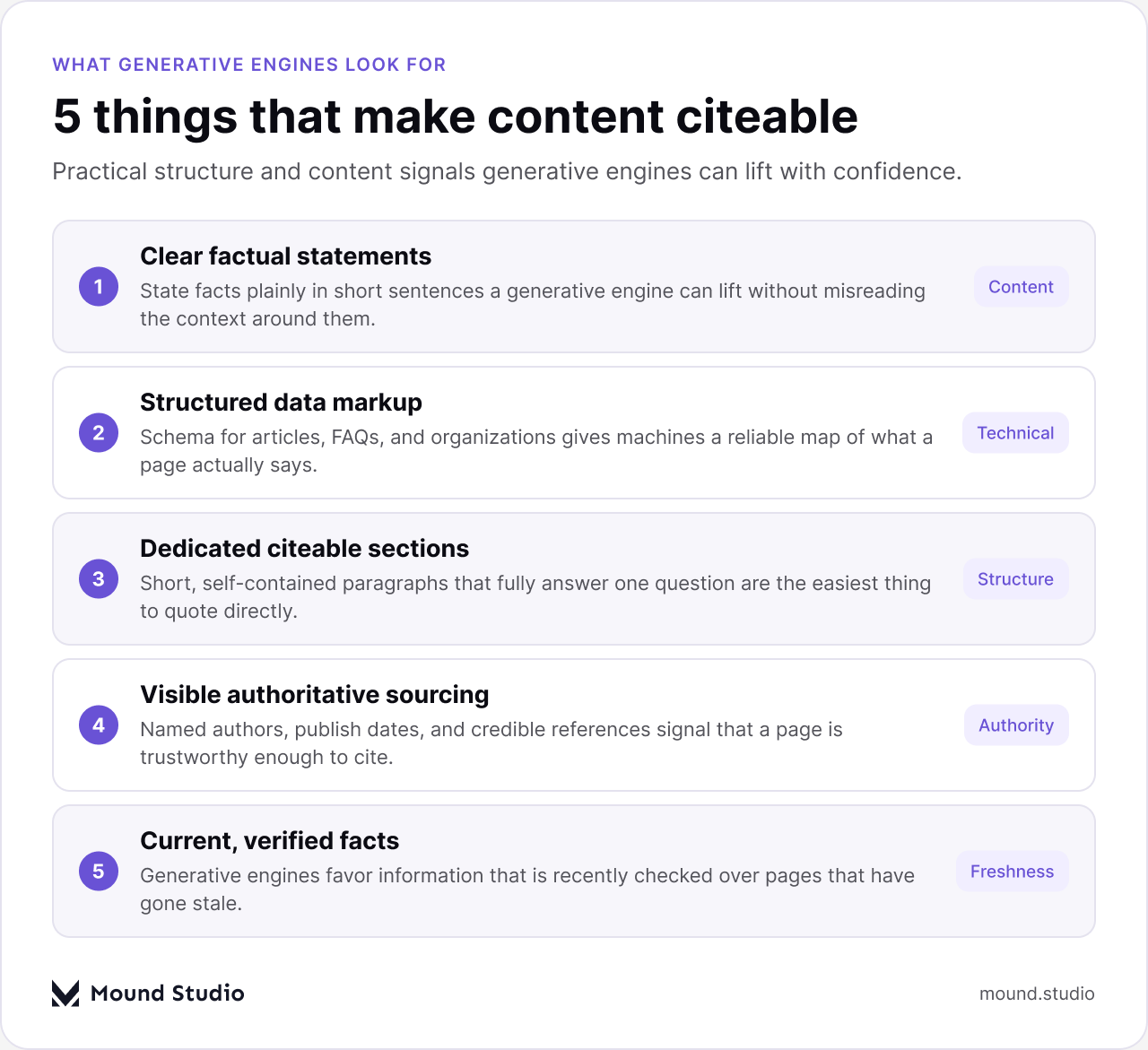
Start with the sentence itself. A fact stated plainly, in a short sentence, survives being lifted out of its paragraph. A fact buried inside a long, clause-heavy sentence often does not, because the engine has to guess at what it means once the surrounding context is gone. We go into this in more depth in our guide on writing content that ranks in AI search.
Structured data is the second lever, and it is the one teams skip most often because it is invisible to a human reader. Schema markup for articles, FAQs, and organizations gives a machine a reliable map of what a page contains, instead of forcing it to infer structure from formatting alone. Our structured data guide covers exactly what to add first.
The other three signals are about trust: showing who wrote a page, when it was checked, and where the claims come from. A page with a named author, a visible date, and links to credible sources reads as more reliable to a generative engine than an anonymous, undated page saying the same thing, and that difference shows up directly in whether it gets cited.
The fastest way to lose momentum on GEO is to try to react to every new acronym and every new AI feature as it appears. A simpler approach is to treat GEO as four ongoing steps applied to the pages that matter most, rather than a one-time project.
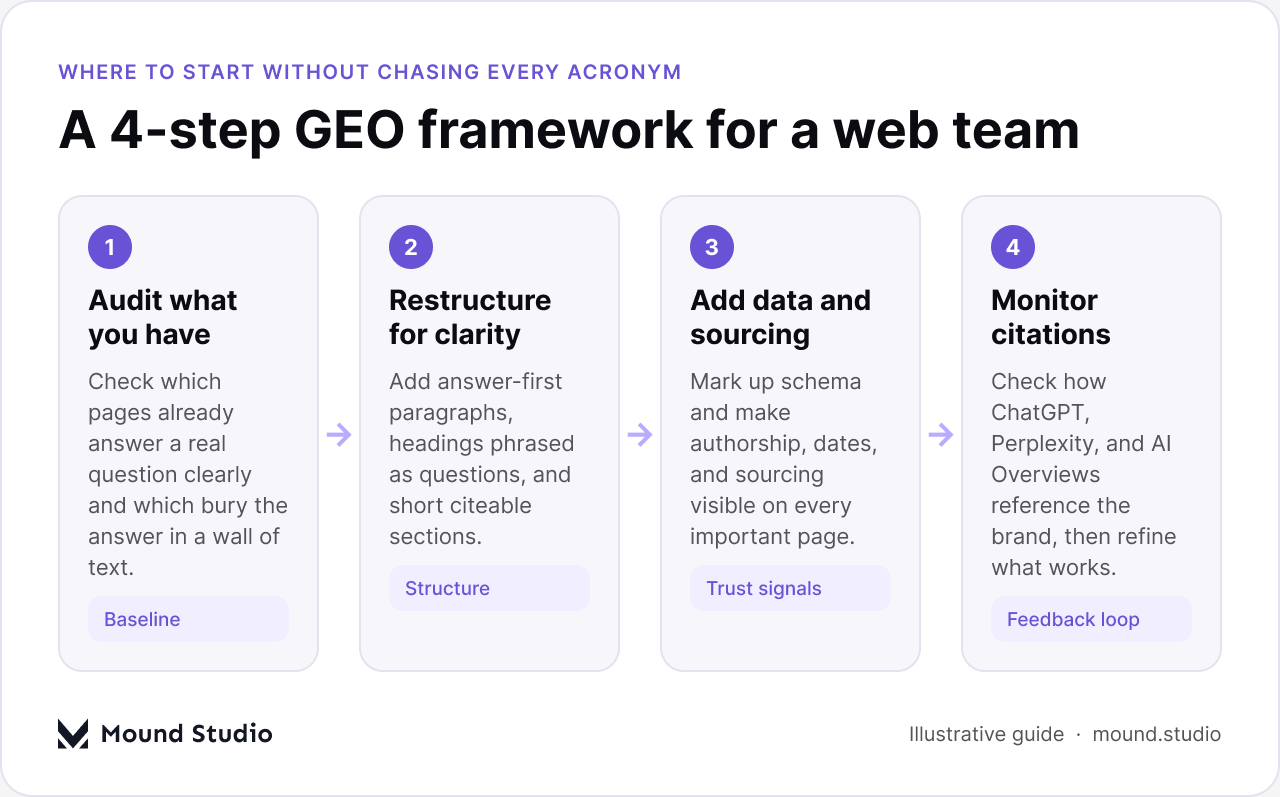
Start with an audit. Pull your ten to twenty highest-value pages and read each one as if you were a generative engine trying to summarize it in one sentence. Pages that already answer their own headline clearly need less work. Pages that bury the point three paragraphs down are the ones to prioritize.
Restructure before you add anything new. Most of the gain comes from reordering and clarifying what already exists: moving the direct answer to the top of a section, turning vague headings into the actual questions readers ask, and breaking long paragraphs into shorter, self-contained ones.
Add the supporting signals. Once the writing is clear, layer in structured data, visible authorship, and links to sources that back up any claim a reader (or an AI tool) might want to verify.
Then monitor and refine. Periodically ask the major AI tools questions your business should be the answer to, and see whether your site gets named. Treat what you find as ordinary feedback, the same way you would read analytics, and adjust the pages that are not showing up. This step is the one teams most often skip, because unlike a rankings dashboard, checking AI answers still takes manual spot-checking rather than an automated report. Even a short monthly pass across a handful of core questions is enough to catch drift early.
None of these four steps requires new tooling or a large budget on their own. What they need is a fixed place on a web team's regular schedule, the same way accessibility or performance checks earn a recurring slot, rather than a one-off sprint that never gets revisited.
Use this as a working checklist the next time a web team sits down to review a page for GEO. It is meant to be gone through page by page, not treated as a one-time site-wide project. Start with the pages that already bring in the most traffic or inquiries, since those are the ones worth the first pass of attention.
| Area | What to check | Priority |
|---|---|---|
| Answer placement | Does the first paragraph after the heading answer the question directly? | High |
| Heading phrasing | Are H2s and H3s written the way a person would actually search or ask? | High |
| Structured data | Is schema present for the article, FAQs, and the organization? | High |
| Sourcing | Is authorship visible, and are claims backed by a credible reference? | Medium |
| Section length | Can any single section stand alone if quoted out of context? | Medium |
| Freshness | Is there a visible last-updated date, and is the content still accurate? | Medium |
Not every site needs a standalone GEO initiative this quarter. A few honest questions help decide where it sits on the priority list.
Whichever position a site is in, the work is rarely wasted. Clearer writing, visible sourcing, and sensible structure help human readers and search engines as much as they help generative engines, so there is little downside to starting even a small pass now.
GEO is not a replacement for SEO or AEO, and it is not a reason to abandon either one. It is the same discipline of clear, well-sourced, well-structured writing, extended to a new set of readers who meet your content through a chatbot before they ever meet your site. Start with the pages that matter most, fix the writing before you fix the markup, and check back on how AI tools represent your brand the way you would check any other channel.
Want a web team to run a GEO audit on your site and tell you plainly what to fix first? Get in touch with Mound Studio.
GEO stands for generative engine optimization: structuring and writing content so tools like ChatGPT, Google AI Overviews, Perplexity, and Claude can read it accurately and cite it.
No. GEO builds on the same technical and content fundamentals SEO already relies on. It adds a focus on being cited accurately by generative AI tools, on top of ranking well in classic search.
AEO focuses on winning one specific answer, snippet, or voice result. GEO is the broader goal of making an entire site trustworthy and legible enough that a generative engine reaches for it across any relevant question, not only pages built as direct Q&A.
Structured data helps, but it works best after the underlying content is already clear. Schema describes what is on a page; it cannot make a vague answer clear on its own.
Ask the major AI tools questions your business should be the answer to and check whether your site gets named. Treat it as an ongoing spot-check, similar to reviewing analytics, rather than a one-time test.