







Agency
How to Choose a Web Design Agency in 2026: 12 Questions to Ask
Build an in-house design team when your product needs constant, day-to-day design attention and someone embedded in the daily decisions of your product team. Work with an agency when the work is project-based, needs a wider range of specialist skills than one or two hires can realistically cover, or you don't have the time right now to recruit, onboard, and manage a design function. Most growing companies eventually land somewhere in between, using an agency to cover gaps around a small in-house core. The right call has less to do with company size and more to do with how steady the workload is and how wide the skill set needs to be.
This guide walks through what actually changes between the two models: cost structure, speed to start, the range of skills you get access to, and how easily each one scales up or down. Then it covers the mistakes teams make when they pick the wrong model, and a checklist you can run before you commit.
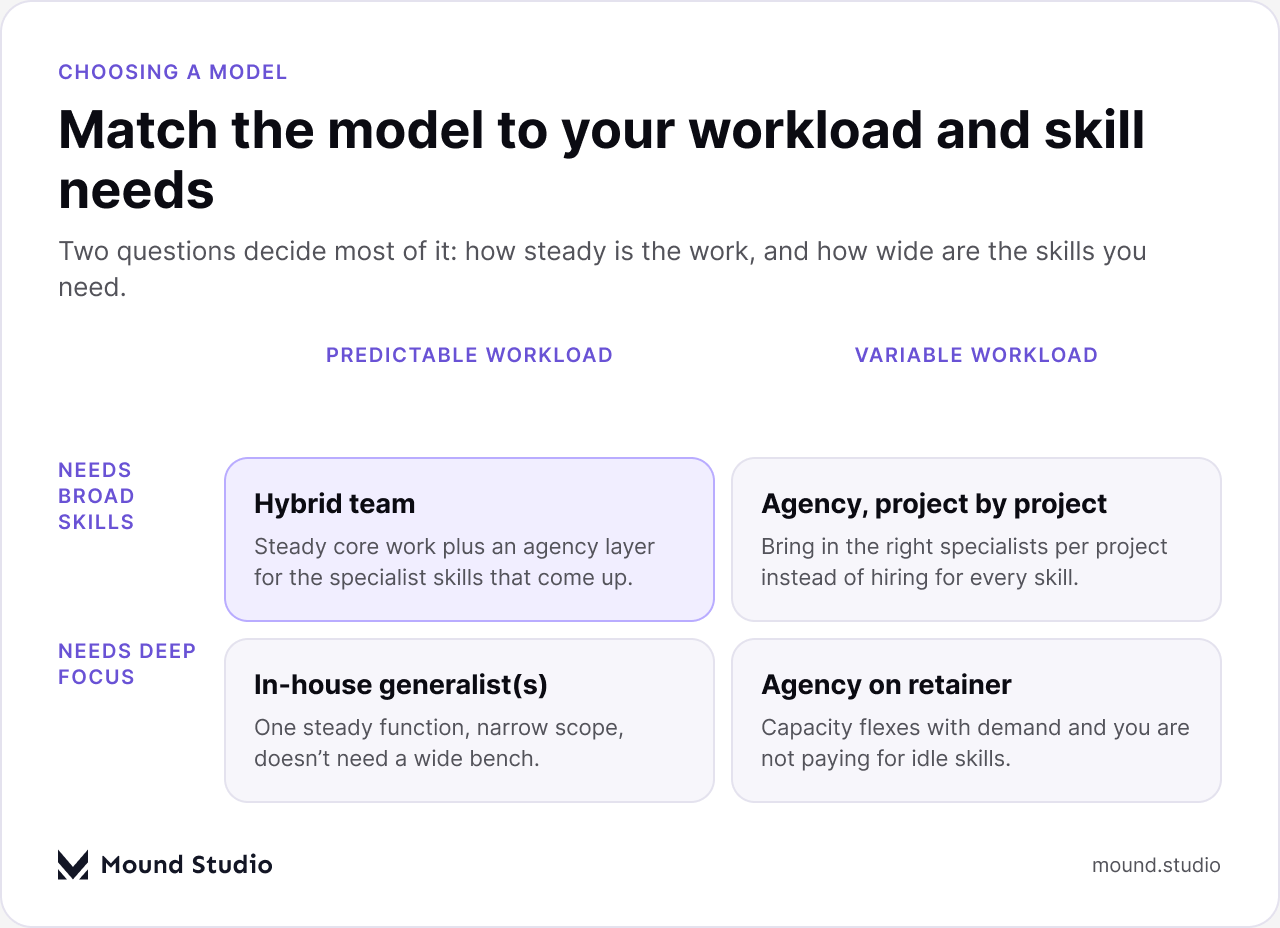
If your design work never really stops, and it needs to stay close to engineering and product decisions every day, hire in-house. If your design work comes in defined pieces, needs a mix of skills you don't have today, or has to start faster than a hiring process allows, work with an agency. If you have a small in-house team that's stretched thin or missing one or two specialisms, add an agency around it rather than choosing one model exclusively. The decision rarely comes down to which model is "better" in the abstract; it comes down to matching the model to how your work actually shows up week to week.
The two models spend money in different shapes, not just different amounts. Comparing them on a single number misses what's actually being paid for.
An in-house hire comes with a fixed salary, benefits, software licenses, and equipment, all of which continue whether design work is heavy that month or light. On top of that sits management overhead: someone has to set direction, review work, and handle the parts of running a team that have nothing to do with design itself, like performance conversations and career growth. None of that shows up on a job posting, but it's real cost and real time. The upside is that this cost buys full-time availability and a person who is always around, not billed by the task.
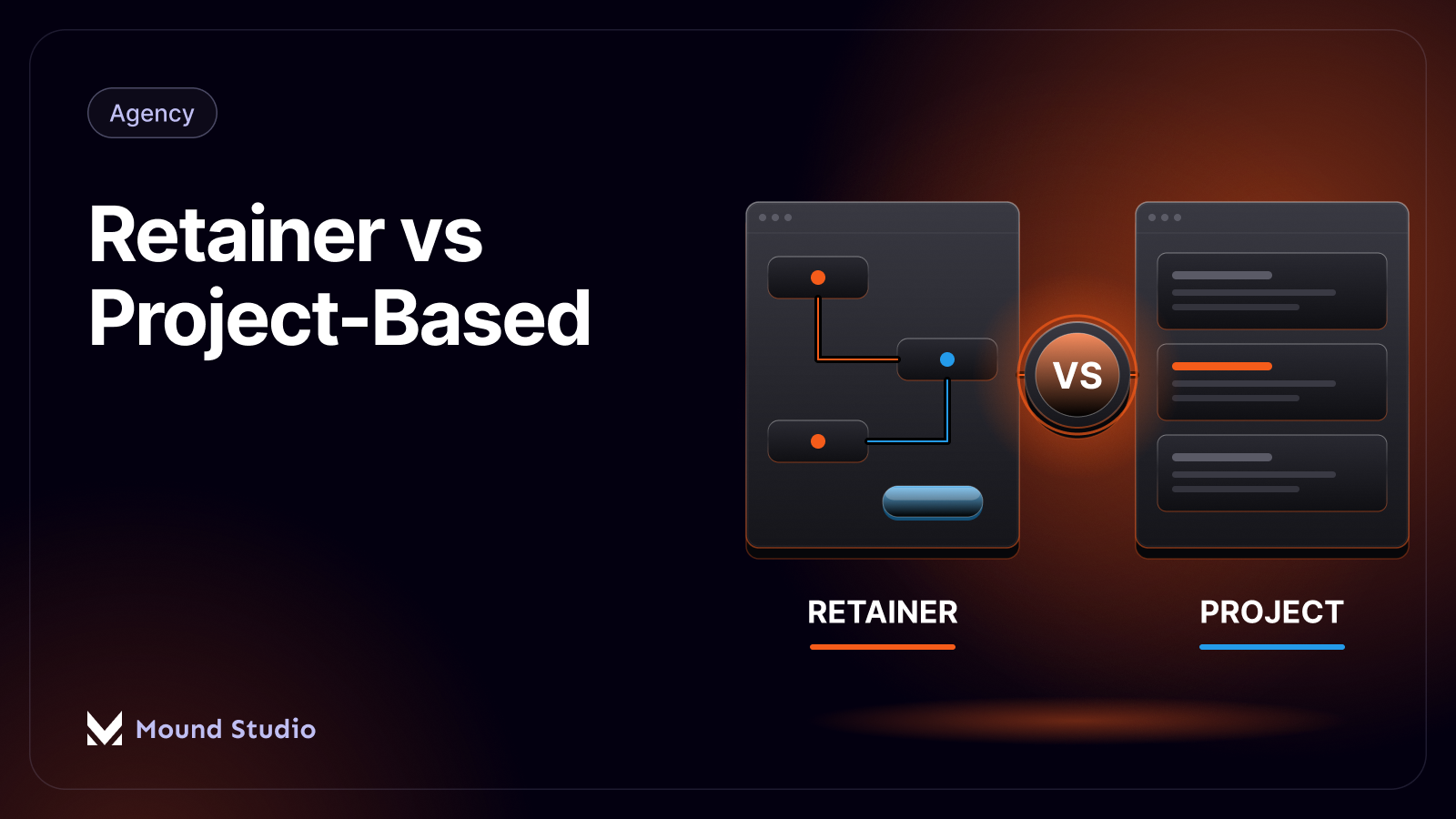
An agency is usually paid through a retainer or a project fee tied to scope, not headcount. You're paying for output and access to a team, and the studio absorbs the hiring, training, and management overhead on its own side. This tends to make agency costs feel more variable: a quiet month can mean lower spend, and a heavy month can mean a higher one, depending on how the engagement is structured. Our guide on what actually drives design agency cost breaks this down further if you're trying to size an engagement. Understanding the difference between paying for capacity and paying for a deliverable also matters here, which is exactly what we cover in retainer vs project-based agency pricing.
Neither structure is inherently cheaper. A busy in-house hire working at capacity every week can be very efficient. An idle in-house hire during a slow quarter is not. An agency retainer you're not fully using is the same problem from the other direction. The clearest way to compare the two is to look at your actual weekly workload over the last few months, not the workload you expect to have someday, and check which structure that workload would pay for more sensibly.
| Factor | In-House | Agency |
|---|---|---|
| Hiring cost | Recruiting time, salary, benefits, equipment | No hiring process; cost is the retainer or project fee |
| Ramp-up time | Weeks to hire, then onboarding to your product | Days to start once scope is agreed |
| Skill range | Limited to who you hired | Broad, spread across a team of specialists |
| Management overhead | Direction, reviews, career growth, tooling | Handled by the agency; you manage the brief, not the people |
Hiring in-house takes time even when it goes well. Writing the role, sourcing candidates, interviewing, and then giving a new hire a few weeks to understand your product, your users, and your existing design decisions before they're fully productive is a normal, unavoidable process. It's not a failure of hiring speed; it's what it takes for one person to build enough context to work independently.
An agency starts faster because the ramp-up work is spread across a team that has already worked together, and because studios are set up to onboard a new client as a repeatable process rather than a one-off. That doesn't mean an agency needs zero context — a new engagement still needs a proper brief and access to your existing materials — but the team itself doesn't need to be assembled from scratch. If your timeline is measured in days or a couple of weeks rather than a full quarter, that difference in ramp-up time is often the deciding factor on its own.
A single in-house hire, however strong, has a personal range: strengths in some areas, gaps in others. That's true of every individual designer, not a knock on any one person. A small in-house team of two or three has a slightly wider range, but it's still bounded by who happens to be on the roster.
An agency gives you access to a team with different specialisms, research, UX, UI, brand, sometimes front-end implementation, without needing to hire for each one. That range is most valuable when a project really needs several different kinds of expertise at once, like a product launch that needs research, interface design, and a marketing site built around it in the same window. It's less valuable if your actual, ongoing need is narrow and steady, in which case paying for breadth you don't use is just overhead.
Scaling an in-house team up means starting a new hiring process, which takes weeks at minimum and commits you to an ongoing cost even if the extra work turns out to be temporary. Scaling it down is harder still, and involves real decisions about people, not just budget lines.
An agency is built to flex. A retainer can usually be adjusted as scope changes, and a project-based engagement naturally ends when the project does. That flexibility is one of the clearest advantages of working with a studio during a period where your needs are still unsettled, like an early-stage product that might pivot, or a business testing whether a new line is worth investing in permanently. It also means you can trial a heavier level of design investment for a single quarter without committing to it as a permanent cost, which is a useful way to test demand before hiring.
If you're weighing an agency for the first time, it's worth reading through the questions to ask a design agency before you sign anything, so you know what a good engagement actually looks like from the outset.
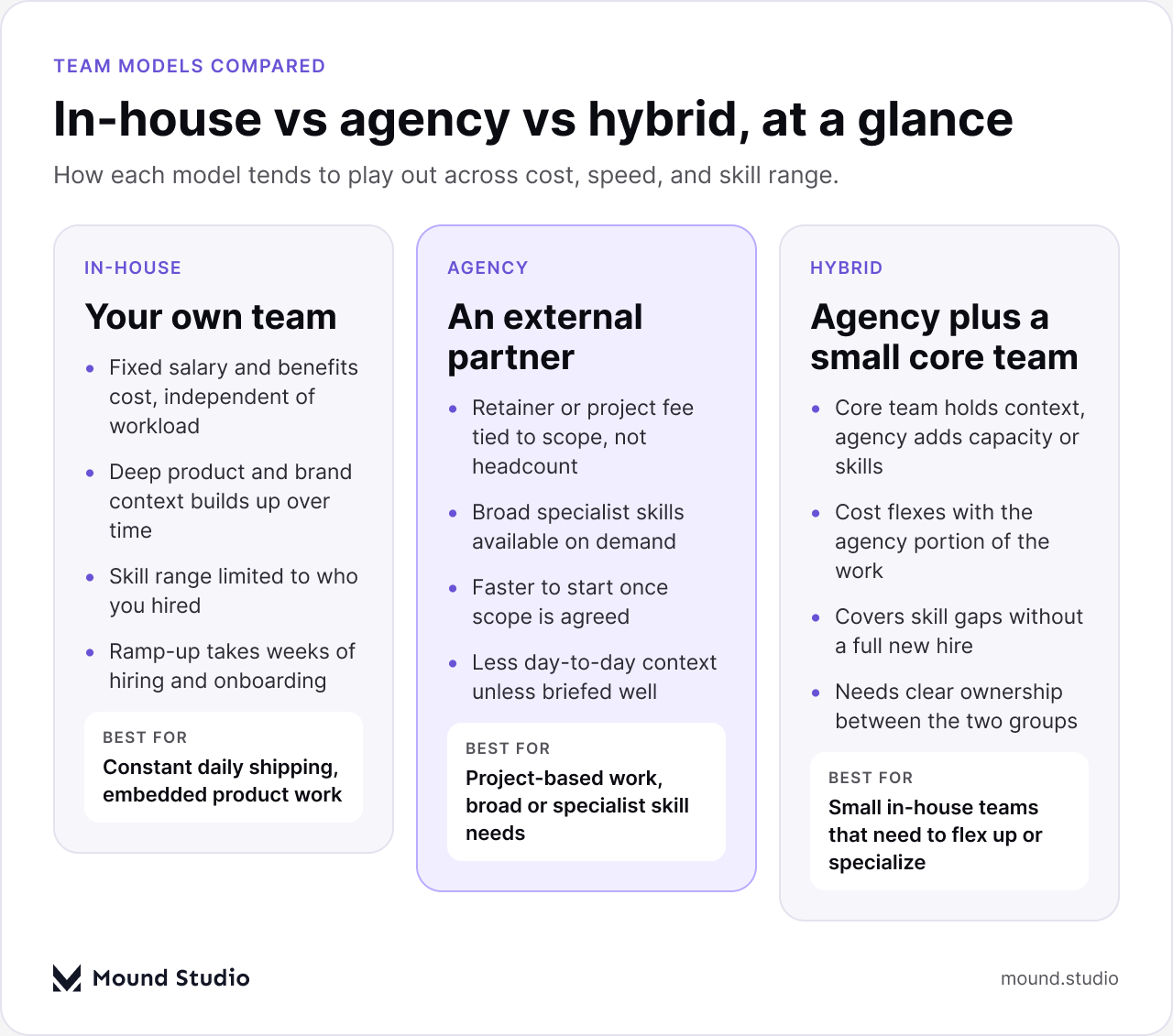
The model that fits the largest number of growing companies isn't purely one or the other. A small in-house team holds the context, owns the product relationship, and handles the steady, everyday work. An agency sits around that core, brought in for a specific specialism the in-house team doesn't have, for a project that needs more hands than the core team can spare, or for a short burst of work tied to a launch or a deadline.
This works well because it separates two different jobs that often get bundled into one hire: holding product context over time, and having deep expertise in every skill a project might need. Very few individual designers do both well. A hybrid setup lets the in-house side own continuity while the agency side brings depth on demand, without either side having to stretch beyond what they're actually good at. The practical part to get right is ownership: decide upfront who signs off on decisions, who briefs the agency, and how the two sides hand work back and forth, so the arrangement doesn't quietly turn into two teams working from different versions of the same brief.
Two mistakes come up again and again when teams choose between these models.
Hiring one generalist and expecting agency-level output. A single in-house designer, no matter how capable, cannot cover research, UX, UI, brand, and front-end polish at the same depth a full team can. This isn't a hiring mistake so much as a scope mistake: the expectation was set for a team's worth of output from one person. If the actual need spans several specialisms at once, either hire more than one person or bring in an agency for the parts that don't fit.
Hiring an agency for work that actually needs a daily embedded presence. Some work really needs someone sitting in your team's daily standups, reacting to product changes in real time, and building the kind of product intuition that only comes from being inside the team every day. Bringing in an agency for that kind of role usually leads to friction: the agency is structured for defined engagements, not for functioning as a de facto employee, and the relationship strains under expectations it wasn't built for. Both mistakes usually trace back to the same root cause: choosing a team model based on budget alone, without first writing down what the work actually looks like week to week.

Run through these questions before you commit to a structure. Most teams find the answer becomes clear after two or three of them.
| Criterion | Typically fits better |
|---|---|
| Constant, weekly design work with no end date | In-house |
| Project-based work with a defined scope and end date | Agency |
| Need for several specialist skills at once | Agency |
| Need for one steady, narrow skill over time | In-house |
| Tight timeline, need to start within days | Agency |
| Budget works better as a fixed, predictable salary | In-house |
| Budget needs to flex with scope month to month | Agency |
| Small in-house team missing one or two specialisms | Hybrid |
Before you decide, take a clear-eyed look at your workload pattern: is it actually constant, or does it just feel that way because there's a backlog right now? Then assess your budget structure, your real timeline, and if you're still unsure, run a pilot. A single project with an agency, or a short contract for an in-house role, tells you more about what you actually need than any amount of planning on paper.
There's no universally right answer between in-house and agency design, only a right answer for your current workload, budget structure, and timeline. Steady, embedded, daily work points toward in-house. Project-based work, broad specialist needs, or a timeline that can't wait for a hiring process points toward an agency. A small in-house team with an agency layered around it covers most of what growing companies actually need. If you're still working through which model fits your team, tell us what you're building and we'll help you think it through.
Not automatically. In-house costs are fixed (salary, benefits, tools, management overhead) whether workload is heavy or light, while agency costs are usually tied to scope through a retainer or project fee. Which one is cheaper depends on how steady and how large your actual weekly workload is, not on the model alone.
An agency can typically start within days of agreeing scope, since the team is already assembled and used to onboarding new clients. Hiring in-house takes weeks at minimum for recruiting, plus more time for a new hire to build enough product context to work independently.
Choose in-house once design work is constant, week after week, and needs to sit inside daily product and engineering decisions rather than being reviewed after the fact. Before that point, an agency or a hybrid setup usually fits better.
Yes, this is a common hybrid model. A small in-house team holds product context and handles steady work, while an agency is brought in for specialist skills, overflow capacity, or a specific project. It works best when ownership and handoffs between the two sides are agreed upfront.
The two most common mistakes are hiring one generalist and expecting a full agency's range of output, and hiring an agency for a role that actually needs someone embedded in daily standups. Both usually come from picking a model on budget alone instead of matching it to the actual shape of the work.