








SEO & AEO
How to Optimize Your Website for AI Search in 2026 (AEO Guide)
Local SEO is the work of making a business show up when people nearby search for the service it offers. For a service business, a plumber, a clinic, a law firm, a cleaning company, that mainly means Google's map pack and the local organic results underneath it, not just the classic ten blue links. The goal is simple: when someone searches "emergency plumber near me" or "family dentist in [city]," the business should show up with the right name, address, phone number, hours, and reviews attached.
Local SEO overlaps with regular SEO, but it has its own set of signals. On-page content and site speed still matter, and our Webflow SEO checklist covers the technical basics that apply to any site. Local SEO adds a layer on top: a verified Google Business Profile, consistent business information across the web, reviews, and content built around the specific places a business serves. A national ecommerce brand and a plumber operating in three towns are optimizing for different things, and treating them the same way is one of the more common mistakes we see.
Most people research a local service on their phone, right before they need it. They search, look at the map results, skim a few reviews, and call or book. A service business that is missing, incomplete, or inconsistent in that moment loses the job to a competitor who set their listing up properly, even if the missing business does better work. Local SEO is not about outranking every competitor nationwide. It is about being complete, accurate, and trustworthy in the handful of searches that actually lead to a call, a quote request, or a booking.
The map pack, the block of three local results with a map that appears above the regular listings, gets a large share of the clicks on a "near me" style search, because it answers the question fastest: who does this, where are they, and are they open now. A business that never appears there is invisible for the exact searches most likely to turn into paying work, no matter how good its regular organic rankings look for broader terms.
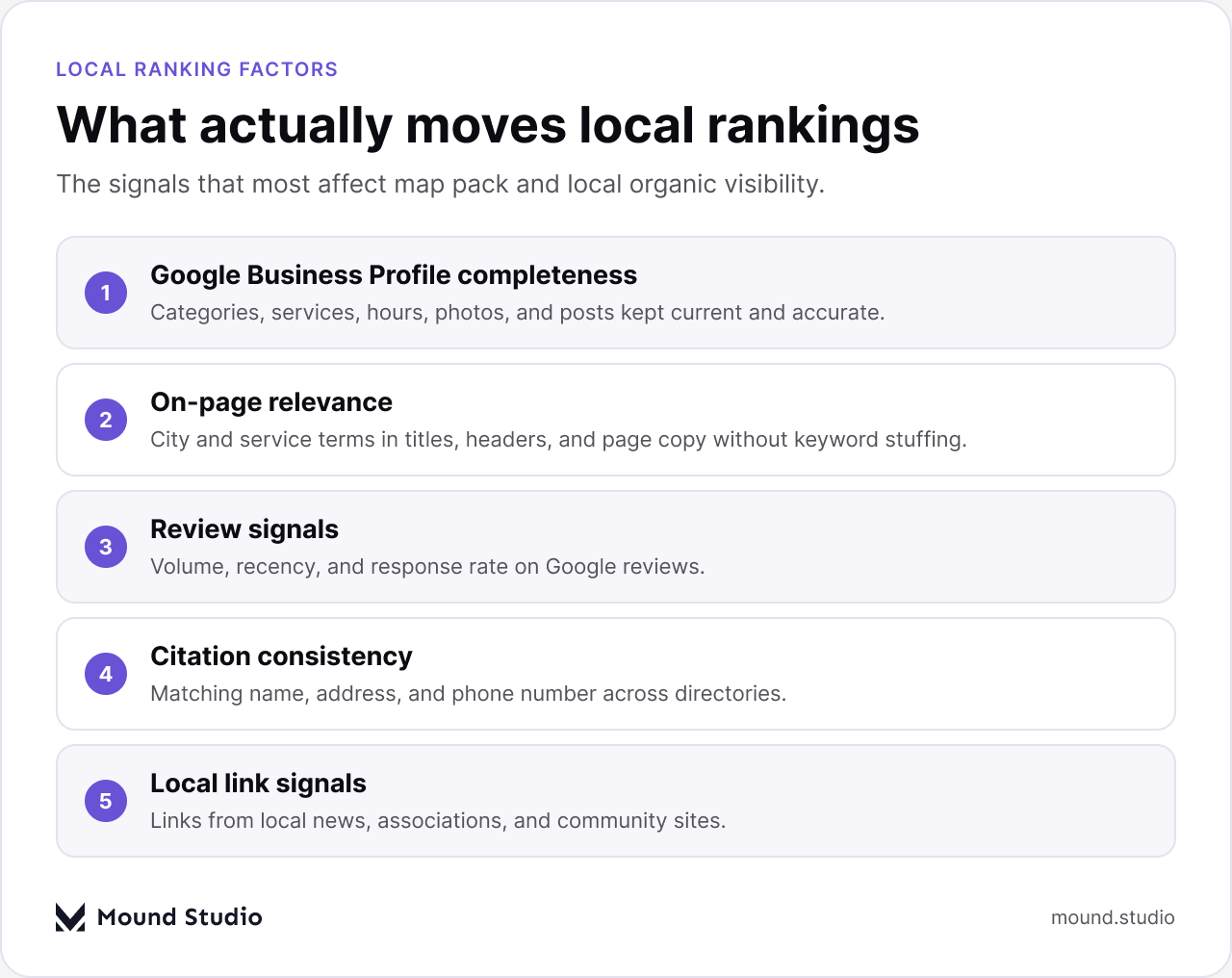
Google does not publish an exact formula, but agencies that work on local listings every week see the same signals show up again and again: a complete and active Google Business Profile, on-page content that matches what people search for, the volume and quality of reviews, how consistent the business's name, address, and phone number are across the web, and links from other local or relevant sites. None of these work on their own. A business with a strong profile but no reviews will still struggle, and a business with great reviews but a stale profile will lose ground too.
Proximity also plays a role that a business cannot fully control: someone searching a few streets away from a location will often see different results than someone searching from across town. That is exactly why the controllable factors, profile completeness, content, reviews, and consistency, matter so much. They are what separates two businesses of similar size and distance from the searcher.
Google Business Profile is the single most important asset in local SEO, because it is what actually appears in the map pack. A profile that is claimed but left half-finished sends a weak signal, even if the website behind it is solid. Verification usually happens by postcard, phone, or email, depending on the business type, and it needs to be completed before the profile can show up reliably in search.
Once the basics are filled in, treat the profile as something to maintain rather than a form to submit once. A profile that gets fresh photos, occasional posts, and prompt review responses tends to hold its position better than one that is set up well and then left alone for a year.
| GBP field | What to fill in | Why it matters |
|---|---|---|
| Business name | Exact legal or trading name, no keywords added | Keyword-stuffed names risk suspension and confuse customers |
| Categories | One primary, a few accurate secondary categories | Categories strongly influence which searches the profile appears for |
| Service area | Cities or postcodes actually served | Keeps the profile out of searches it can't realistically fulfil |
| Photos | Recent, real photos added regularly | Profiles with fresh photos get more attention in the map pack |
A business that serves more than one town or region needs more than a single homepage to rank locally. Search engines and searchers both respond better to a page written for a specific place than to one generic page trying to cover everywhere at once. The right structure depends on how the business actually operates.
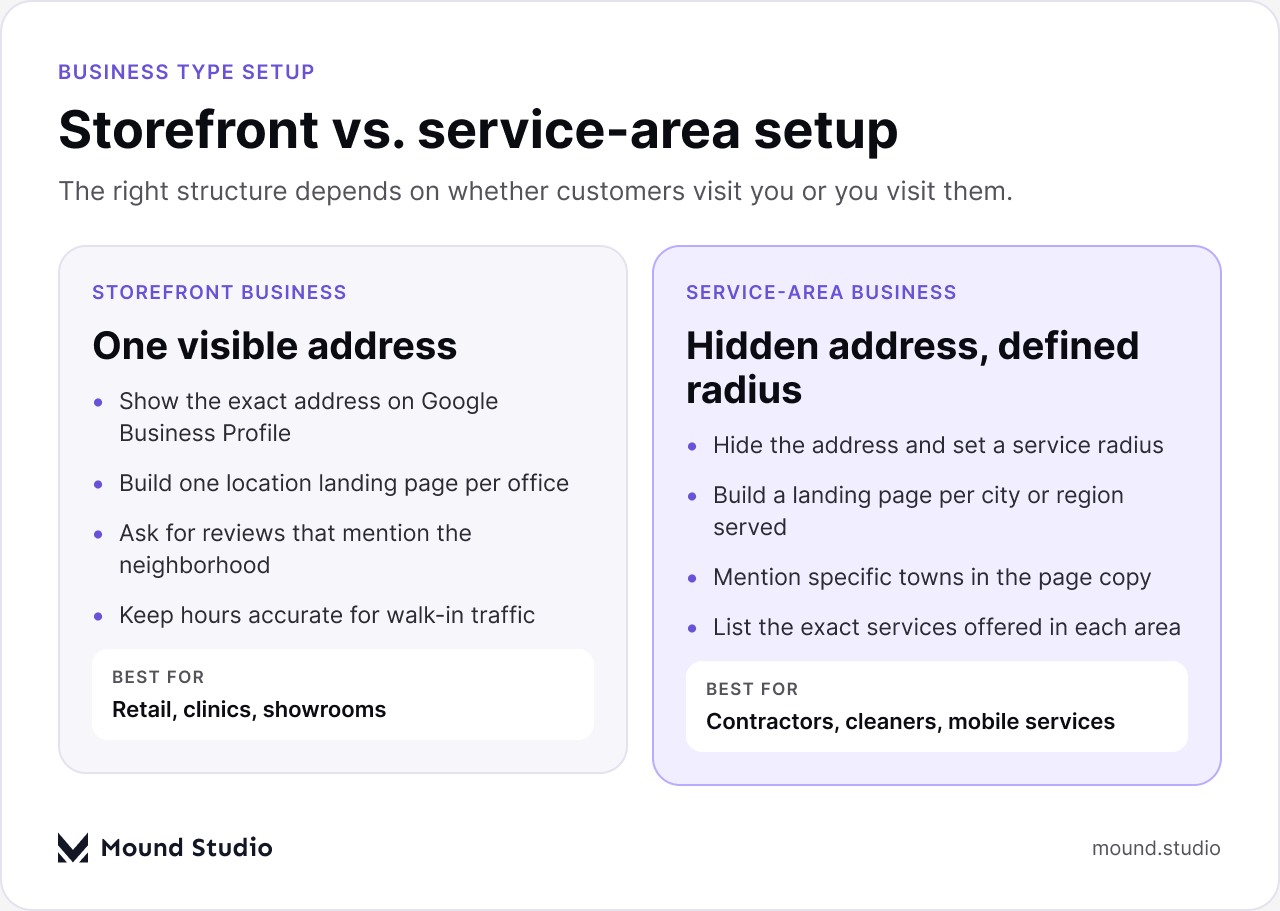
A storefront business, a clinic, a salon, a showroom, usually needs one strong location page per physical address, with the address, a map, hours, and directions clearly shown. A service-area business, a contractor, a cleaner, a mobile technician, instead needs a page for each city or region it covers, written with real local detail: the neighborhoods served, common jobs in that area, and any local considerations that matter, such as older housing stock, seasonal weather, or local permit rules. Copying the same paragraph and swapping the city name rarely works; both search engines and readers notice.
A well-built location page usually includes a short intro naming the area, a list of the specific services offered there, a testimonial or two from a customer in that area if one is available, a clear call to action, and a local phone number where the business has one. It should link back to the main services pages rather than sit as an isolated dead end, and it should be reachable from the site's main navigation or a locations menu, not buried where only a direct link finds it.
A citation is any online mention of a business's name, address, and phone number: on directories, industry associations, chambers of commerce, or review sites. NAP consistency means that information matches exactly, everywhere it appears. A business listed as "123 Oak St." on one directory and "123 Oak Street, Suite B" on another sends a small but real signal of unreliability, and at scale those mismatches add up.
The fix is not exciting, but it works: pick a single, correct version of the business name, address, and phone number, and update every directory, social profile, and industry listing to match it exactly. Prioritize the directories that matter most for the industry and location first, then work down the list.
Not every citation carries the same weight. A handful of major, general-purpose directories matter for almost any service business, and beyond those, industry-specific directories and local associations tend to help more than a long list of low-quality sites most people never visit. A roofer benefits more from a listing in a roofing association directory or the local chamber of commerce than from a dozen generic sites nobody in that area actually browses. When a business moves, changes its number, or rebrands, updating citations should be part of the checklist, not an afterthought discovered months later.
Reviews influence rankings and they influence conversions, which makes them worth real attention rather than an afterthought. Volume matters, but so does recency. A business with fifty reviews from three years ago and none since looks less active than one with twenty reviews spread over the last few months. Responding to reviews, including negative ones, shows both search engines and potential customers that the business is paying attention.
The simplest way to build review volume is to ask, consistently, right after a job is finished or a service is delivered, when the experience is still fresh. A short link or QR code sent by text or email removes friction and gets more responses than a vague request weeks later.
Google reviews carry the most weight for map pack visibility, but reviews on Facebook, Yelp, or industry-specific platforms still shape how a customer decides whether to call, and a mismatch between glowing Google reviews and a neglected profile elsewhere looks odd to anyone who checks both. When a negative review shows up, a calm, specific, professional response usually does more good than deleting or ignoring it, and it shows future customers how the business handles a problem, not just how it handles praise.
National SEO is mostly about ranking a single page for a topic against every competitor in the country. Local SEO is about ranking multiple, narrower pages against a much smaller set of nearby competitors, while also managing a Google Business Profile that behaves more like a live directory listing than a page a business fully controls. A service business rarely needs to outrank a national brand on a broad term; it needs to be the obvious, trustworthy choice for searches happening in the towns it actually serves. A smaller number of well-built, accurate local pages tends to outperform a large volume of thin, generic ones.
Most of the mistakes we see are not exotic. They are ordinary maintenance that got skipped once and was never picked back up.
Not every fix carries the same weight, and few businesses have time to do everything at once. The most useful approach starts with the items that are quick to complete and have the biggest effect on visibility, then moves on to the bigger projects. Weighing each task by how long it takes against how much it is likely to move the needle keeps the work focused instead of scattered across a dozen half-finished efforts.
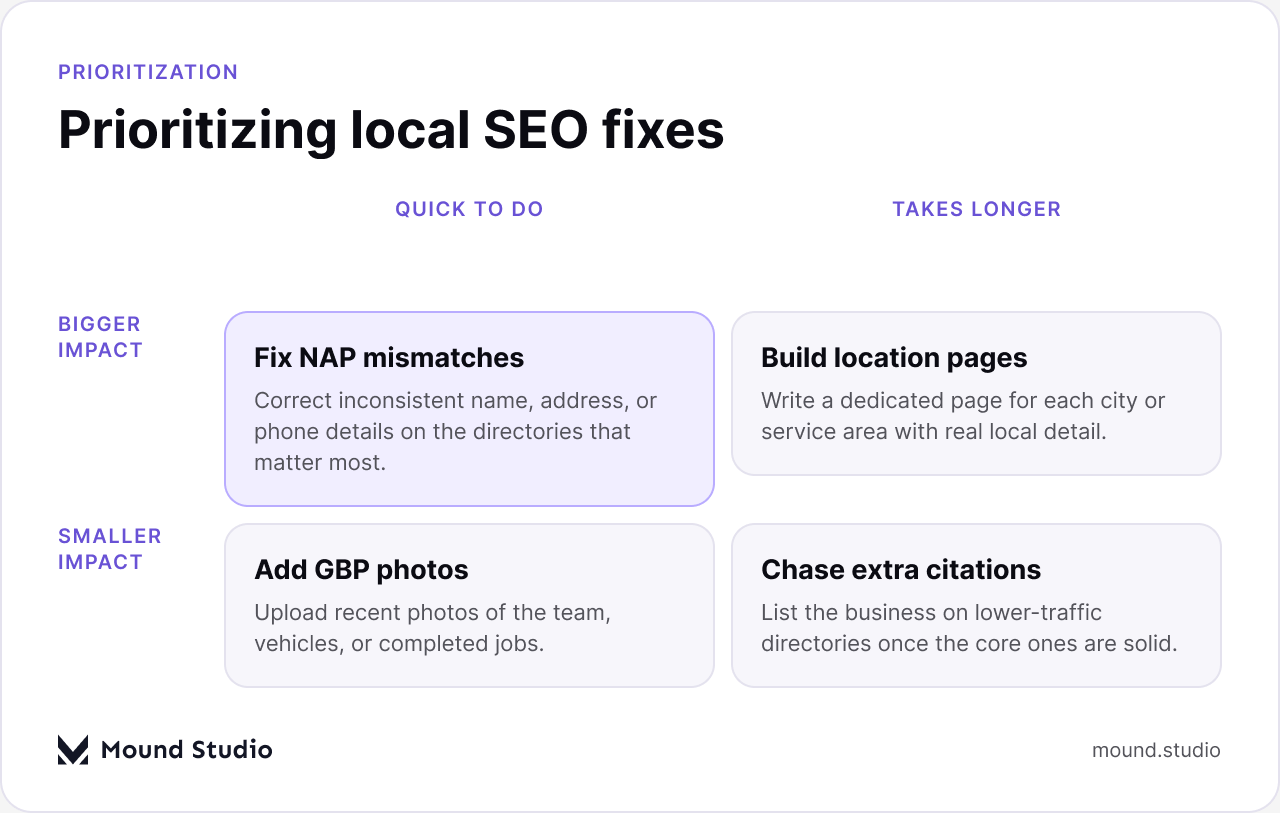
| Phase | Focus | Typical work |
|---|---|---|
| Phase 1 | Foundation | Claim and complete Google Business Profile, fix obvious NAP mismatches |
| Phase 2 | Content | Build or rewrite location pages with real local detail |
| Phase 3 | Trust | Build a steady review request process and respond to every review |
| Phase 4 | Authority | Pursue citations and links from local and industry sources |
Use this as a quick audit. Most service businesses can work through it in an afternoon and then fold the remaining items into a regular monthly routine.
Local SEO for a service business is less about chasing every ranking factor and more about being complete, consistent, and easy to trust in the exact moment someone nearby is searching. A finished Google Business Profile, real location pages, matching business details across the web, and a steady flow of reviews cover most of what actually moves the needle. For a broader look at how AI-driven search changes discovery beyond the map pack, see our guide to optimizing a website for AI search. If a local SEO setup needs a second look, get in touch and we can walk through what is missing.
Most service businesses start seeing movement in Google Business Profile visibility within a few weeks of completing their listing, while broader ranking improvements from landing pages, citations, and reviews typically build over a few months of steady work.
A dedicated page for each city or region with real, specific detail performs far better than one page trying to cover every location at once, especially for service-area businesses that operate across several towns.
Yes. A service-area business without a walk-in location should hide its address on Google Business Profile and set a defined service area instead, so customers aren't misled about visiting in person.
There's no fixed number. What matters more is a steady stream of recent reviews and a consistent response habit, rather than a large one-time batch followed by months of silence.
Local SEO focuses on ranking in map results and local search for a specific place, while AEO focuses on how AI tools and answer engines summarize and cite a business's content. The two overlap but solve different problems. Our structured data guide covers the AEO side in more depth.