








Website
Website Redesign Checklist for 2026: What to Do Before, During, and After
Answer engine optimization, or AEO, is the practice of structuring your website so that AI assistants and search features can find your content, understand it, and use it in their answers. Think ChatGPT, Perplexity, Google's AI Overviews, and similar tools.
People increasingly ask a question and read the answer without opening a single page. If your business is not part of that answer, you are invisible at the moment someone is deciding who to trust.
One caveat before we start. Nobody outside these companies knows exactly how AI systems choose their sources, and the systems keep changing. What follows is not a secret formula. It is the set of practices that consistently make content clearer, more trustworthy, and easier to quote, which also helps regular SEO.
Write pages that answer real questions directly, structure them clearly, label them with schema markup, keep your brand facts consistent everywhere, show real expertise, and make sure crawlers can read the page. Then check the result by asking AI assistants the questions your customers ask. It is clear writing plus clean structure, not a trick.
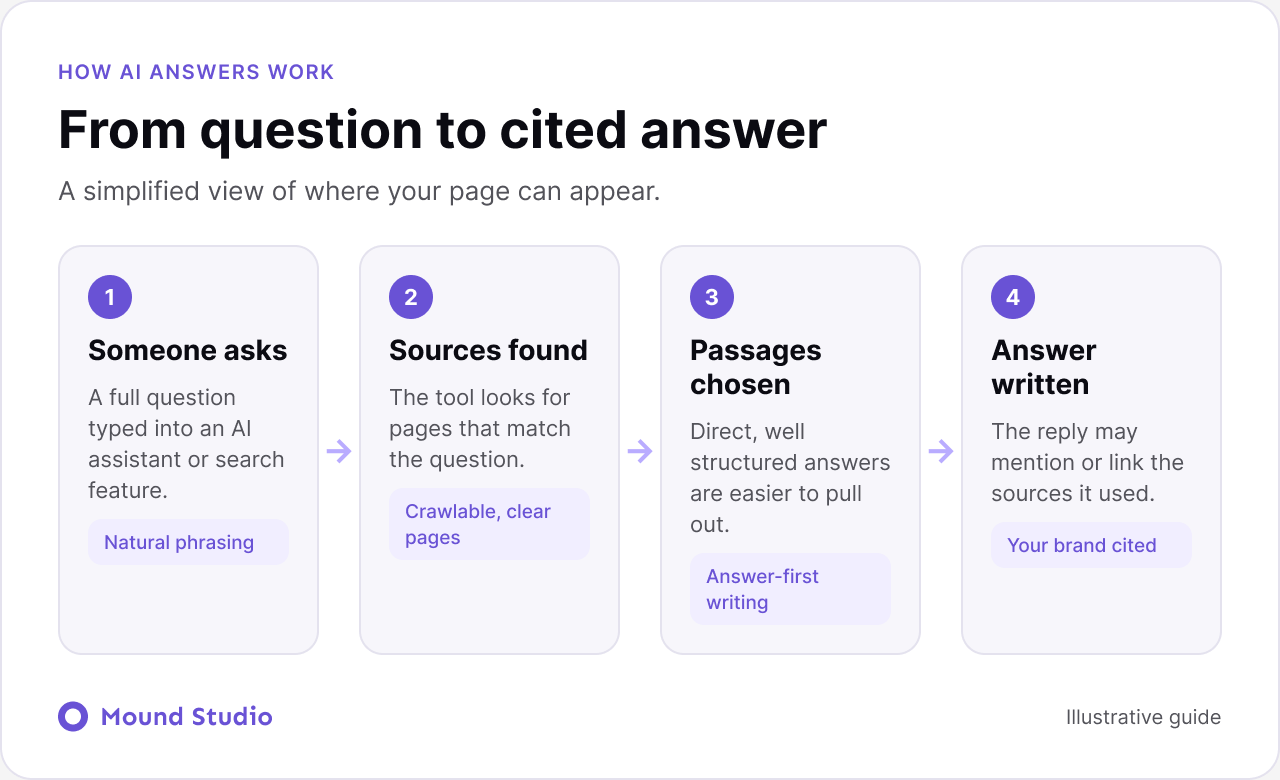
The details differ between tools, but the flow is broadly similar. A person asks a full question. The tool finds pages that seem to match. It picks passages that answer the question clearly. Then it writes a reply, sometimes with links or brand mentions. Your goal is to be a page that is easy to find, easy to understand, and easy to quote at each of those steps.
SEO aims to earn a ranking and a click. AEO aims to earn a mention or a citation inside the answer itself. The two overlap heavily. Strong SEO fundamentals still matter, since AI tools often draw from content that already ranks and is well structured. If you are not sure your SEO basics are in place, start there.

| Area | Traditional SEO | AEO |
|---|---|---|
| Main goal | A higher position and more clicks | A mention or citation inside the answer |
| Content style | Keyword targeted pages | Direct answers to full questions |
| Key signals | Links, relevance, page speed | Clarity, structure, consistency, expertise |
| How you check | Rankings and traffic reports | Asking assistants and tracking referrals |
Picture a small agency with a services page, a pricing guide, and a blog. A customer asks an assistant, "How much does a website redesign cost for a small business?" The assistant looks for pages that answer that exact question in plain language.
The agency's pricing guide opens with a long story about the company and only mentions cost in paragraph five. A competitor's page opens with a two sentence answer, explains what changes the price, and lists the steps in order. The second page is easier to quote, so it is more likely to be used.
Nothing about the second page is clever. It simply does the work for the reader and for the machine. The fix for the first page is small: move the answer to the top, turn the vague heading into a question, and keep the story for later. That is the pattern we see again and again when we review sites.

Lead each section with a direct answer in one or two sentences, then add detail. If a section is titled "How long does a website redesign take?", the first line should say how long it takes. Save the story and the caveats for the paragraphs that follow.
People ask AI tools full questions. Headings that mirror those questions make your content easy to match. Use plain, natural phrasing, and think about how a customer would type or say the question.
Schema markup, such as Organization, Article, FAQ, and Service, gives machines a clear label for what each page is about. In Webflow you can add JSON-LD per page. In WordPress you can add it through a plugin or your theme. Make sure the markup matches what is actually visible on the page.
Your name, services, location, and descriptions should read the same on your site, LinkedIn, directories, and review platforms. Inconsistency makes it harder for a system to be confident about who you are and what you do.
Named authors, clear credentials, case studies, and original insight all signal that a qualified team is behind the content. Thin, generic pages rarely get cited. Add examples from real work, and explain your reasoning, not just your conclusions.
Content hidden behind scripts, logins, or slow rendering can be missed. Check your robots.txt, use clean HTML structure, and keep performance healthy. Decide deliberately which AI crawlers you want to allow rather than blocking everything by accident. Our guide to Webflow site speed optimization covers the performance side.
AI answers often lean on information found across the web. Reviews, guest articles, directory listings, and press mentions all help your brand appear in more places that assistants read.
Update important pages with current information and show the date. Outdated advice rarely gets recommended.
A quotable answer stands on its own. If someone copied only that paragraph, it should still make sense. Here is a simple way to check your writing.
Read the paragraph out loud. If you run out of breath, split it. If you would not say it to a customer on a call, rewrite it. Clear spoken language tends to be clear written language, and it is the easiest kind for a system to pick up.
Also avoid burying key facts in images. A price range or a process shown only inside a graphic cannot be read as text. Put the same information in the page copy as well.
Take a page about "How long does a website redesign take?" as an example. Here is how the parts fit together.
| Part of the page | What to do | Why it helps |
|---|---|---|
| Heading | Use the question itself | Matches how people ask |
| First paragraph | Give the answer in one or two sentences | Easy to quote |
| Body | Explain factors, steps, and examples | Shows real expertise |
| Lists and tables | Break out steps and comparisons | Clear structure |
| FAQ block | Answer follow up questions briefly | Covers related queries |
| Schema and dates | Label the page and show updates | Clear context and freshness |
Keep a simple log with the date, the tool, the question, and what the answer said. After three months you will see which pages get picked up and which do not.
Many sites block crawlers by accident, usually through an old robots.txt rule or a security setting. Others allow everything without thinking. Neither is a decision.
Start by reading your robots.txt file and listing which bots it mentions. Then decide what you want. Some businesses are happy for assistants to read and quote their public guides. Others prefer to limit access to certain sections. Both are reasonable, as long as the choice is deliberate and someone on the team owns it.
After any change, test that your main pages still load for a plain crawler without scripts. If the content only appears after a login or a heavy script runs, treat that as a problem to fix. Our Webflow SEO checklist covers the technical checks in more detail.
Many teams respond to AEO by publishing dozens of new pages. That usually backfires. Ten thin pages that repeat each other are less useful than three strong ones that each answer a distinct question well.
A better habit is to review what you already have. Merge pages that cover the same question, update the ones that are out of date, and remove the ones that no longer reflect how you work. When your facts are consistent across pages, an assistant has less reason to doubt any single one of them.
This is also where a shared style for headings, summaries, and dates pays off. When every guide follows the same pattern, editing gets faster and quality stays even.
Expect it to be gradual. Search features and assistants refresh their information at different speeds, and some sources update slowly. Small improvements to a handful of pages can show up within weeks in one tool and not at all in another.
Treat the work as a routine rather than a one time project. A monthly hour spent rerunning your test questions, updating one or two pages, and fixing anything that drifted will beat a big push followed by silence. Keep notes on what you changed, so you can connect a change to a result later.
Do not try to fix the whole site at once. Start with the pages that matter most for revenue.
If your site is due for a bigger rework, our website redesign checklist shows how to fold this in. For a wider view of how AI is changing design work, see AI in UX design.
A short planning conversation saves a lot of rework. Before you touch a single page, agree on answers to these questions.
If you want a deeper look at the labeling side, read our guide to structured data for AI search. It explains which schema types are worth the effort and how to test them.
Optimizing for AI search comes down to being clear, credible, and easy to quote. Answer questions directly, structure your pages properly, and be consistent about who you are everywhere you appear.
Want to see how your site shows up in AI answers today? Get in touch and we will review it with you.
AEO is structuring your content so AI assistants and search features can find, understand, and quote it in their answers.
No. It builds on SEO. Clear structure, real expertise, and a fast, crawlable site help with both.
Ask AI assistants the questions your customers ask, track referral traffic from AI tools, and repeat the same prompts each month.
No. Schema gives machines a clear label for your page, which helps them understand it, but nobody can promise a citation. Clear answers and consistent facts matter just as much.
Start with the pages closest to revenue, such as service pages and your most useful guides. Make the opening answer the question, then work outward.