







Product
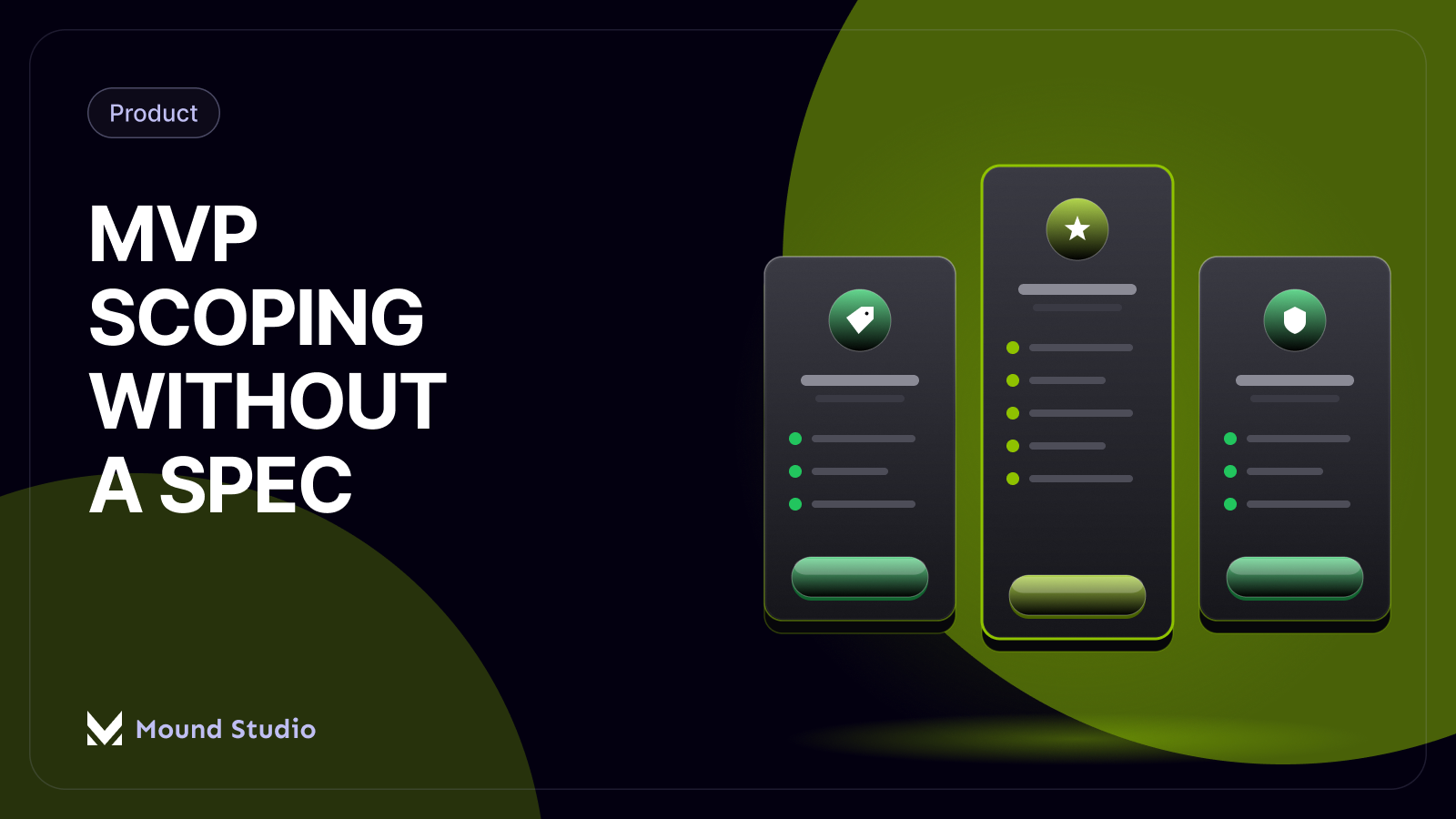
MVP Scoping: How to Define Scope Without a Full Spec
You validate an MVP idea by testing the one assumption it depends on with people outside your team, before you write production code: talk to the people who have the problem, build the smallest thing that can produce real behavior, and measure what they do rather than what they say. If you can't point to a specific test that did this, the idea hasn't been validated yet, no matter how many people have said it sounds good.
That answer is simple to state and easy to skip in practice. Most teams don't skip validation on purpose. They skip it because "validation" gets used loosely, because a few positive conversations feel like enough, or because the pressure to start building outweighs the discipline to test first. The result is an MVP that gets built, shipped, and then quietly reveals that nobody actually wanted it in the form it was built. This guide walks through what validating an MVP idea actually involves, a step-by-step process for doing it, how to compare validation methods, where teams most often go wrong, and a decision guide you can use before greenlighting a build.
Validating an MVP idea means testing the core assumption behind it against real behavior from real people, before you invest in building the full product. It is not the same as getting feedback on a pitch, collecting opinions in a survey, or confirming that an idea sounds reasonable to people who already like you. Validation is specifically about reducing the risk that you spend weeks or months building something that doesn't solve a problem anyone will act on.
Every product idea rests on a handful of assumptions stacked on top of each other: that a problem exists, that it's painful enough for people to want a fix, that your approach is a believable fix, and that people will pay, commit time, or change behavior to use it. Validation means isolating the riskiest of these assumptions and testing it directly, instead of testing the whole bundle at once by building a finished product and hoping.
The honest reason to validate first is cost. A conversation costs an hour. A landing page costs a few days. A full build costs weeks of engineering and design time, plus the opportunity cost of everything else that wasn't built instead. If the core assumption is wrong, you want to find that out at the hour stage, not after launch. We've scoped MVPs for founders who had already built a first version before any validation happened, and the pattern is consistent: the rebuild costs more than the validation would have, and it costs trust and momentum on top of that.
Validation also changes what gets built. Teams that test their core assumption first tend to ship a narrower, sharper MVP, because the validation process surfaces which features actually matter to the problem and which ones were assumptions dressed up as requirements. If you're still working out what belongs in the first release at all, our guide to scoping an MVP without a full spec covers how to separate what needs to be built from what still needs to be learned.
Validation works best as a short, ordered sequence rather than a single activity. Each step narrows the idea and reduces risk before the next one adds cost.
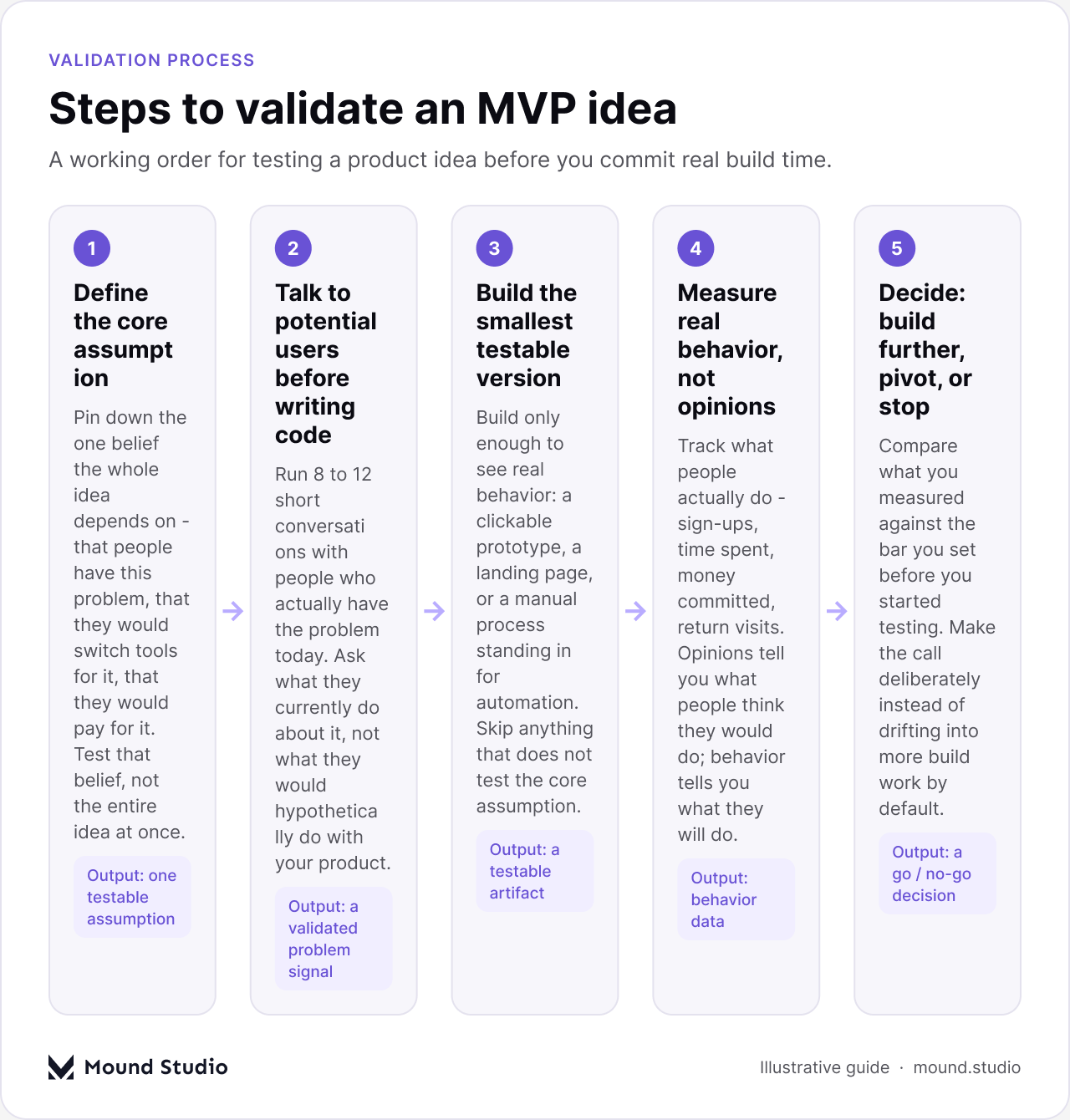
Start by naming the single belief the idea depends on most. Not the whole idea, one assumption. It might be "people will pay to automate this manual task" or "teams will switch from their current tool if this is faster." Write it down as a falsifiable statement, something that a test can actually prove true or false. If you can't state it this specifically, that's the first sign the idea isn't ready to validate yet, it's still ready to be scoped.
Run a short set of conversations, usually eight to twelve, with people who currently experience the problem. Ask about what they do today to deal with it, what they've tried, and what's frustrating about their current approach. Avoid asking whether they'd use your product; hypothetical answers are unreliable because people are generally optimistic about imaginary tools. You're listening for the problem's intensity, not pitching a solution.
Once the assumption and the problem are both clearer, build only what's needed to generate a real signal. That could be a clickable prototype, a landing page describing the outcome with a waitlist or purchase button, or a manual process where you personally do the work behind the scenes while the user experiences something that feels like a product. The goal isn't to look finished. It's to create a situation where someone can act, and you can observe what they actually do.
Track what people do, not what they say about what they'd do. Sign-ups, time spent, money committed, return visits, and referrals are behavior. Survey enthusiasm and verbal encouragement are not. Set a threshold before you run the test, not after, so you're not tempted to reinterpret a weak result as a good one once you've seen it.
Compare the result against the threshold you set. If it clears the bar, move forward with the next layer of the build. If it's close but not quite there, consider a pivot on the specific assumption that underperformed, not a wholesale restart. If it clearly misses, stop before more time goes into it. This step is where validation actually pays off, and it's the step most commonly skipped because stopping or pivoting feels like a setback instead of the process working as intended.
Different validation methods answer different questions and take different amounts of time to produce a usable signal. Choosing the wrong one for the assumption you're testing is a common way validation efforts stall out without a clear result.
| Method | What it tells you | Time to learn |
|---|---|---|
| Customer interviews | Whether the problem is real, how painful it is, and what people currently do instead | 1 to 2 weeks |
| Landing page + waitlist | Whether the pitch itself is compelling enough to get a stranger to act | 1 to 2 weeks |
| Concept test with a clickable prototype | Whether the proposed flow makes sense and where people hesitate or drop off | 2 to 3 weeks |
| Limited pilot with real users | Whether the solution holds up under real, ongoing use, not just a first impression | 4 to 8 weeks |
A practical pattern: start with interviews to confirm the problem is real, run a landing page or concept test to see if your specific approach lands, and reserve a pilot for ideas that have already cleared the cheaper tests. Skipping straight to a pilot is expensive when a round of interviews would have surfaced the same disqualifying signal for a fraction of the cost and time. If you're also trying to figure out how long the build itself will take once validation clears, our breakdown of how long MVP development really takes is a useful next read.
Most MVP ideas come with more than one open question, and not every question deserves the same amount of validation effort. Sorting them by impact and effort keeps the process from sprawling into a project of its own.
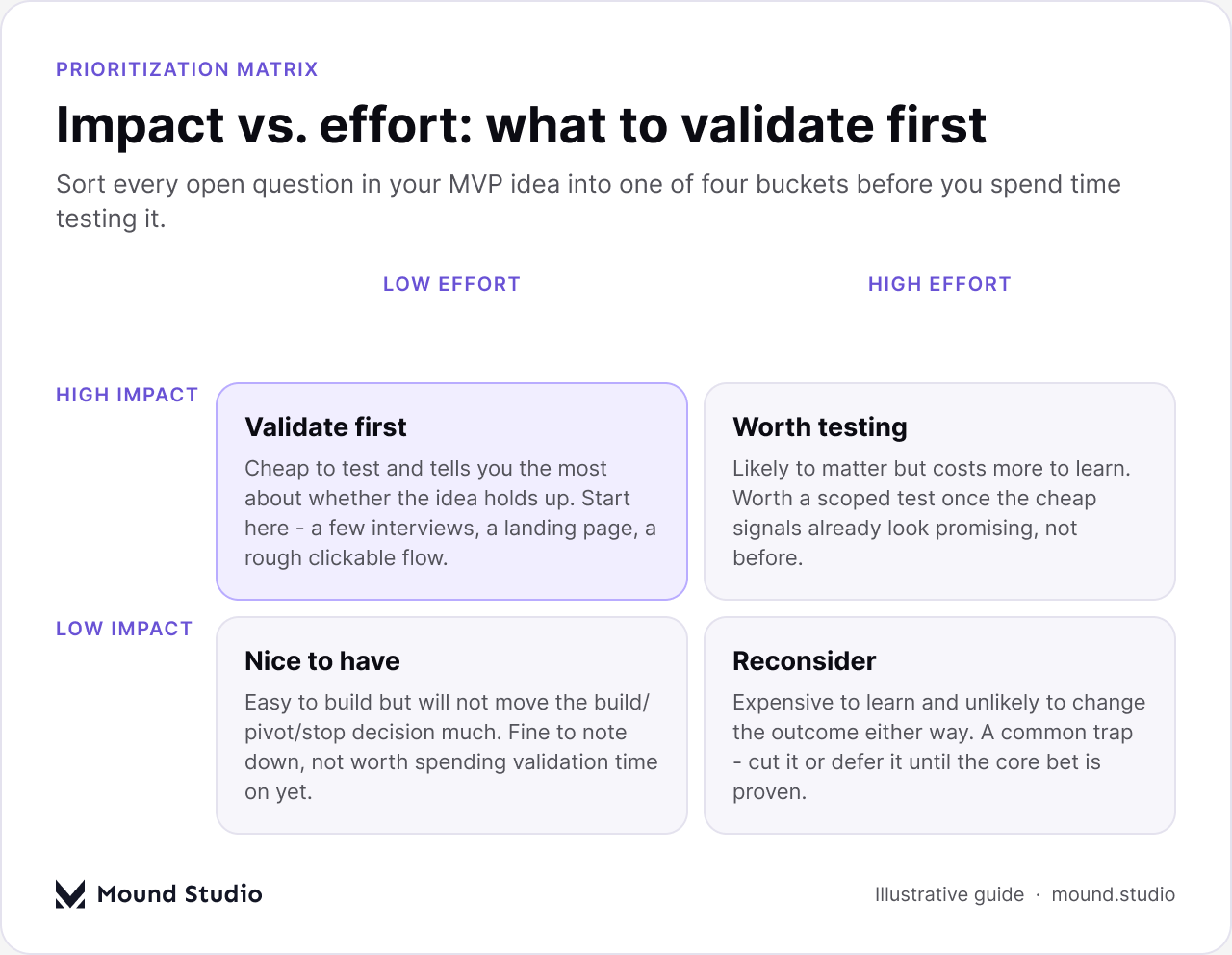
Questions that are cheap to test and would meaningfully change the decision belong at the top of the list, always. Questions that would matter a lot but cost more to learn are worth a scoped test, but only once the cheaper signals already look promising. Low-effort, low-impact questions can be noted and set aside rather than formally tested. High-effort, low-impact questions are usually a trap: they feel thorough to investigate but rarely change whether the MVP should move forward, so they're better reconsidered or dropped from the validation plan entirely.
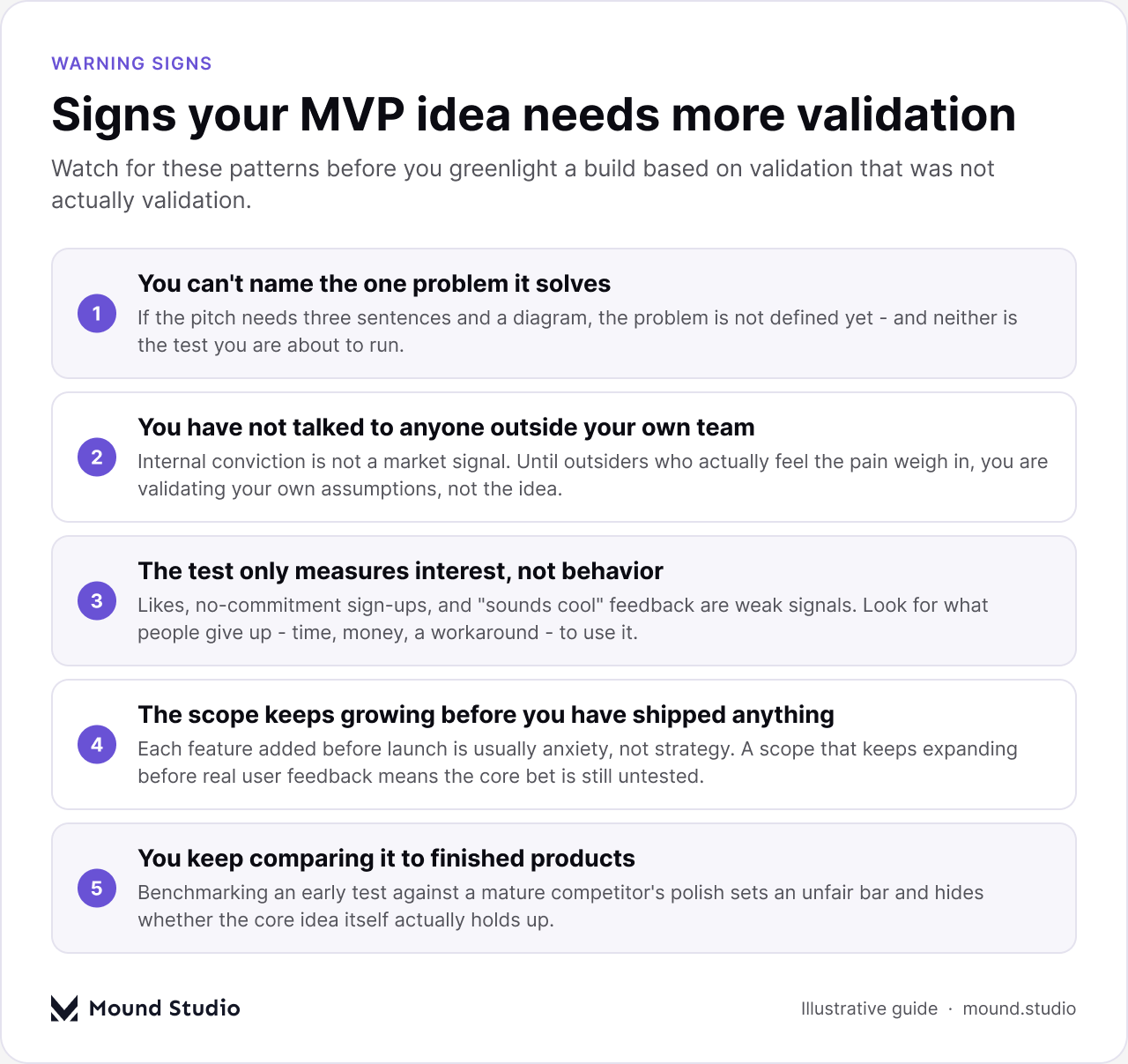
A handful of patterns show up again and again when validation doesn't produce a useful answer.
Once a test has run, the results need to be read against a clear standard rather than general optimism. The table below outlines how to read the most common outcomes.
| Signal | What it means | Decision |
|---|---|---|
| Strong demand signal: people commit time, money, or effort | The core assumption holds up under real conditions, not just conversation | Move forward into scoped MVP build |
| Lukewarm interest with no real commitment | The problem may be real but not urgent enough, or the pitch isn't landing yet | Refine the assumption or the pitch and re-test before building |
| No real pain point found in interviews | The underlying problem is weaker than assumed, or it's being solved well enough already | Stop or pivot to a different problem |
| Users want it but won't pay or commit | Interest exists but the value proposition or pricing model needs rework | Test a different commitment mechanism before building |
Before moving from validation into a build, it helps to run through a short checklist rather than relying on a gut feeling about how the testing went.
If most of these are true, you're in a reasonable position to move into scoping and building. If several aren't, that's not a failure, it's useful information about where the idea still needs work before it's worth a build. Teams building for SaaS in particular often find the fastest path is to pair this kind of validation with a tightly scoped first release; our guide on building your first SaaS MVP covers how that scoping typically plays out once validation clears.
Validating an MVP idea isn't about certainty, it's about reducing the odds that a build becomes a guess dressed up as a plan, and if you're weighing whether your idea is ready to test or ready to build, get in touch and we'll help you figure out which stage you're actually at.
Most MVP validation can be done in two to six weeks, depending on the method. Interviews and a landing page test typically take one to two weeks each, while a concept test with a clickable prototype runs two to three weeks and a limited pilot can take four to eight weeks. The goal is to match the method to how much confidence the decision actually needs, not to run every method on every idea.
No. Many of the most useful validation methods, like customer interviews and a landing page with a waitlist, don't require any working product at all. A prototype becomes useful once you need to test whether a specific flow makes sense or where people hesitate, but it's rarely the first step.
Validating an idea tests whether the underlying problem and your proposed approach to it are worth pursuing at all. Validating an MVP tests whether the specific, scoped version you're planning to build actually delivers on that approach for real users. Idea validation usually comes first, and its results shape how the MVP gets scoped.
Eight to twelve structured conversations with people who actually experience the problem is usually enough to spot a consistent pattern, whether that pattern is strong pain or a weak signal. Fewer than that and one or two outlier opinions can skew your read; many more than that without a clear pattern emerging is often a sign the problem itself is too vague to test.
Mixed results usually mean one of the underlying assumptions was tested imprecisely rather than that the whole idea is a dead end. Go back to the single core assumption, narrow the test further, and re-run it with a clearer threshold for what counts as a pass. Treat an unclear result as a signal to refine the test, not as permission to proceed anyway.