







Agency
What to Ask Before You Hire a UI/UX Design Agency
A design sprint is a short, time-boxed process, usually run over five days, that takes a team from an open problem to a tested prototype without writing production code. It compresses the normal cycle of researching, designing, building and testing into one focused week, so a team can learn whether a direction works before committing real engineering time to it.
The format was popularized for digital product teams, but the structure applies just as well to a website redesign, a new feature, or a tricky positioning question. The point is never the deliverable itself. A sprint produces a prototype and a handful of user reactions, and those exist only to answer one question the team agreed on before the week started.
We run design sprints at Mound Studio when a client has a real decision to make and no good way to make it except by guessing or arguing. A sprint replaces the guessing and the arguing with a cheap test.
What makes the format work isn't the schedule itself, it's the constraints the schedule forces. A fixed week means the team can't keep exploring forever, so it has to commit to a direction by day three. A single decider means the group can't fall back on an open-ended vote, so disagreements get resolved instead of left open. And testing with real users on day five means the team's own opinion of the idea stops being the only opinion that counts. Remove any one of those constraints and the week tends to stretch out and lose its point.
Most design sprints follow five stages, usually mapped one per day: understand the problem, diverge with ideas, decide on a direction, build a prototype, and test it with real users. Some teams compress this into four days by merging the first two stages, but the sequence stays the same.
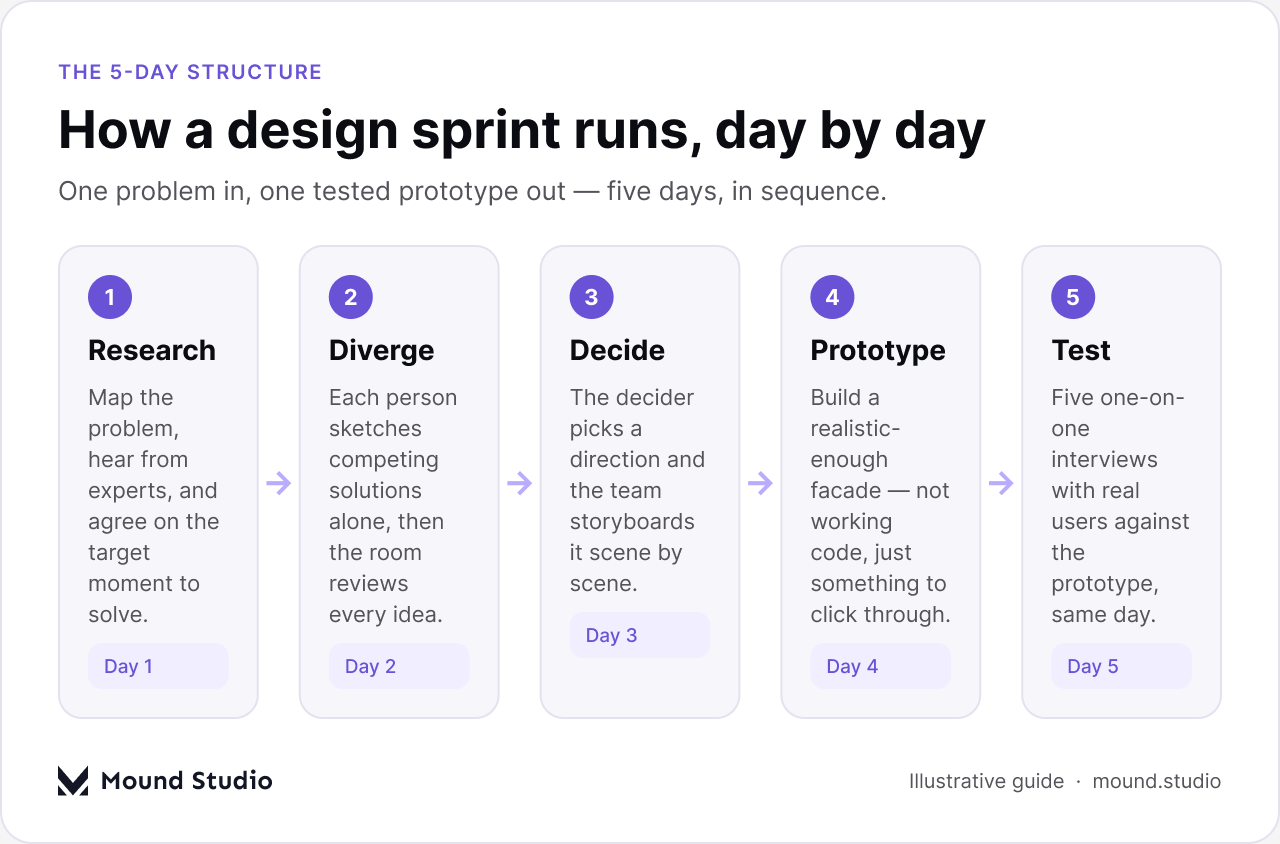
Here is what each stage actually involves in practice:
| Day | Focus | Who's needed | Output |
|---|---|---|---|
| Day 1 | Understand | Whole team + subject experts | Agreed target decision |
| Day 2 | Diverge | Whole team | Individual sketches reviewed |
| Day 3 | Decide | Whole team + decider | Storyboard |
| Day 4 | Prototype | Design-capable team members | Clickable prototype |
| Day 5 | Test | Whole team + 5 users | Interview notes, a go/no-go read |
A design sprint is worth running when a team is stuck on one specific, high-stakes decision and has no cheap way to test it other than building the real thing. It is the wrong tool for exploring a broad topic, for work that just needs executing, or for problems that are already well understood internally.
If you're bringing in outside help to run the week, treat the kickoff like any other agency engagement. Our list of questions to ask a design agency covers what to clarify before anyone starts sketching.
Preparing for a design sprint means lining up the right people and a clear question before the week starts, not during it. Most sprints that drift or fail to produce a usable answer failed in the prep, not the week itself.
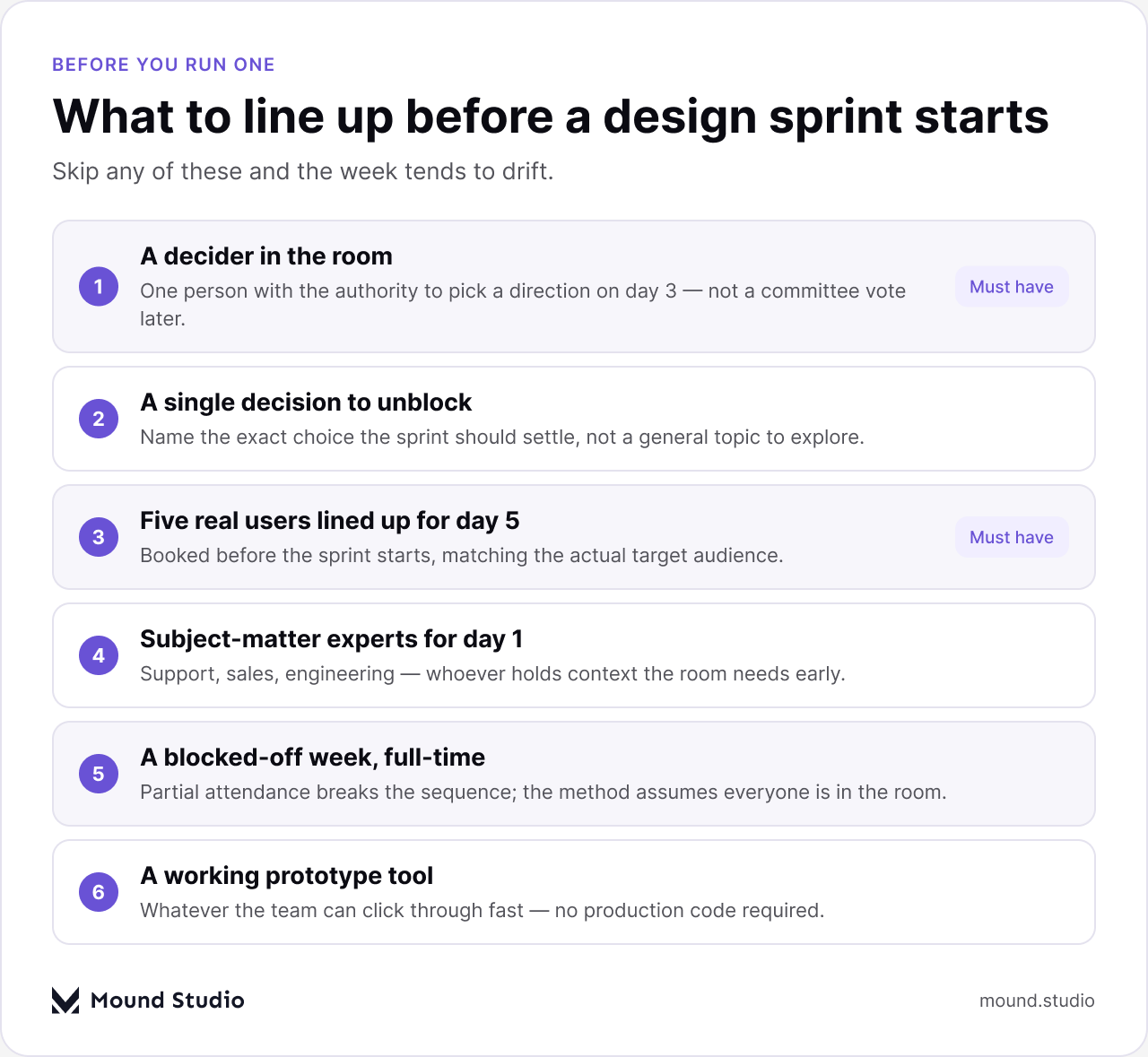
The single most important piece of preparation is naming the decision. "Improve our onboarding" is a topic, not a decision a sprint can resolve. "Should new users set up a project before or after seeing the dashboard" is a decision a sprint can test in five days. The narrower the question, the more useful the week. The same clarity belongs in any project kickoff, sprint or not — see our guide to writing a website design brief.
| Role | Responsibility |
|---|---|
| Decider | Picks the direction on day three and owns the call afterward |
| Facilitator | Keeps time, runs exercises, keeps the room moving |
| Core team | Sketches, storyboards, and builds the prototype |
| Subject experts | Brief the team on day one, then step back |
Facilitating a design sprint well means protecting the schedule and the decision-making process more than steering the content. A good facilitator doesn't tell the team what the right answer is; they make sure the room moves through each exercise on time and that quieter voices get heard before louder ones dominate.
Each activity in a sprint, from sketching to critique, works better with a hard stop than an open-ended discussion. A twenty-minute sketching window with a visible timer produces sharper ideas than an hour with no limit, because people stop second-guessing and commit to something on paper.
Sketching alone before sharing, and voting with sticky dots instead of an open debate, both reduce the pull toward whoever is most senior or most confident in the room. The group reviews ideas without knowing who drew what, which keeps the conversation on the idea itself rather than on who proposed it.
Put the sprint question on the wall, or at the top of the shared document, and refer back to it whenever the conversation drifts. It's easy for a room to spend an hour debating something interesting but unrelated to the actual decision, and a visible reminder is the cheapest way to pull things back.
Once the decider has picked a direction on day three, the facilitator's job is to stop re-litigating it. Storyboarding works best when the team treats the choice as settled for the rest of the week, even if individual members would have picked differently. The test on day five is where that choice actually gets checked, not another round table discussion.
The most common mistake is starting a sprint without a clear decision owner, which leaves the team with a prototype but no one willing to commit to what it means. The others tend to repeat across teams new to the format.
Most of these are fixable mid-sprint if a facilitator catches them early. A missing decider can sometimes be resolved by pausing on day three and getting a clear answer from whoever has the authority, even if they weren't planning to attend every session. A skipped user test is harder to recover from once the week is over, which is why it's worth protecting day five specifically when a sprint's schedule comes under pressure from other meetings.
A design sprint and a standard project timeline solve different problems: a sprint tests one decision in a fixed week, while a standard timeline delivers the finished, shippable work over a longer, open-ended schedule. They aren't competing approaches. Many of our engagements use a sprint to settle direction, then move into a standard build once the decision is validated.

A standard timeline moves through discovery, design, build, and quality assurance in sequence, with testing happening on a rolling basis rather than concentrated into a single day. Its output is finished work, meant to ship. A sprint's output is a validated (or invalidated) direction, nothing more and nothing less. Running a sprint before a standard timeline doesn't add time to a project; it usually saves time, because it catches a wrong direction before a team spends weeks building on it. Whether that next phase runs in-house or with an outside partner is its own decision — see our breakdown of in-house vs. agency design teams.
Not every stuck project needs a sprint, and not every team has the setup to run one well. Before blocking out a week, it helps to check the basics against what the format actually requires: a narrow question, a present decider, and real users willing to sit down with a prototype. Run through these questions before committing a week to a sprint:
If the answer to most of these is yes, a sprint is a reasonable way to spend the week. If the team can't name a single decision, or can't free up a decider, it's worth fixing that first. A sprint run without those two pieces in place tends to produce a nice-looking prototype and no clearer answer than before.
A design sprint is a focused way to turn one open, high-stakes decision into a tested answer in a week, as long as the team shows up with a clear question, a real decider, and users willing to give unscripted reactions to a prototype. Used for the wrong kind of problem, or without that preparation, it's just an expensive workshop. If you're weighing whether a sprint makes sense for your next project, talk to our team about it.
Yes. Some teams run a compressed three or four-day version by combining the understand and diverge stages, or by skipping individual sketching in favor of a faster group session. The trade-off is less time spent exploring competing ideas before the team commits to one.
The decider should be whoever has the authority to act on the outcome afterward, usually a product owner, founder, or senior stakeholder. It doesn't need to be the most senior person in the room, but it does need to be someone the rest of the team will follow once the call is made.
No. Sprint prototypes are built to look and feel real enough to react to, not to function as working software. Most are built with design and prototyping tools rather than code, which is part of what keeps the week to five days.
The team reviews the interview notes from day five and decides whether to move forward with the idea, adjust it and test again, or drop it. A validated direction typically moves into a standard project timeline for full design and build.
Yes, with adjustments. Remote sprints tend to run in shorter daily blocks rather than one unbroken day, since a full day of video calls is harder to sustain than a full day in a room. The sequence and the roles stay the same; what changes is the pacing and the tools used for sketching and prototyping together.