







Ai
How AI Fits Into a Modern Product Design Workflow

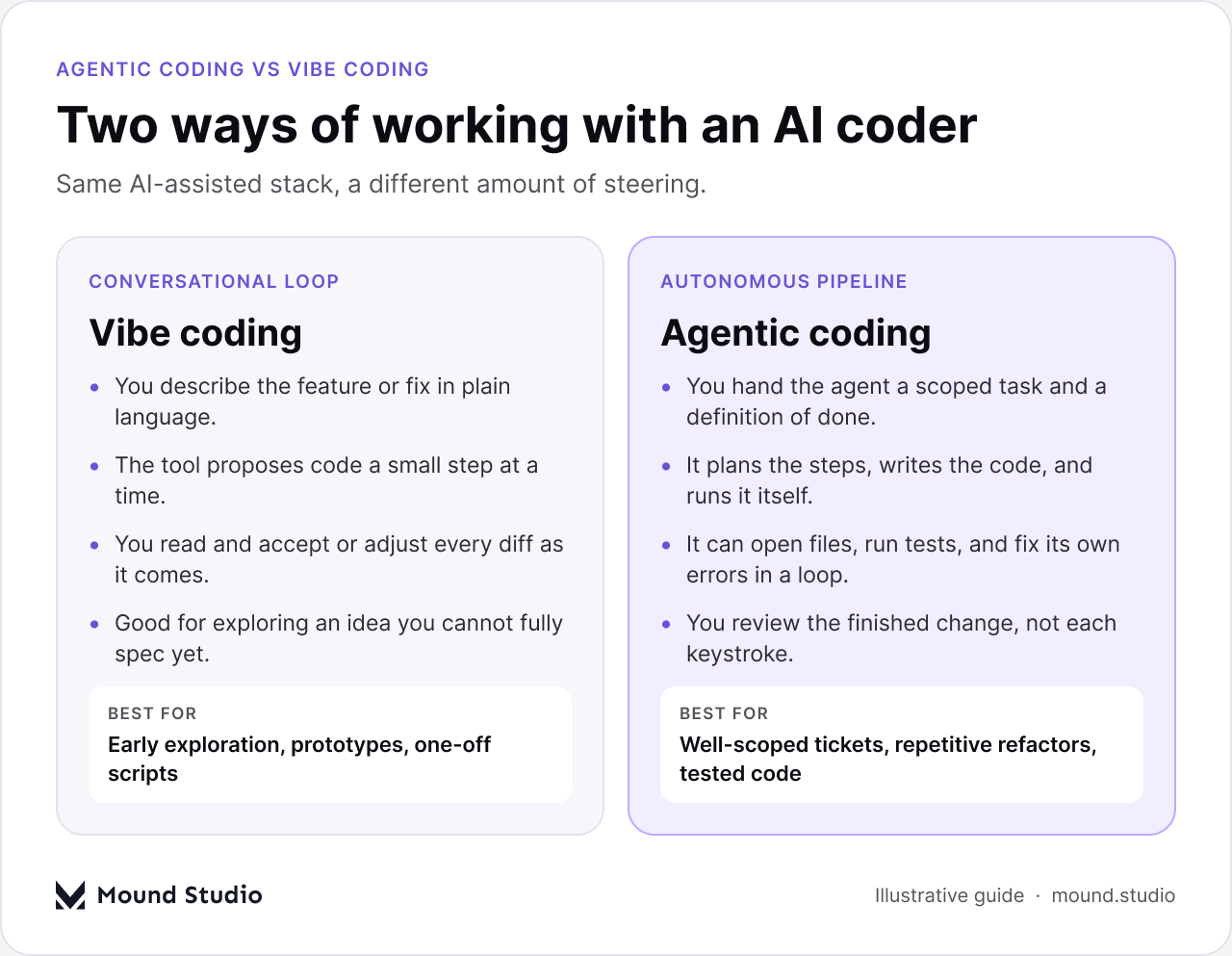
The real difference is how much of the work you steer versus how much you hand off. Vibe coding is a conversation: you describe what you want, the tool proposes code, and you check each step before moving on. Agentic coding is a handoff: you give an agent a scoped task and a definition of done, and it plans, writes, runs, and fixes the code on its own before you review the finished result. Both use the same generation of AI coding tools. The difference is where the human sits in the loop.
We work with both styles inside client projects at Mound Studio, often in the same week and sometimes on the same feature. Neither one replaces judgment. They just ask for it at different points.
Vibe coding is the style most people picture when they think of building with AI: a chat window, a plain-language request, and a stream of small code changes you approve as they arrive. You might ask for a new component, see the first pass, ask for a tweak, then ask for another. The session is conversational and iterative. Nothing moves forward without you reading it first.
This is a good fit when you cannot fully describe the end state yet. You are exploring a layout, testing an interaction, or trying three versions of a script to see which one reads better. The tool is a fast pair, not an independent worker. You stay hands-on the entire time, which is exactly the point: the value is in tight feedback, not in speed alone.
The tradeoff is attention. A long vibe coding session with dozens of small prompts can drift from the original goal if nobody restates it. It also does not scale well to a large, well-defined task, because reviewing forty small diffs one at a time takes about as long as writing the feature yourself.
Agentic coding removes the step-by-step steering. You still write the brief, but instead of approving each change, you describe the outcome: the ticket, the acceptance criteria, the files that are in scope, and the tests that need to pass. The agent then plans its own steps, edits the code, runs the test suite, reads the failures, and tries again, often several times, without asking you in between.
What makes this possible is tool access. An agentic setup can open a terminal, run a build, read the error output, and act on it. That loop of plan, execute, observe, and correct is what separates it from a single prompt-and-response exchange. The output you see is not the first draft; it is whatever the agent settled on after checking its own work.
This fits tasks you can already describe clearly: a scoped bug fix, a repetitive refactor across many files, a migration with a known target state, or a feature with an existing pattern to follow. It fits less well when the goal itself is still unclear, because an agent working alone toward a fuzzy target tends to produce a confident, wrong answer rather than a useful question.
On paper the distinction sounds tidy. In practice, three things change once a team moves from one style to the other.
In vibe coding, you are effectively still the author. You accept, reject, or edit every suggestion, so the final code reflects a long series of your decisions. In agentic coding, the agent is closer to a contributor: it makes implementation choices inside the boundaries you set, and you only see the outcome of those choices, not the process.
Vibe coding usually leaves testing to you, prompt by prompt, unless you explicitly ask the tool to write and run tests too. Agentic coding treats tests as part of the loop by default: a scoped agentic task without a test suite to run against is flying without instruments, so the agent has nothing to check its own work against.
In vibe coding, you catch a mistake the moment you see a diff you do not like. In agentic coding, small mistakes get caught earlier by the agent's own test run, but a mistake in the underlying assumption, the wrong scope, the wrong library, a misread requirement, only surfaces at the final review. That review has to be thorough, because it is the one checkpoint left.
| Dimension | Vibe coding | Agentic coding |
|---|---|---|
| Who drives each step | You, prompt by prompt | The agent, inside a scoped task |
| Typical unit of work | One small change or question | A whole ticket or refactor |
| How errors get caught | You see the diff and catch it there | The agent tests and retries, then you review the result |
| Best starting point | An idea you have not fully defined yet | A task you can already write a clear brief for |
| What you still do yourself | Read and steer every step | Write the brief, then review the finished diff |
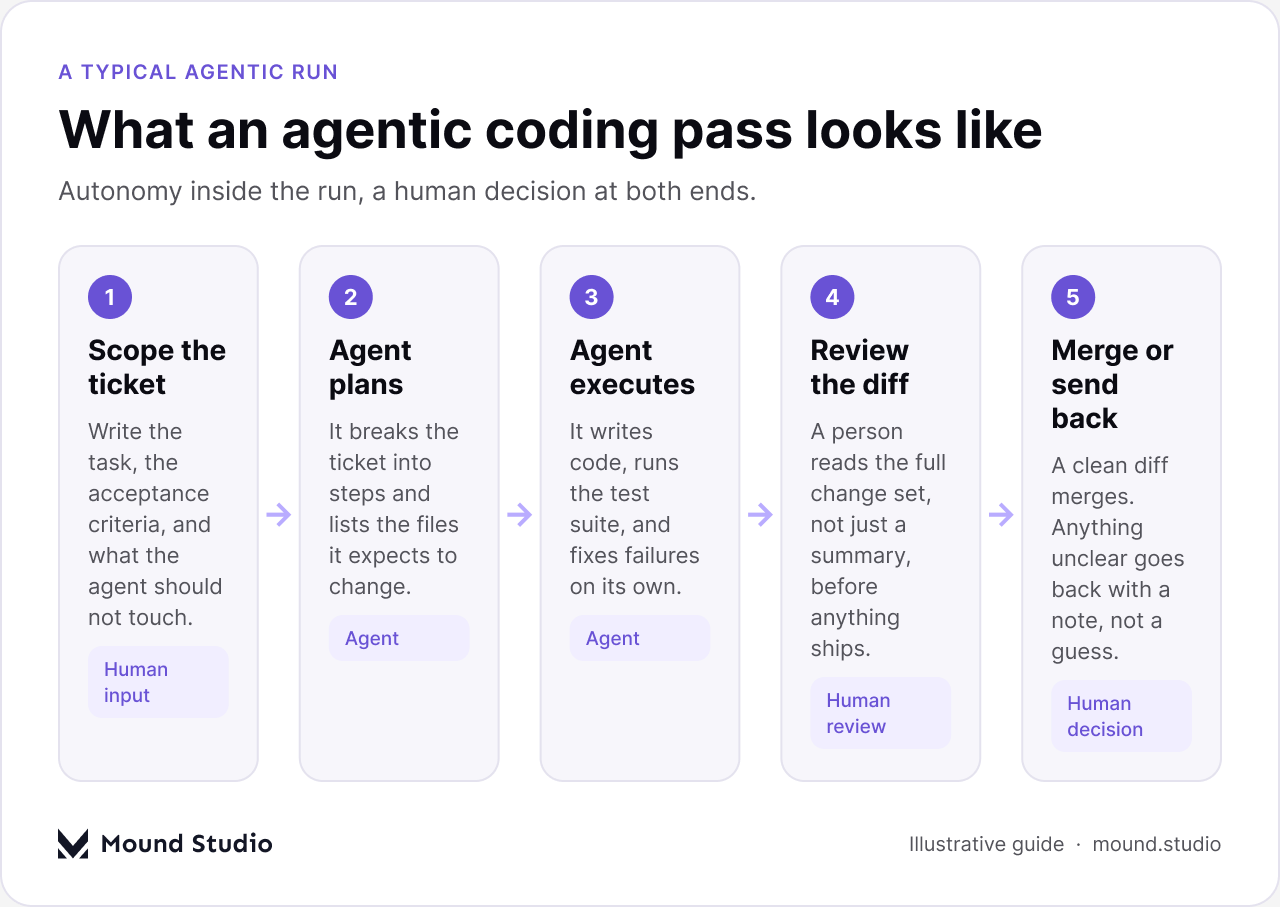
A useful way to picture agentic coding is as a five-part loop with people at both ends and the agent doing the middle on its own.
Notice that step four is doing the same job a code review always did. Agentic coding does not remove review; it moves review to the end of a larger unit of work instead of spreading it across many small ones.
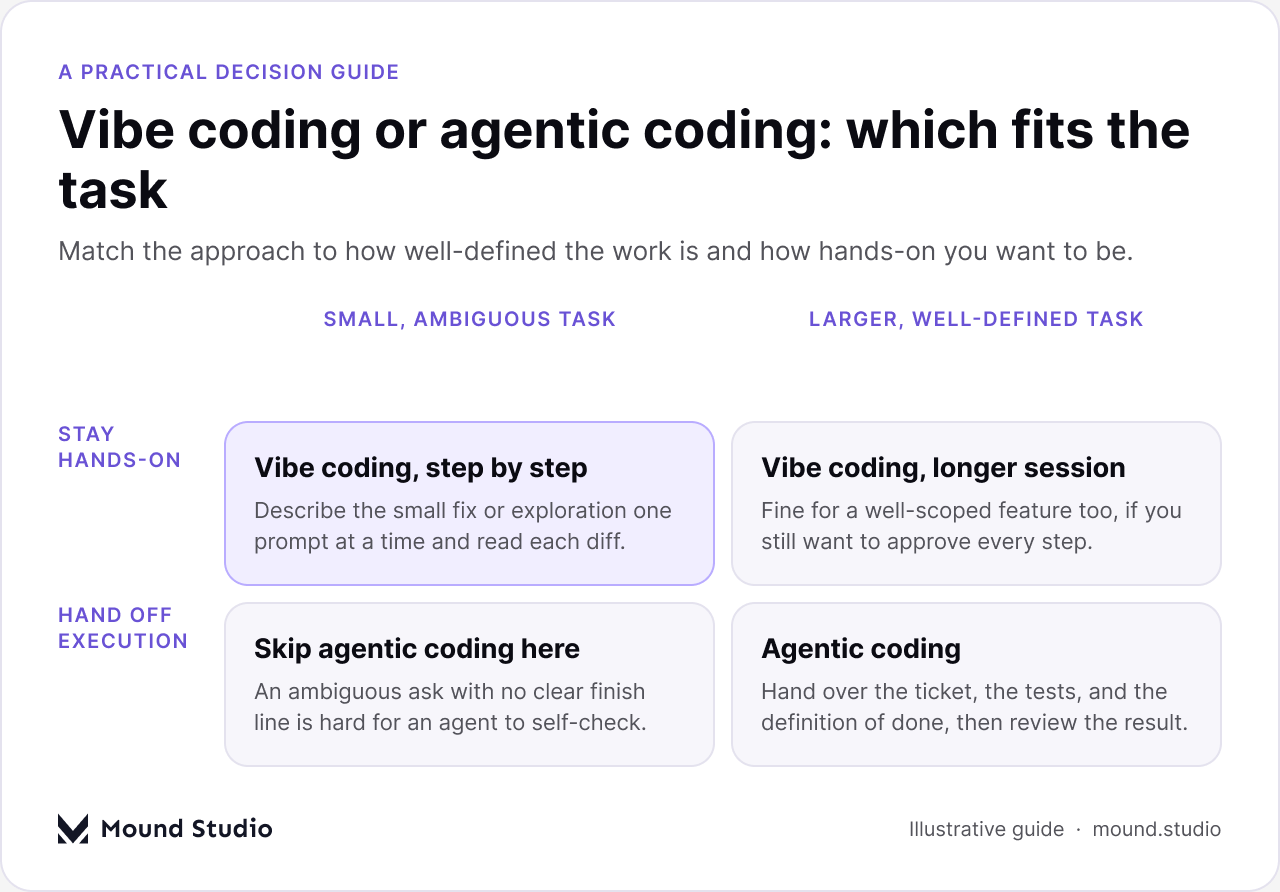
Most teams do not need to pick one style forever. The choice usually comes down to the task in front of you.
Reach for vibe coding when:
Reach for agentic coding when:
A lot of real projects use both in the same week: vibe coding to work out what a new feature should even look like, then a scoped agentic task once the shape is clear enough to write a brief for. We took this approach on client work that touched how AI fits into a product design workflow, exploring the interaction in a conversational session before handing the repeatable part to a scoped agentic pass.
Neither style removes the need for a person who understands the codebase to look at the result. What changes is when that person looks, and at what.
| Failure mode | What it looks like | Guardrail |
|---|---|---|
| Scope creep | The agent quietly touches files outside the ticket | State what it should not touch, then check the diff against that list |
| A confident but weak test | It writes a test that passes because it checks too little | Read the new tests, not only whether they pass |
| Silent dependency changes | It updates a package or config to make something run | Review the dependency and config diff, not only the source files |
| No rollback plan | A merged agentic change breaks something later | Use the same review and revert process as any other change |
| Prompt drift in vibe coding | A long session loses track of the original goal | Restate the goal every few prompts, or start a fresh session |
The common thread is that oversight has to be specific. A general instinct that "it looks fine" is not a check. Reading the actual files that changed, running the tests yourself at least once, and confirming the scope matches the ticket are the three habits that carry over regardless of which approach you are using. Teams evaluating AI prototyping tools for design work run into a version of the same question: the tool changes, but the review habit does not.
If a team's answer to most of these is no, the fix is rarely a better tool. It is usually a smaller scope, a clearer brief, or a slower review, whichever the current project is missing. That holds whether the code came from a conversational session or an autonomous one, and it is the same discipline behind any vibe coding workflow built for a design-first team: the process around the tool matters as much as the tool itself.
Vibe coding and agentic coding are not competing technologies, they are two different amounts of autonomy applied to the same kind of tool. Vibe coding keeps you inside every step, which suits exploration and anything you cannot fully define yet. Agentic coding moves you to the start and the end of a larger unit of work, which suits a task you can already scope clearly. Both still need a person who reads the actual result closely, not just the summary of it. If you are weighing which approach fits a specific project, or want a second read on how a current build is set up for either one, get in touch with us.
Not exactly. It is a different amount of autonomy, not a step up on the same ladder. Vibe coding keeps you steering every change; agentic coding hands off a scoped task and only asks for your attention at the start and the end.
It can run without a person watching each step, but that is different from running without review. The finished diff still needs someone to read it, and failure modes like scope creep or a weak test are exactly what an unreviewed run misses.
Yes. Most teams use vibe coding for the parts of a project that are still taking shape, then move to a scoped agentic task once the work is clear enough to write a brief for.
Handing an agent a vague goal before it has been scoped. Without a clear definition of done, the loop the agent runs still produces confident output, it is just confidently built on the wrong assumption.
Look at how well you can already describe the outcome. If you can write a clear brief and a pass or fail test, agentic coding fits. If you are still working out what the result should look like, stay in a vibe coding session until it does.