








SEO & AEO
AEO vs SEO: What Is the Difference and Why It Matters
Yes, for a meaningful slice of searches, but not evenly and not in the way most site owners fear. When a search engine can answer a question directly at the top of the results page, some share of searchers get what they need and never scroll down to the list of links. That shift is real. What it does not do is erase the value of ranking well or of being the source an AI answer draws from. Being the page an AI Overview summarizes and cites still carries weight with the people who do click, and it still puts your name in front of everyone who reads the summary, click or not.
An AI Overview is a generated summary that sits above the standard list of blue links, pulling together information from several sources into one short answer. Google popularized the format, but the pattern now shows up across the search and chat landscape: AI-powered summaries in other search engines, answer boxes inside chat products, and browser assistants that read a page and answer a question without opening it. The shared idea is the same everywhere. Instead of making the searcher pick a link and read the page, the system reads several pages for them and hands back a short synthesis, usually with source links attached.
For site owners, this means the results page now has two audiences to design for: the person who reads the AI summary and moves on, and the person who still clicks through to a page. Both audiences see your brand name if you are cited. Only one of them becomes a session in your analytics.
A featured snippet pulled one clear answer from one clear source and displayed it above the rest of the list, with that source easy to identify and credit. An AI Overview usually draws from several pages at once and writes a new paragraph that blends them, which means there is often no single "position zero" the way there used to be. Multiple sites can be cited in the same summary, sometimes with a small link next to the specific claim that came from each one, sometimes with links grouped to the side. For a business watching its visibility, this changes what needs to be tracked. It is no longer only whether you rank first, it is also whether you get pulled into the synthesis at all, and whether the summary represents you accurately.
This same synthesis pattern shows up in standalone AI chat products that answer a question by researching several sources in the background rather than sending the person to a results page at all. The two are not identical products, but they reward the same kind of content: a clear, specific, well-supported answer that a system can lift cleanly and attribute correctly. Getting one right tends to help with the other, which is part of why the practices behind writing content that ranks well in AI search overlap so closely with the practices behind ranking well in AI Overviews specifically.
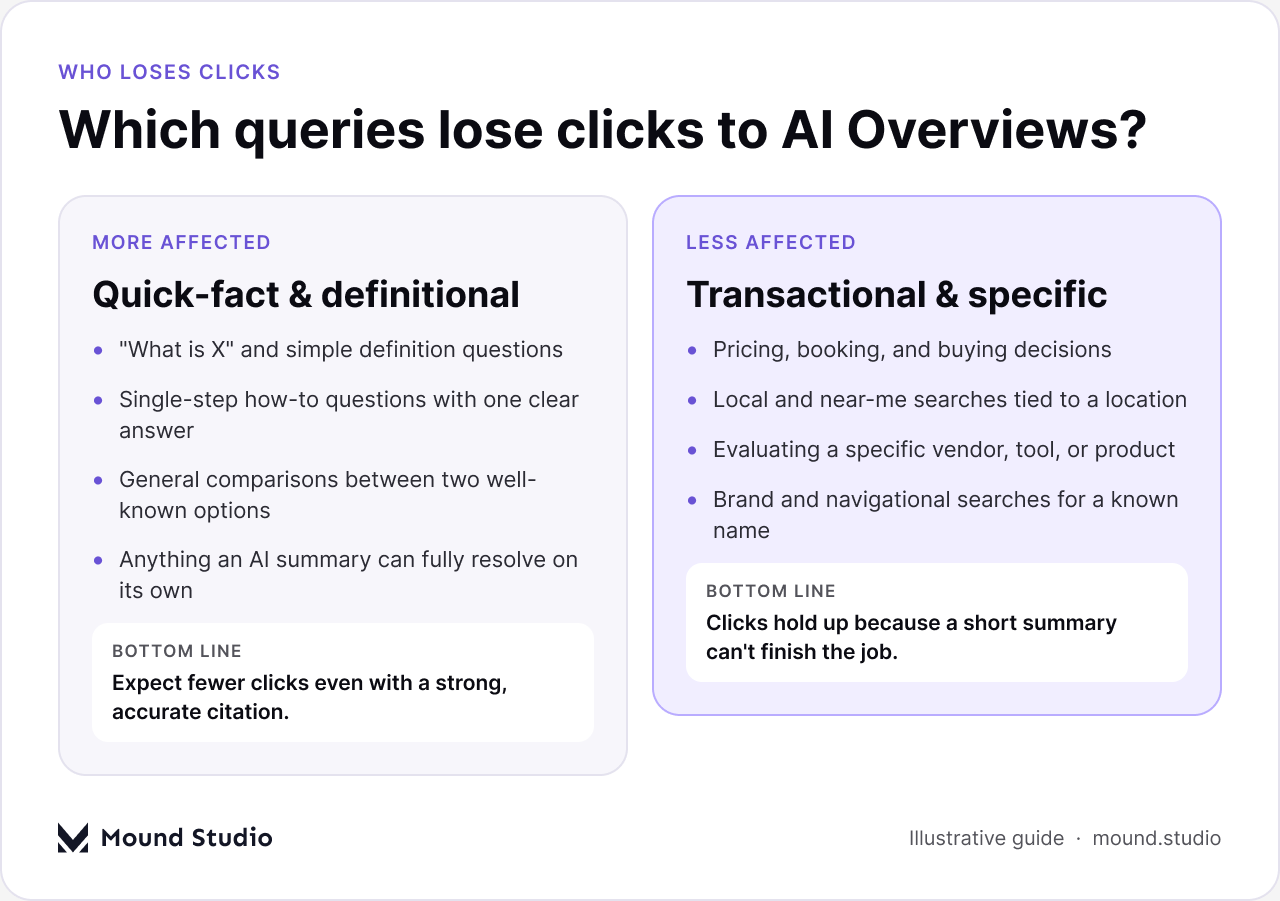
Search behavior has always included a share of answer-and-done queries: a definition, a date, a quick fact, a unit conversion. Those queries rarely earned much of a click in the first place, because the searcher's need was satisfied by a snippet or a knowledge panel long before AI Overviews existed. What has changed is the range of queries that can now be answered this way. A "what is" question, a comparison of two well-known options, or a general how-to question can often be summarized well enough that a portion of searchers stop there.
The queries that hold up best are the ones an AI summary cannot fully answer on its own: anything that depends on the searcher's specific situation, anything transactional such as pricing, booking, or buying, anything local, and anything where the searcher wants to evaluate a specific vendor, tool, or product rather than read a general explanation. Brand searches and navigational searches, where someone already knows who they want, are barely touched.
No. A citation inside an AI Overview is still a form of distribution, even without a click attached to it. The searcher reads your brand name and, often, a line lifted directly from your page. That is closer to a billboard impression than a wasted opportunity: it builds familiarity, and familiarity is a large part of why someone clicks your listing over a competitor's the next time they search normally, or why they type your name directly into the address bar later. Treating every uncredited impression as a loss misses that a citation is still marketing, just measured differently than a session in analytics.
Agencies that have worked through website redesigns long before AI Overviews existed will recognize the pattern. A strong directory listing, a quoted expert mention, or a well-placed press feature rarely brought a flood of direct clicks either, yet none of those were ever treated as worthless. AI citations sit in that same family: a channel that builds recognition and trust even when the analytics dashboard cannot draw a straight line from impression to conversion.
The practical question for a business is not how to stop AI Overviews from summarizing them, which is not something a single site controls. The useful question is how to make sure that when a summary happens, it is accurate, it credits the source clearly, and the page behind it still gives a strong reason to click. That is a content and structure question, not a traffic-blocking one.
| Scenario | What you get | What you don't get |
|---|---|---|
| Cited, no click | A brand impression and a correctly attributed answer in front of the searcher | A session, a lead, or analytics data on that visit |
| Cited, then clicked | Full attribution plus an engaged visitor who already trusts the summary | Nothing lost; this is the best-case outcome |
| Ranked, not cited | Ordinary organic click behavior, largely unaffected by the AI summary above it | The brand-recall benefit of appearing in the summary itself |
Not every page on a site carries the same relationship to AI Overviews, and treating them all the same wastes effort. Some content is naturally built for a quick, cited answer and will rarely earn a click regardless of how well it is written. Other content depends entirely on the click, because the value only shows up once someone is on the page comparing options, checking a price, or filling out a form. Sorting content by intent and by how easily an AI system can summarize it gives a clearer picture of where to spend time.

In practice, this sorting shows up clearly across ordinary site sections. A local service page answering "how much does X cost in my area" tends to draw a citation and still a click, because pricing depends on specifics an AI summary cannot fully resolve. A general definition page answering "what is X" tends to draw a citation with little click-through, because the summary alone often satisfies the searcher. A software comparison page tends to keep its clicks, because the reader wants to see the actual interface, pricing tiers, or a live demo before deciding, none of which a short summary can replace.
Getting cited accurately is less about chasing one platform's algorithm and more about writing the way a careful editor would: answer first, support second. A five-step approach covers most of it.

Fix these and a page tends to perform better in both worlds: more likely to be summarized accurately, and more likely to hold a click from the searchers who still want the full page. Structured data plays a direct role here too, since it gives a system an unambiguous way to confirm what a page is actually about.
| Element | Why it helps |
|---|---|
| Direct answer in the first two sentences | Gives both readers and AI systems the exact line most likely to get lifted into a summary |
| Headings phrased as real questions | Matches how people actually search and how systems match content to a query |
| Specific, checkable detail | Concrete steps and named factors are easier to summarize correctly than vague claims |
| Lists and tables for supporting detail | Structured content is easier to extract cleanly and easier for a human to scan |
| Clear byline and consistent brand mention | Gives a system something specific to anchor an attribution to |
Search performance reports remain the starting point, but they need to be read differently now. Look at impressions and clicks as two separate stories rather than one combined trend. A page holding steady or growing impressions while its click share softens is usually a sign that more of its visibility is happening at the summary level, not a sign the content stopped working. Pair that with a look at direct traffic and branded search volume over the same stretch of time. When citations are doing their job, brand awareness tends to hold up or grow even as click-through on informational queries drifts down.
It is worth checking this at the page level, not only the site level. A handful of high-traffic informational pages absorbing most of the click softening, while transactional and comparison pages hold steady, is a very different situation than a broad decline across the whole site. The first is the expected shape of this shift. The second is worth investigating as a separate technical or content problem.
Start with the pages that already draw the most search traffic and rewrite the opening of each one so it answers the core question in the first sentence. Then look at the pages built around comparisons, pricing, or a specific decision, and make sure the reasons to click through are obvious even in a two-line summary: things like a calculator, a live quote, or a tool a summary cannot replace. Save the deepest structural work for the content type your business depends on most. If most of your pipeline comes from people comparing options, a comparison table plus a clear next step matters more than shaving a paragraph off a definition page.
It also helps to separate two metrics that used to be treated as one. Rankings and impressions tell you whether you are being found and, increasingly, whether you are the one being cited. Clicks and conversions tell you whether the page itself is doing its job once someone arrives. For the terminology behind this shift, see the difference between AEO and SEO, and how the two goals fit together in practice through optimizing a site for AI search.
AI Overviews are changing how a fraction of searches resolve, not eliminating the value of ranking well. Some queries will lose clicks and there is no template that changes that. What a business controls is whether its content earns an accurate citation when a summary happens, and whether the page behind that citation still gives a real reason to click through for the searchers who want more than a summary. Structure the answer clearly, back it with specifics, and keep the click-worthy reasons obvious, and the shift becomes something to work with rather than something to fight. If you want a second opinion on how your content is structured for this, talk to our team.
Unlikely across the board. Transactional, local, and comparison-driven searches still depend on a person visiting a page to complete an action an AI summary cannot do for them, such as booking, buying, or evaluating a specific vendor.
There is no reliable, universal way to prevent a page from being summarized while staying visible in normal search results. The more workable goal is making sure any summary that does happen is accurate and credits the source clearly.
Not directly. Rankings and citations are a visibility signal, while clicks measure something different: how the page performs once someone arrives. A page can stay well-ranked and well-cited even if its click volume shifts.
Rewrite the first two sentences after each major heading so they answer the question directly, then check that headings are phrased the way people actually search.
No. Pages built to drive a click, like pricing, booking, or comparison pages, should keep prioritizing the reasons to click through. Save citation-focused rewrites for the definitional and how-to content that draws quick-answer searches.