








Branding
What Is Included in a Brand Identity Package? A Clear Breakdown for 2026
Claude can turn scattered brand notes into one documented voice guideline, check new copy against that guideline before it goes out, and help adapt a single message across channels without losing the brand's tone. It won't replace the judgment behind a brand's voice. That judgment still belongs to the people who built the brand. What it removes is the manual, repetitive part: pulling patterns out of old copy, checking a short product update against half a dozen rules by hand, and reworking the same announcement for an email, a social caption, and a support reply.
If you already have some copy and a rough sense of your brand's tone, Claude can help you turn that into a proper voice-and-tone guideline in a few working sessions instead of a few weeks. Once the guideline exists, the same approach can check drafts against it and rewrite one message for different channels while keeping the voice consistent. The guideline still needs a human owner. Claude speeds up the writing and the checking, not the deciding.
This applies whether the guideline is for a small in-house marketing team, a founder writing most of the copy themselves, or an agency that needs new writers to sound like the client's brand from their first week. The size of the team changes how much editing the first draft needs, not whether the approach works.
Most teams we work with know roughly what their brand sounds like. What they don't have is a document that says so in a way a new hire, a freelance copywriter, or an agency can actually use. The voice lives in a founder's head, in a handful of emails everyone agrees are "on brand," and in whatever the last person who wrote the website copy happened to land on.
Writing it down properly takes time most teams don't set aside. Someone has to read through old copy, name the patterns, argue about which adjectives actually describe the brand versus which just sound nice, and then write examples clear enough that someone else can follow them without a meeting to explain it. That work keeps getting pushed to next quarter, so the guideline stays a slide in a pitch deck instead of a document people open before they write.
The cost of that shows up slowly rather than all at once. A freelance writer picks up the account and guesses at the tone from whatever page they happened to read first. Support answers questions in a voice that doesn't match the marketing site. A new hire asks three different people what "on brand" means and gets three different answers. None of it looks like a crisis in the moment, but a year in, the brand sounds like it was written by several people who never talked to each other — because it was.
This is also where Claude fits into a larger shift in how agencies work day to day. It's part of the same pattern we cover in bringing Claude into a design agency's workflow, applied specifically to brand voice instead of the wider project.
The process below is the version we use with clients who have copy and opinions about tone but nothing written down yet.
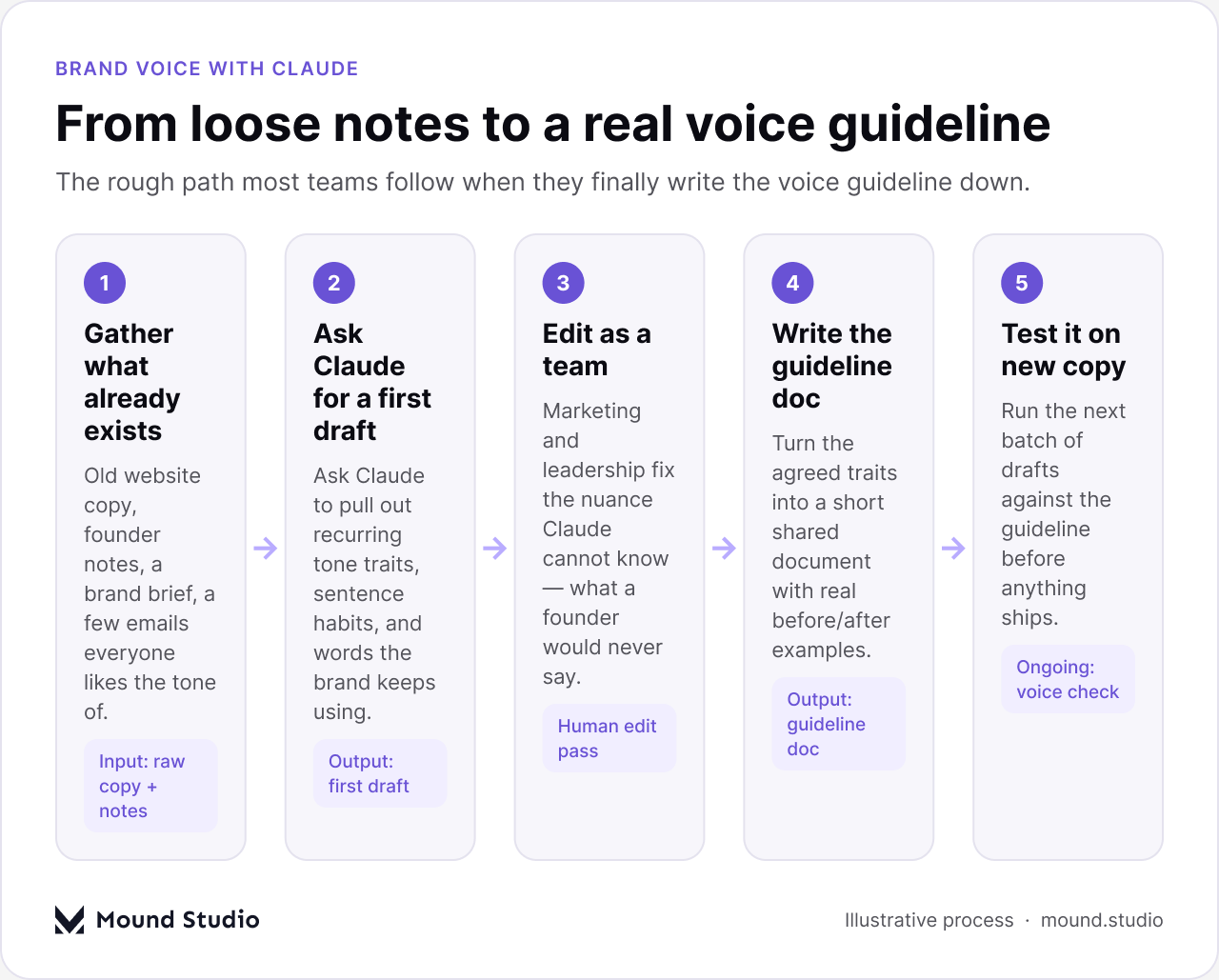
A few notes on that process. The first draft Claude produces from old copy is a starting point, not a finished guideline. It tends to over-generalize, and it will occasionally pick up a one-off quirk as if it were a rule. The team edit pass is where the guideline actually becomes accurate. Skipping it is the most common way a voice guideline ends up describing copy nobody on the team actually likes.
The raw material matters more than the prompt. Ten well-chosen pieces of existing copy beat a long, careful instruction with nothing to point at. A workable starting set usually includes the homepage and a couple of product pages, three or four emails the team already agrees sound right, any brand brief or positioning document that exists even in rough form, and a page or two of copy the team dislikes and can say why. That last part matters, since a guideline that only shows good examples doesn't teach anyone what to avoid.
From there, the ask is simple: read this copy, name three to five recurring traits, describe the sentence habits and word choices behind them, and flag anything that looks inconsistent across the pieces. What comes back is a first draft to argue with, not a guideline to publish. Teams that get the best results treat that first pass as a rough cut, not a finished job. The value is in having something concrete to react to instead of starting from a blank page.
A guideline that only lists three adjectives — "bold, friendly, clear" — doesn't tell anyone how to write a subject line or an error message. It needs enough structure that someone unfamiliar with the brand can pick it up and use it correctly on the first try.
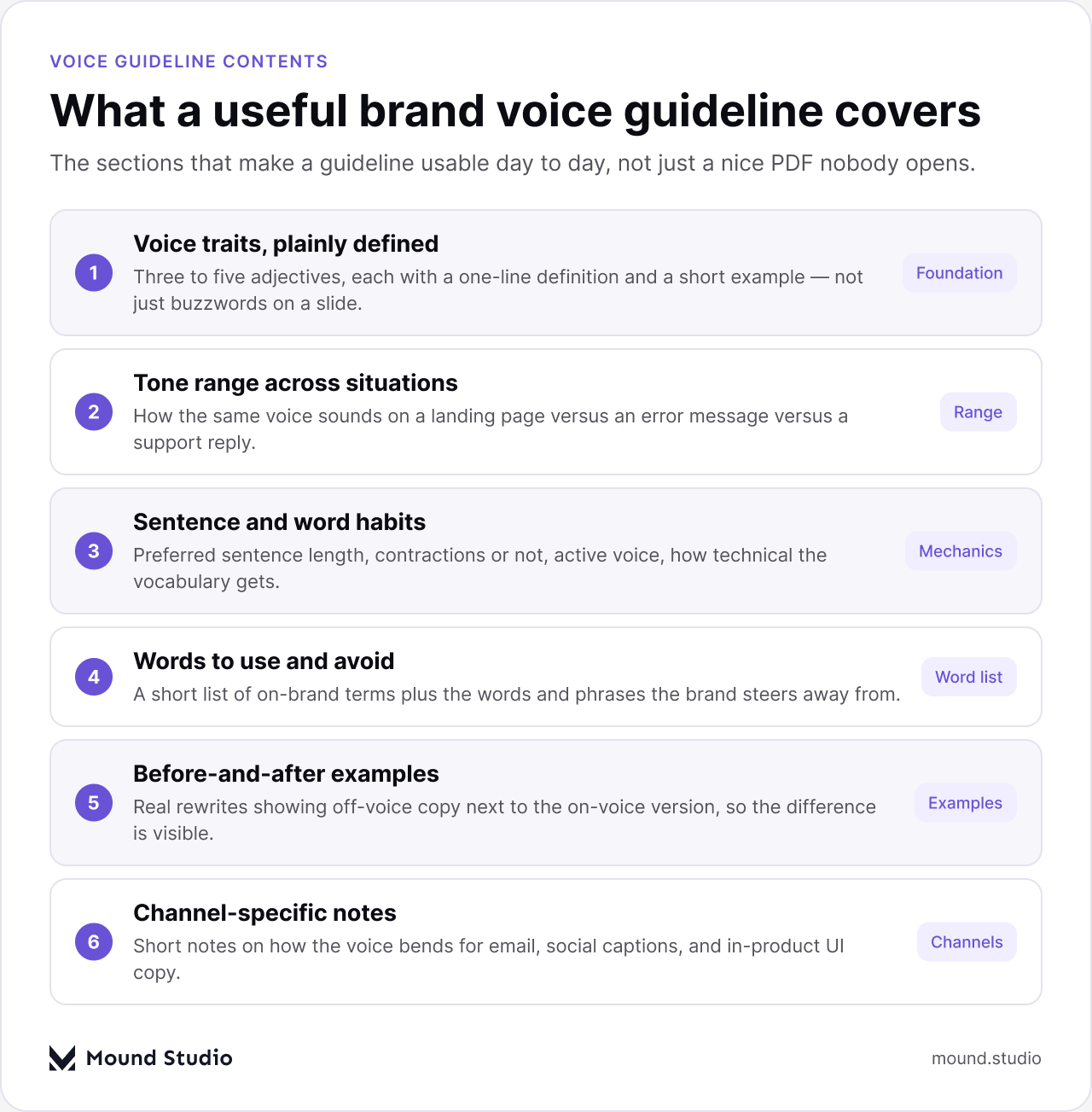
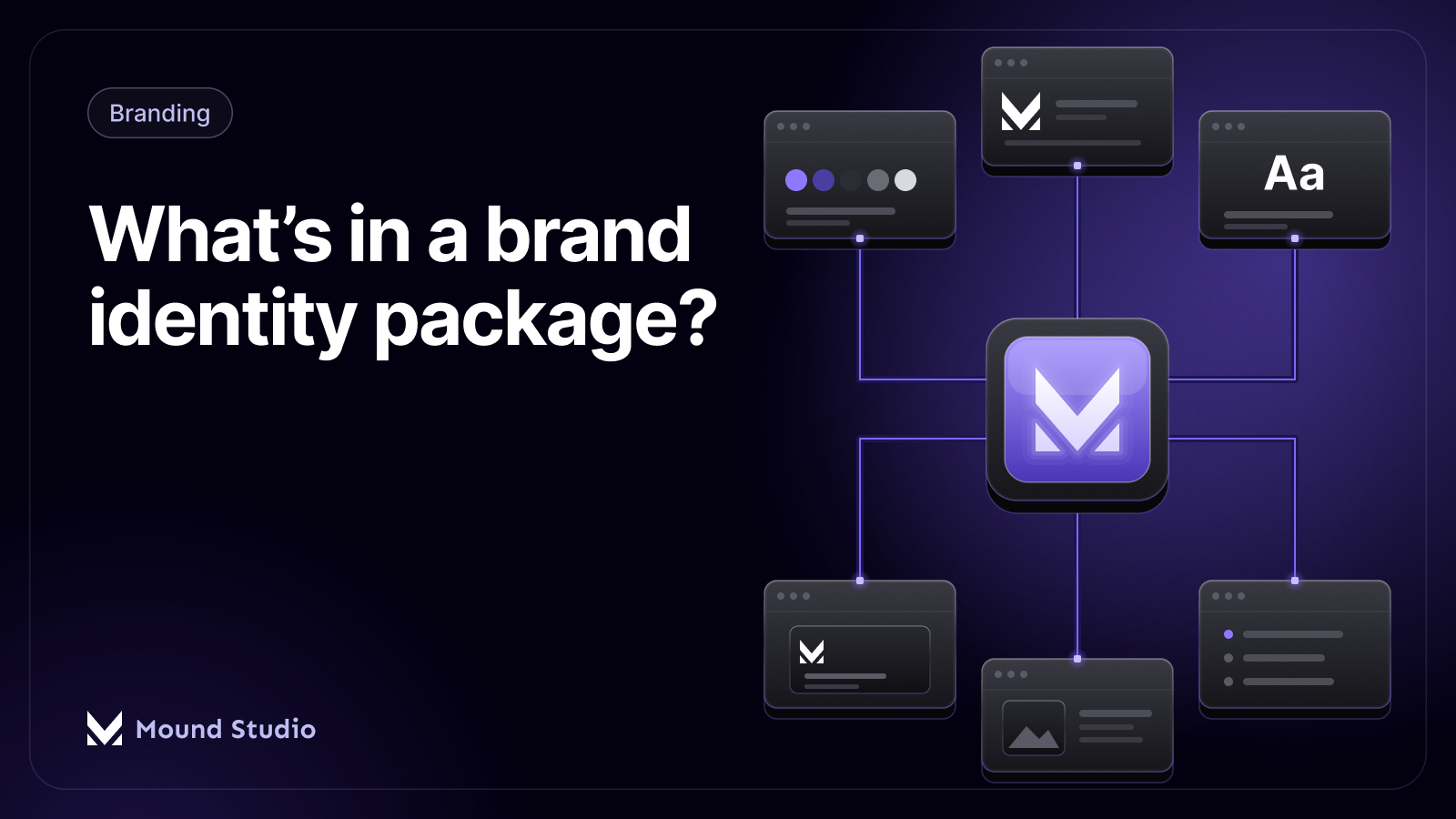
The table below sets out the same sections with a short note on what a good version of each one actually answers. This sits alongside the rest of a brand's identity system, and if you haven't mapped that out yet, our piece on what belongs in a brand identity package covers where voice fits next to logo, color, and type.
| Section | What it should answer |
|---|---|
| Voice traits | What three to five words describe the brand, and what does each one rule out? |
| Tone range | How formal or playful does the brand get on a landing page versus a refund email? |
| Sentence habits | How long are sentences on average, and are contractions used or avoided? |
| Word list | Which terms are always used for a product or feature, and which words are avoided? |
| Examples | What does an off-voice draft look like next to the corrected, on-voice version? |
Once the guideline exists, the next problem is enforcement. A guideline nobody checks drafts against is a document, not a standard. Feeding both the guideline and a new draft into Claude and asking it to flag anything that breaks a stated rule gives a first-pass read before a draft reaches a person who would otherwise have to catch every issue by eye.
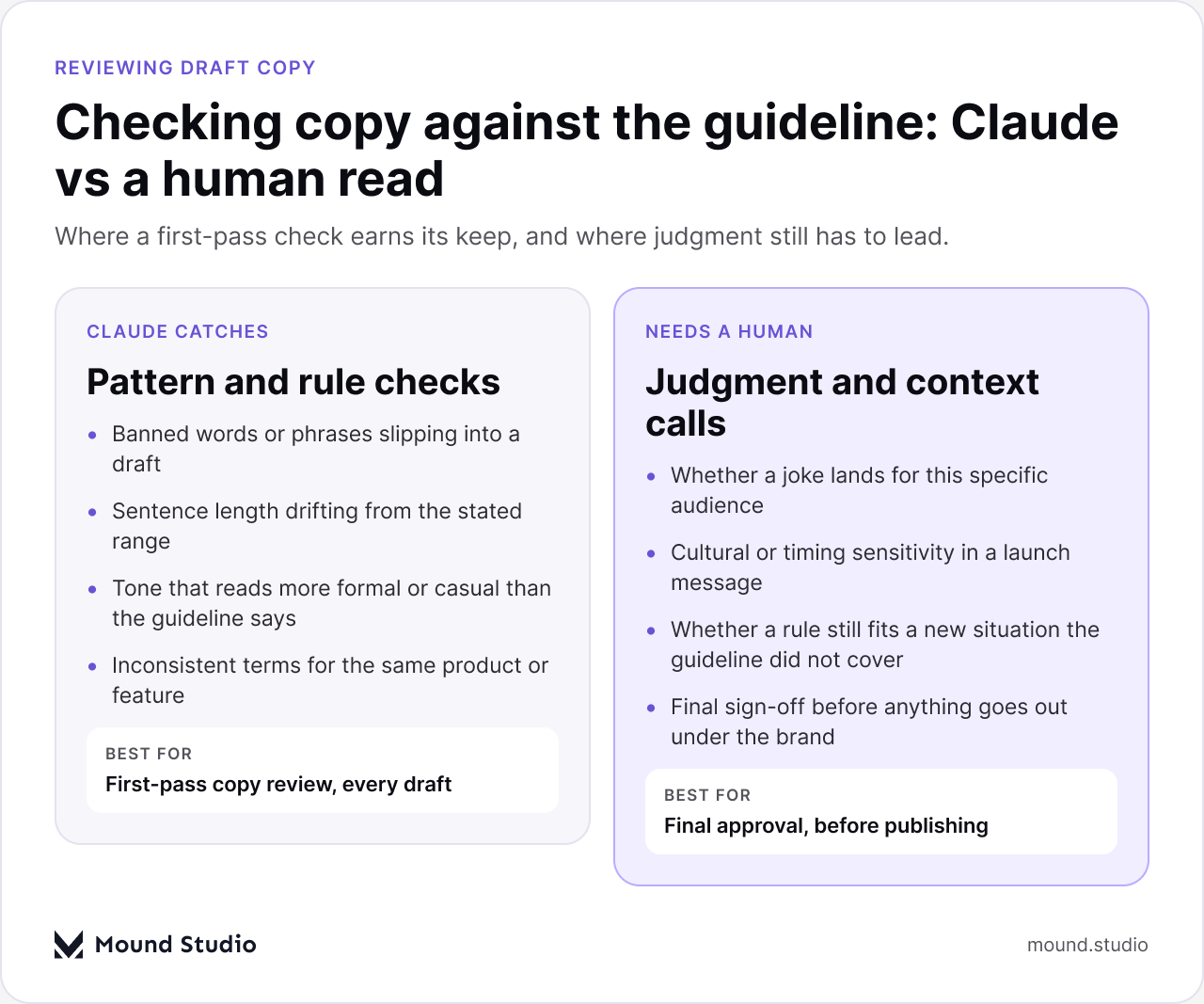
The pattern that works well in practice: use Claude for the pass that catches rule violations, things like banned words, tone drifting outside the stated range, and inconsistent product names, and keep a person responsible for anything that depends on context the guideline can't fully capture, like whether a joke will land with a specific audience or whether the timing of a message is right.
A product announcement written for the blog and copied straight into an email or a social caption usually reads wrong in at least one of those places: too long for social, too casual for a support reply, or missing context an email needs to make sense on its own. Claude can take one approved message and rework it for each channel while checking each version against the same guideline, so the core message and the voice both hold across all of them. It's the same underlying approach we use for UX writing and microcopy, just applied to marketing and support copy instead of interface text.
| Channel | What usually changes | What should stay the same |
|---|---|---|
| Website copy | Length, structure, headings | Word choice, sentence rhythm |
| Greeting, sign-off, level of detail | Core message, tone | |
| Social caption | Length, use of questions or hooks | Vocabulary, brand terms |
| In-product UI copy | Brevity, instruction style | Formality level, word list |
This is also where a documented word list earns its place. Without one, a rewrite for social often swaps in a synonym that reads fine on its own but breaks the consistency the guideline was meant to protect in the first place.
A single guideline doesn't always fit. A company with a consumer product and an enterprise sales motion often needs the marketing site to sound different from the sales deck, and a group with several sub-brands may want each one distinct while still recognizably part of the same parent. Claude handles this better as a base guideline plus short delta documents than as one document trying to cover every case.
The base guideline covers what's shared across every version: the word list, the core traits, and the things the brand never does regardless of audience. Each sub-brand or business line then gets a short addendum: what shifts in tone, what vocabulary changes, and one or two examples showing the difference next to the base version. This keeps the shared foundation from drifting apart while still letting each context sound like itself. Trying to hold all of that in one long document usually just makes the whole thing harder to use.
Run through this before deciding whether to write a new guideline from scratch, patch the one you have, or leave it alone for now.
If most of that list is true, the guideline is doing its job and just needs the occasional update when something new comes up. If none of it is true, the guideline probably needs the Claude-assisted rebuild described above, not a full rewrite from a blank page. The old copy is still useful raw material even if the document built from it never quite worked.
A brand voice guideline only earns its place if people actually open it before they write and check their drafts against it before they publish. Claude makes both of those steps faster: turning old copy into a first draft, catching rule violations before a draft reaches review, and reworking one message for every channel it needs to reach. The judgment behind the voice still has to come from the team that built the brand. If you want help documenting your brand's voice or checking whether the one you have is still doing its job, tell us what you're working on.
It can produce a solid first draft from existing copy and notes, but it still needs a team edit pass to catch nuance and confirm the traits actually match how the brand wants to sound.
Start with what already exists, such as website copy, a handful of emails everyone agrees sound right, and any brand brief, then ask Claude to pull out recurring tone and sentence patterns as a first draft to edit from.
Yes, if you give it both the guideline and the draft, it can flag banned words, tone drift, and inconsistent terms. It won't reliably judge context-dependent calls like humor or timing, so a person should still sign off.
Whenever a real exception comes up that the guideline didn't anticipate, or when the brand's audience or product changes enough that the original examples no longer fit.
The core traits and word list should stay the same everywhere. What changes by channel is length, formality, and structure, since an email and a social caption follow different shapes even when the voice underneath is identical.