








SEO & AEO
GEO vs SEO: What Generative Engine Optimization Really Means
Yes, for a good part of the day-to-day work. Claude can draft answer-first outlines, generate FAQ question sets, check a draft against a structure checklist, and summarize a stack of competitor pages faster than a person working alone would. What it cannot do is decide which claims are true, judge whether a competitor's content is actually good, or take responsibility for what goes live. The useful way to think about it is as a drafting and checking layer inside a workflow your team still owns, not a replacement for the strategy work.
SEO is built around ranking in a list of search results that a person then scans and clicks through. AEO, or answer engine optimization, is built around being the source an AI system pulls from when it writes a direct answer, a summary, or an AI Overview. The two overlap more than they conflict: both reward pages that answer a real question clearly, structure that content under headings, and back it up with specifics instead of filler. The difference is the audience for the opening lines of your page. A search results snippet gets scanned by a person. An AI answer often gets built from text that software is parsing and, in some cases, citing directly. We cover the mechanics of that shift in more detail in our guide to AEO vs SEO, and in how to write content that AI search can actually use.
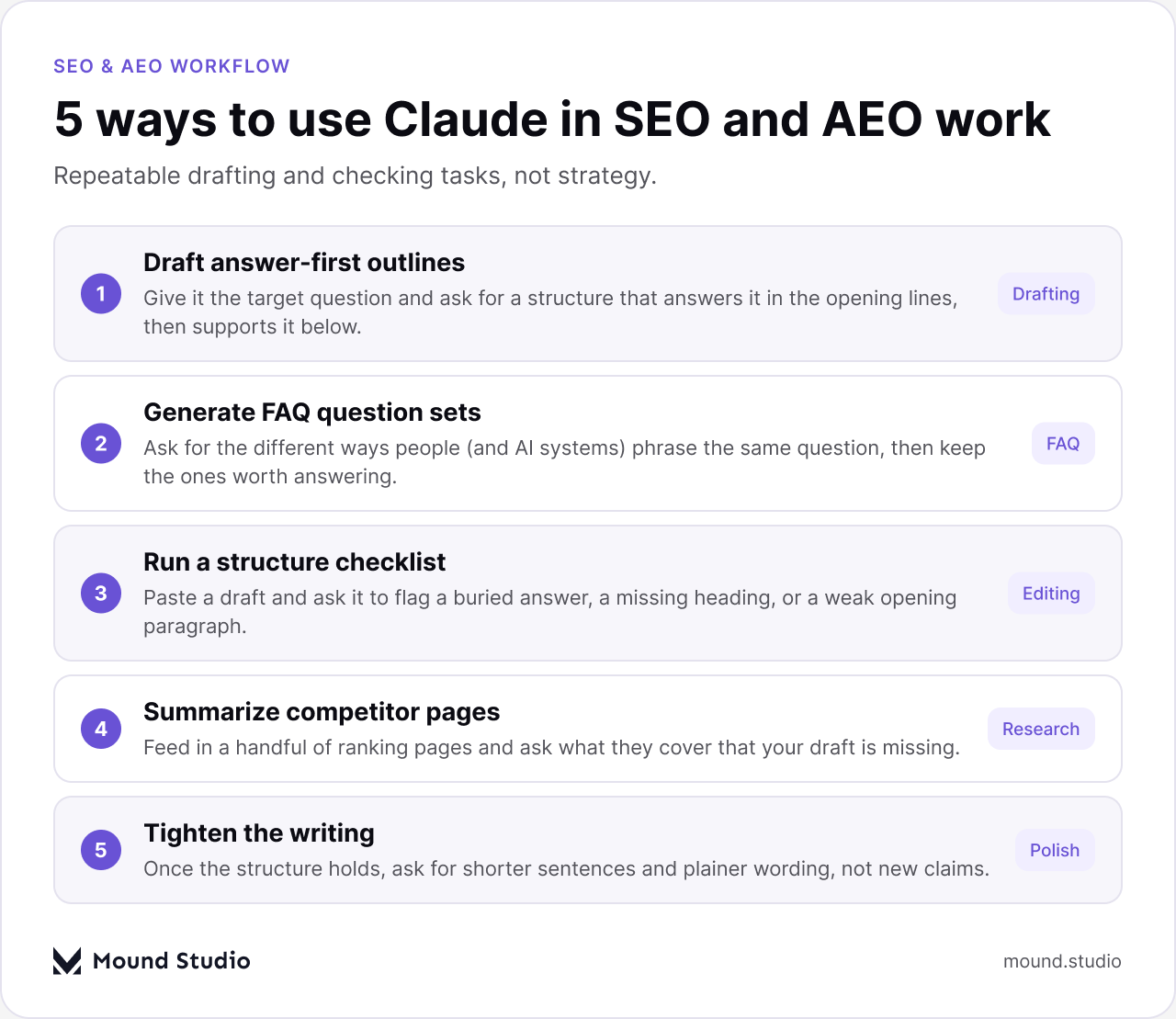
In practice, the fit is narrower and more useful than it sounds. Claude is strong at turning a target question into an answer-first outline, at listing out the different ways real people (and AI systems) phrase the same underlying question, and at reading a draft against a checklist to flag what's missing. It's also useful for a first pass on competitor content: paste in a handful of ranking pages and ask what topics or questions they cover that your draft doesn't. Each of these is a task with a clear input and a checkable output, which is exactly where a drafting tool earns its place. None of them require Claude to know whether a claim is true, whether a competitor's advice is actually good, or what your brand should commit to in writing. Those calls stay with the people who own the content.
The quality of what comes back depends almost entirely on what goes in. A brief that says "write about SEO" produces a generic draft, because there's nothing specific to answer. A useful brief names the exact question a reader is typing, who that reader is, what they already know, and what facts or examples must show up in the answer. It also says what to leave out: claims you can't back up, competitors by name if that's not your style, or a tone that doesn't match the rest of the site. Five minutes spent writing that brief usually saves far more time on the editing pass, because the first draft starts closer to something you'd actually publish.
The technique itself is simple once the brief is solid. Give it the exact question you want the page to answer, tell it the audience, and ask for an opening that answers the question directly within the first two or three sentences. Then ask for the supporting structure below: the headings, the order of sections, and where examples or specifics should sit. A workable sequence looks like this:
What makes this different from asking for "an SEO article" is the constraint. A vague brief gets a vague draft. A specific question with a specific audience gets a specific answer, which is what both a reader and an AI system are actually looking for.
| Element | What to check | Why it matters |
|---|---|---|
| Opening lines | Answers the question within the first two or three sentences | AI systems often pull from just the opening |
| Headings | Phrased like the real questions people type | Matches how people and AI search actually query |
| Supporting detail | Backs the answer with specifics, not filler | Keeps the page useful for a human reader too |
| FAQ block | Covers the follow-up questions, answer-first | Gives AI systems a self-contained answer to cite |
Ask it for the different ways a real searcher, or an AI system parsing a question, might phrase the same underlying need. People rarely ask a question the way a marketer would write a heading, and a good FAQ set captures that gap. Ask for concise, answer-first responses to each variation, then do two things before you keep any of them: trim the ones that overlap so the page doesn't repeat itself, and check every answer against your own product or process, because a plausible-sounding answer is not the same as an accurate one.
Paste in a finished draft along with the rules you want it held to: no buried answers, no missing headings, no banned words, a clear opening. Ask it to point out exactly where the draft breaks those rules, line by line if needed. This is where Claude is consistently reliable, because checking a draft against a fixed list of rules is a narrow, well-defined task. It will catch the kind of thing a writer skims past after reading their own draft five times: an answer that shows up in paragraph three instead of paragraph one, a heading that reads like a title instead of a question, an FAQ that skips the one question people actually ask.
Claude does not browse the live web as part of this workflow, so the useful version of this task starts with you gathering the pages: pull the text from a handful of pages currently doing well for your target question, paste them in, and ask what topics, examples, or angles they cover that your draft is missing. This is a fast way to spot a gap in coverage: a question nobody on your team thought to answer, an angle you hadn't considered, a format like a comparison table that keeps showing up because it works. It is not a fast way to verify a competitor's claims, their numbers, or whether their advice is actually sound advice, and it's not a way to judge writing quality either, since a page can rank well without being especially good. Treat the output as a list of things to check and possibly cover, not a list of things to copy.

Four things belong to your team, every time. Whether a claim is true and current, because Claude can restate something confidently without knowing it's wrong. Whether a competitor's content is actually good, since being highly ranked isn't the same as being accurate or well-reasoned. What the brand should say and how it should sound, since a house voice is a decision, not a default. And the final review before anything publishes, because responsibility for a published page does not transfer to a drafting tool. A workflow that skips any of these four is cutting a corner it will eventually have to go back and fix.

Start with a brief that names the target question, the audience, and any facts that must be included. Ask for a draft built on that brief. Run the draft against your structure checklist and your FAQ needs. Have a person verify facts, tone, and any competitor claims the draft leans on. Publish, then reuse the same brief format for the next question. The value here isn't any single step; it's that the loop is repeatable, so the second and third pieces of content take less setup than the first.
Most of the problems we see come from treating a fast draft as a finished one, or from asking Claude to make a call it isn't positioned to make. None of these are hard to avoid once you know to watch for them.
A short way to sort tasks is to ask whether the output is checkable against a clear rule. If yes, it's usually a good fit. If the task is a judgment call about truth, quality, or brand, put a person on it first.
| Task | Good fit for Claude | What still needs a human |
|---|---|---|
| Answer-first outline | Yes | Confirm the facts it's built on |
| FAQ question variants | Yes | Verify every answer |
| Structure checklist review | Yes | Decide if a flagged issue is worth fixing |
| Competitor page summary | Yes | Confirm any claim before you rely on it |
| Brand voice and final claims | No | Always a human call |
Before anything Claude helped draft goes live, run it through a short check: does the opening answer the question, are the facts confirmed against your own sources, does the FAQ cover what people actually ask, and has a person signed off on tone and accuracy. If any of those is missing, the draft isn't done yet.
Claude is a useful part of an SEO and AEO workflow when it's kept to drafting and checking: answer-first outlines, FAQ sets, structure reviews, and first-pass competitor reads. It's not a strategy team, a fact-checker, or a substitute for a person deciding what your brand should say. Build the workflow around that split and the tool earns its place without creating new problems to clean up later. Most teams find the biggest gain isn't in any single draft, but in how much faster the second and third piece of content come together once the brief, the checklist, and the review step are all in place. If you want help setting up a content workflow that uses AI where it helps and keeps judgment where it belongs, tell us what you're working on.
It can produce a full draft, but the strategy, keyword judgment, and fact-checking still need to come from your team. Treat the draft as a strong starting point, not a finished page.
AEO is about being the source an AI system pulls from when it builds a direct answer, rather than only ranking on a results page. It matters because a growing share of searches now end with an answer instead of a click.
No. It works from what you give it, so paste in the actual competitor content or your own data rather than asking it to recall current rankings or figures from memory.
Give it your own facts, examples, and voice to work from, then edit the output down to plain, specific language instead of publishing the first draft as final.
No. It's most useful for structure, FAQ sets, and checklists, and least useful for original strategy calls or claims that need firsthand verification.