








Agency
How to Choose a Web Design Agency in 2026: 12 Questions to Ask

Once a contract is signed, most design agency onboarding follows a similar shape: a kickoff call to align on goals, a short window to collect brand assets and account access, a discovery phase where the agency researches the audience and competitors, and then a first round of deliverables that opens the ongoing feedback loop. The exact pacing shifts with project size and scope, but that four-part sequence — kickoff, access, discovery, first deliverables — is the backbone of almost every engagement, whether the project is a brand refresh, a new website, or a full product redesign.
Knowing what to expect in those opening weeks matters more than it seems. A client who understands the shape of onboarding can prepare the right materials ahead of time, answer questions faster, and avoid the stop-start pattern that stretches timelines and frustrates both sides. It also sets expectations correctly: the first few weeks of a project are rarely about seeing polished screens — they are about making sure the work that follows is pointed in the right direction. Clients who expect visuals immediately sometimes read a quiet discovery phase as a lack of progress, when in most cases it is the opposite.
This guide walks through what actually happens after you sign with a design agency, what to have ready before the first call, how communication tends to work, and the habits that separate projects that move quickly from ones that stall.
The period right after signing is less about design work and more about setup. Agencies use this time to gather context, confirm scope, and build the foundation the actual design and development work will sit on. Skipping or rushing this stage is one of the more common reasons projects lose momentum later, because decisions made without enough context tend to get revisited.
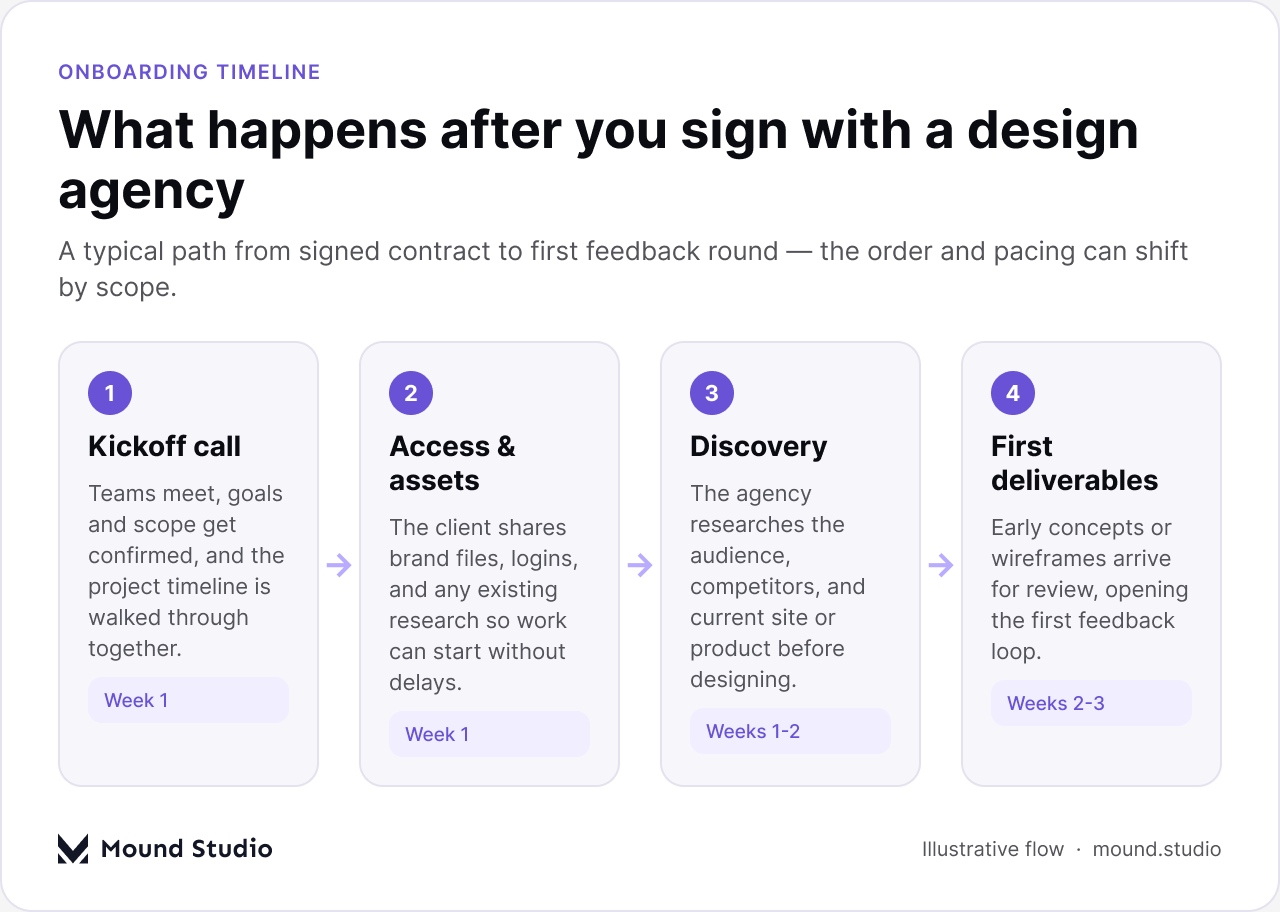
This is usually the first real conversation after the contract is signed. The agency and client team walk through goals, audience, scope, and the rough shape of the timeline together. It is also where everyone meets the people they will be working with for the next several weeks or months, which matters more than it sounds — a kickoff call with the right stakeholders in the room tends to surface misalignments early, before they turn into rework. A good kickoff usually ends with a shared understanding of what "done" looks like for the first phase, not just a list of deliverables and dates.
Immediately after kickoff, the agency will ask for brand files, existing research, analytics access, and any logins needed to audit the current site, product, or systems. This step is often the quiet bottleneck of onboarding — not because the work is hard, but because gathering scattered credentials and files across a team takes longer than anyone expects. Clients who have this ready at signing routinely move through the first two weeks faster than those who collect it piecemeal, chasing down a password here and a font file there while the agency waits to start.
With access in hand, the agency researches the audience, reviews competitors, and audits what already exists — the current site, the current brand, or the current product, depending on scope. Discovery is where most of the thinking happens before any visual work begins: identifying what is working, what isn't, where competitors are strong or weak, and what the audience actually needs from the end result. Projects that skip or shorten discovery tend to produce designs that look fine in isolation but miss something the client only notices once it is in front of them, which usually means a slower first review round, not a faster one. It is also common for discovery to surface questions the client hadn't considered — about priorities, audience segments, or technical constraints — which is part of why this phase rarely moves as fast as a kickoff call alone might suggest.
The first concepts, wireframes, or direction options usually arrive once discovery findings are in place. This is the point where the relationship shifts from information-gathering to collaboration — the client reviews, the agency explains the reasoning behind choices, and feedback starts shaping the next round. How this first loop goes often sets the tone for the rest of the project, which is part of why clear, consolidated feedback matters so much in these early rounds. A first round that goes well usually isn't the one with zero feedback — it's the one where the feedback is specific, tied to the project's goals, and gathered from the right people before it reaches the agency.
Preparation before the first call is one of the clearest levers a client has over how smoothly onboarding goes. None of it requires special expertise — it is mostly a matter of gathering what already exists and deciding who needs to be in the room.

If a client is still deciding which agency to work with at all, it is worth reading through how to choose a web design agency and the list of questions to ask a design agency before signing — the answers to those questions often reveal how structured an agency's onboarding process actually is.
| Touchpoint | Who's usually involved | What it typically covers |
|---|---|---|
| Kickoff call | Project lead on both sides, key stakeholders | Goals, scope, timeline, team introductions |
| Asset handoff | Client's internal point of contact | Brand files, logins, existing research |
| Discovery review | Agency strategist or lead designer | Research findings, audience and competitor notes |
| First feedback round | Approving stakeholders | Reactions to initial concepts or wireframes |
A useful companion to this preparation is a written brief. Agencies that ask for one early are usually trying to avoid guesswork later — see what belongs in a website design brief for a sense of what that document should include before the first call even happens.
Communication patterns vary by agency, but a few habits show up often enough to call common rather than universal. Many teams default to async updates — short written check-ins between calls — rather than daily meetings, since onboarding work (research, asset organization, early concepts) does not always need a live conversation to move forward. Review cadence tends to follow the shape of the deliverables rather than the calendar: a call or written summary after discovery wraps, another after the first concepts are ready, rather than a fixed weekly rhythm regardless of what is actually done.
This is a pattern, not a rule. Smaller projects sometimes run on tighter, more frequent check-ins; larger ones with more stakeholders often need more structure and more advance notice before reviews. What tends to matter more than the exact cadence is clarity about where things stand and what is coming next, so neither side is guessing.
Most agencies run onboarding through a mix of a shared project board, a messaging channel for quick questions, and a shared drive for files and references. None of these tools are unique to design work — they are the same kind of setup most client-facing teams use — but having one agreed place for files and one agreed place for conversation cuts down on the back-and-forth of "did you see the note I sent" that otherwise eats into review time. A short written summary after each major call, even an informal one, also tends to prevent the same question from being asked twice a few weeks later.
Participation is where a lot of onboarding timelines are actually won or lost. The work itself — research, design, iteration — takes roughly the time it takes. What varies wildly between projects is how long feedback takes to come back, how many people weigh in, and how clear the priorities are when it does.

A few habits reliably add weeks to a timeline. Feedback that sits untouched for two or three weeks loses momentum and forces the team to re-familiarize itself with the work before responding to notes. Having many stakeholders review separately, rather than consolidating into one note, often produces conflicting direction that is harder to resolve than if no feedback had come in at all — one reviewer asking for bolder colors while another asks for something more subdued leaves the agency with no clear direction to design toward. And reviewing work without stating what matters most — tone, functionality, speed to launch — leaves the agency guessing at priorities instead of designing against them.
None of this is about clients being difficult. In most cases, slow feedback and scattered approvals come from genuine scheduling pressure, not a lack of interest in the project. The fix is rarely about trying harder — it's about agreeing on a feedback process at kickoff, so turnaround time and approval order are expectations from the start rather than something negotiated mid-project when a deadline is already at risk.
| Common mistake | Why it slows things down |
|---|---|
| Feedback left for weeks | Context is lost on both sides, momentum stalls |
| Too many separate approvers | Conflicting notes create extra rework cycles |
| No stated priorities | Feedback becomes subjective instead of goal-driven |
| Scope added mid-review | Timeline and budget assumptions no longer hold |
Agencies that scope work by project rather than ongoing retainer tend to be more sensitive to these mistakes, since added scope has a more direct effect on budget and timeline. The difference matters enough that it is worth understanding before signing — see retainer vs. project-based agency pricing for how that choice can shape how flexible onboarding and later scope changes will feel.
Before the first call, a client is in good shape if they can check off most of the following:
None of this needs to be polished. A messy folder of logos and a half-finished list of competitor sites is still far more useful than starting from nothing — the goal is to save the first weeks for research and direction, not for chasing down files.
Design agency onboarding is not a black box — it tends to follow a kickoff call, an access and asset handoff, a discovery phase, and a first round of deliverables that opens the feedback loop. What a client controls most is preparation and participation: having assets and access ready, naming one clear approver, stating priorities up front, and turning feedback around consolidated and on time. Projects that get these right tend to move through the early weeks with far less friction than those that don't. If it would help to talk through what onboarding would look like for a specific project, get in touch with our team.
The first step is usually a kickoff call, where the agency and client team align on goals, scope, and the rough timeline before any research or design work begins.
There's no universal number, but discovery and the first round of deliverables commonly take a few weeks depending on project scope — the client's preparation and feedback speed affect this more than the agency's internal process.
Brand assets, access credentials for relevant platforms, a named point of contact, and a short list of stakeholders who need to approve decisions.
Because early feedback loops set the pace for the rest of the project — slow or inconsistent feedback in the first rounds tends to compound into longer delays later on.
One named approver per phase, who gathers input beforehand, is far more common and leads to fewer conflicting revisions than open review by several people at once.