








Branding
8 Brand Identity Elements Every Business Needs

You name a business by setting clear criteria first, generating a wide list of options, screening each finalist for trademark and domain conflicts, testing the strongest names with real people, then filing the name before you build a brand around it. Skipping the screening and testing steps is the most common reason a business ends up renaming later. The process below is the one we walk clients through on naming projects, from a first product name to a full company rename.
A good business name is easy to say, easy to spell from hearing it once, free to use without trademark conflict, and able to stretch as the business grows. It does not have to describe exactly what you sell. Some of the strongest names in any category are the ones that said little at launch and let the product define the word over time.
Before you brainstorm a single option, agree on the criteria you will judge every name against. Write these down. A shortlist without agreed criteria turns into a popularity contest in a meeting room, and the loudest opinion wins instead of the best name.
| Criterion | Why it matters |
|---|---|
| Pronounceable | People need to say it out loud, read it from a sign, and repeat it to a friend |
| Spellable from sound | A name people mishear or misspell loses search traffic and referrals |
| Trademark-clear | Avoids a forced rename after you have spent on signage, packaging, and marketing |
| Domain-available | A workable domain under mound.studio-style conventions keeps the brand consistent online |
Criteria should also cover tone: formal or casual, serious or playful, literal or abstract. If you run a rebrand rather than a fresh launch, add one more criterion: how close the new name can sit to the old one without confusing existing customers.
Brainstorming works best with structure, not a single open-ended session. We run naming workshops through several methods in sequence, because each method surfaces a different kind of name and together they cover far more ground than free association alone.
Aim for a long list before you cut anything. Fifty to a hundred raw options is a reasonable range for a single business name; a narrower product-line name can work from a shorter list once the parent brand is set. Mix the methods within a single session rather than running them one after another in separate meetings, since a name generated under one method often triggers a better variation under a different one a few minutes later.
Once the raw list exists, do a first pass purely on gut reaction: read every name aloud and cut anything that is hard to say, easy to misspell, or already close to a name you recognize in the category. This first cut usually removes more than half the list and leaves a working shortlist you can run through criteria and screening without wasting time on names that were never going to survive contact with a trademark search.

Most business names fall into one of three families, and the right one depends on how much the name itself needs to carry versus how much marketing will carry over time.
A descriptive name tells people what you do immediately, which helps a local or category-first business get understood fast, but it is harder to trademark broadly and easy for competitors to echo. An invented or abstract name takes more effort to explain early on, but it is easier to own as a trademark and does not box the business into one category if it expands. A founder or heritage name builds a personal, story-driven feel, which suits studios and consultancies, though it ties the brand to one person's reputation going forward.
| Approach | How it reads | Trademark strength | Good fit |
|---|---|---|---|
| Descriptive | Says what you do | Weaker, hard to own broadly | Local, category-first businesses |
| Invented / abstract | Needs explaining at first | Stronger, easier to defend | Brands planning to expand |
| Founder / heritage | Personal, story-led | Moderate, tied to the name's use | Studios, consultancies, legacy firms |

Run a trademark and domain screen on every name before you test it with anyone outside the project. Testing a name that turns out to be unavailable wastes the goodwill of the people you asked and sends you back to the brainstorm with a shorter list than you think you have.
At minimum, check the trademark register in your country and the category you operate in, search the name plus your industry term in a search engine to see who else uses it, and check the matching domain and the social handles you actually plan to use. A name can pass a casual search and still conflict with a registered trademark in your exact category, which is why a real trademark search matters more than a search engine check alone.
Watch for near-matches too, not just exact ones. A name that only differs from a registered mark by a letter or a plural can still draw a legal objection, especially in a crowded category. If you are naming a product or feature rather than the company itself, the screening bar is usually lower, but it is still worth a basic search before the name appears on packaging or a pricing page.
A business does not need a registered trademark to have rights in a name. In many places, simply using a name in commerce builds up unregistered, common-law rights in the area where that business operates, and a formal trademark register search will not always surface that kind of use. This is one more reason a plain search engine check matters alongside the formal trademark register search, especially for a name that will operate locally or regionally rather than nationally.
Testing a name means putting it in front of people who are not already attached to the project and watching how they handle it, not asking whether they like it. Liking is a weak signal; recall, spelling, and pronunciation are strong ones.
Keep the test group small and relevant rather than broad and random. A handful of people who match your actual customer profile will tell you more than a large group with no connection to the category.
The mistakes below account for most of the naming regrets we see, and nearly all of them trace back to skipping a step rather than picking the wrong word.
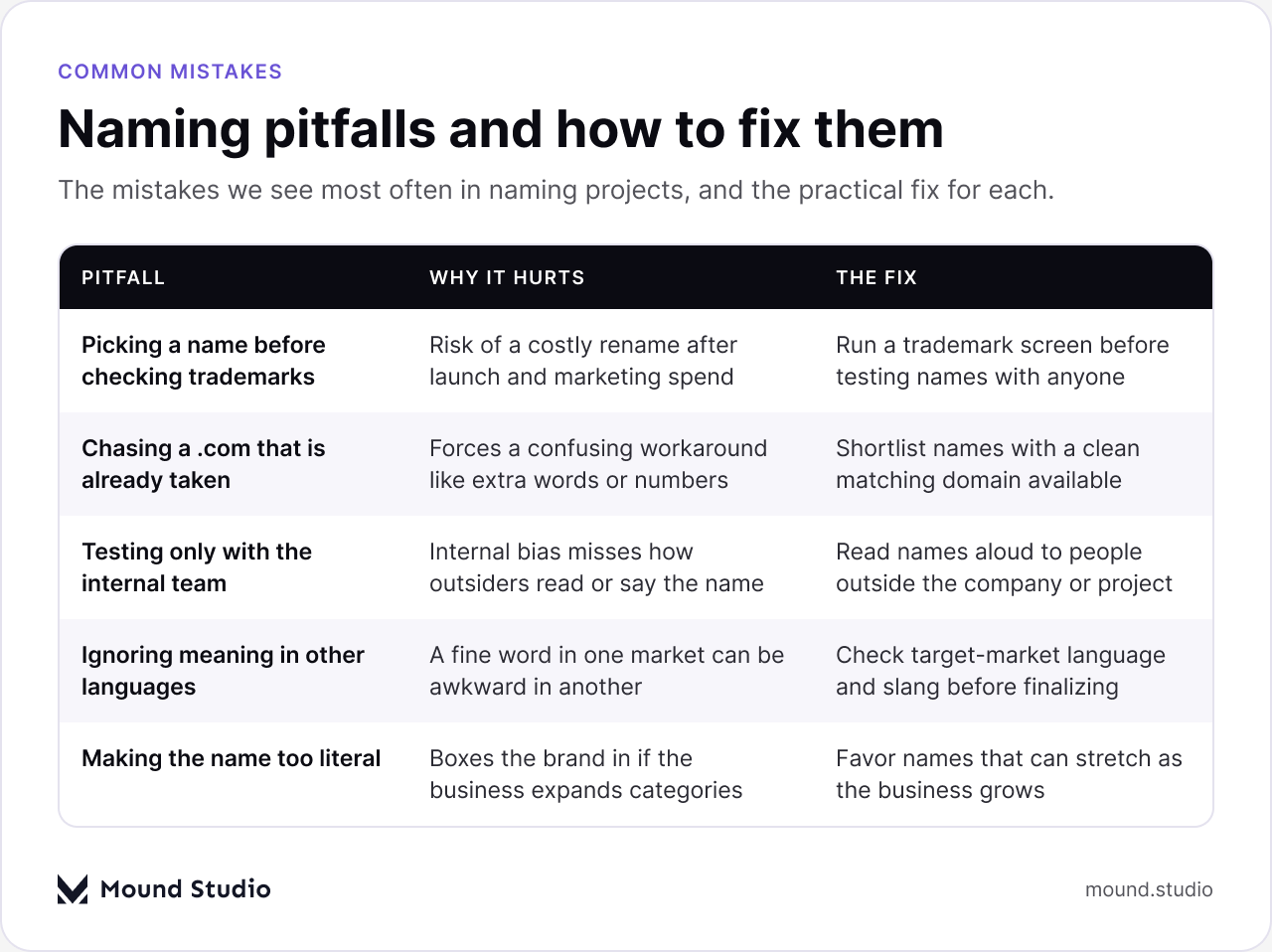
Picking a name before checking trademarks is the costliest mistake, since it risks a forced rename after signage, packaging, and marketing spend. Chasing an already-taken domain forces an awkward workaround, like adding an extra word or a number that nobody types correctly. Testing only with the internal team misses how outsiders actually read or say the name, since everyone inside the project already knows what it means. Ignoring how the name reads in other languages can turn a fine word in one market into an awkward one in another, which matters as soon as the business sells beyond its home market. And a name that is too literal can box the brand in if the product line grows past its original category.
A parent company name and a product name usually need different qualities. The parent name should be flexible enough to sit behind everything the business eventually makes, while a product or sub-brand name can be more specific, descriptive, and short-lived if needed.
| Entity | Naming goal | Example pattern |
|---|---|---|
| Parent company | Flexible, trademark-clear, built to last | Stands alone, no category word baked in |
| Product line | Specific, descriptive, easy to swap later | Parent name + product descriptor |
| Sub-brand | Distinct identity, still traceable to parent | Own name with a "by [Parent]" tagline |
A consistent naming convention across a product line also makes it easier to add new products later without a separate naming project each time. Set the pattern once, during the parent company naming work or shortly after, so it is in place before the second or third product arrives. This is also where visual consistency matters: see our notes on brand identity elements for how naming connects to logo, color, and type decisions across a product family.
A rename carries constraints a fresh name does not: existing customers, search rankings, signage, contracts, and reviews all point to the old name. The criteria-setting and screening steps are the same, but the brainstorm has one more filter, which is how much distance the new name needs from the old one.
Some rebrands keep a thread to the original name on purpose, trimming or adjusting it rather than replacing it outright, to carry recognition forward. Others cut ties completely, usually because the old name is tied to a problem the business wants to leave behind, or because the business has grown well past what the original name describes. Either way, plan the transition communication alongside the name itself. A name change that customers hear about after the fact, rather than before, creates more confusion than the new name itself ever will. For a full walkthrough of what that transition involves, see our guide to rebranding a business.
By the time you reach a true shortlist, every remaining name has usually cleared the basic bar: it is pronounceable, trademark-clear, and has a workable domain. The decision at that point is less about rules and more about fit, and a short set of tie-breaker questions helps move it along without going in circles.
When a decision stalls because two or three people each prefer a different finalist, go back to the criteria list from the start of the project rather than relitigating personal taste. The name that best matches the written criteria should win the tie, even if it was not anyone's first instinct.
Once a name clears this checklist, the next step is usually visual identity: logo, color, and type decisions that need a settled name to build around. Our piece on choosing brand colors is a reasonable next stop once the name itself is locked.
Naming a business goes faster and holds up better when criteria, screening, and testing happen in that order, not as an afterthought once a name already feels right. If you want help running a naming project for a new business, a product line, or a rename, get in touch with our team.
A focused naming project typically runs a few weeks from criteria-setting through testing and legal screening. The screening step is usually the bottleneck, since trademark searches and domain checks take longer than the brainstorm itself.
Not necessarily. A descriptive name helps people understand the business quickly but is harder to trademark and can limit the brand if it expands into new categories. An abstract or invented name takes more explaining at first but tends to hold up better over time.
A preliminary search can be done without one, but a trademark attorney should review any finalist before you file or commit to heavy marketing spend. The cost of a review is small next to the cost of a forced rename.
Treat a taken domain as a signal to reconsider the name, not a problem to engineer around. Workarounds like extra words or misspellings tend to confuse customers and hurt word-of-mouth referrals more than they save.
It can, especially for a single-product business, but a company planning multiple products usually benefits from a naming convention that separates the parent name from each product name, so new products do not need a full naming project of their own.