








SEO & AEO
How to Optimize Your Website for AI Search in 2026 (AEO Guide)
Someone types a question into ChatGPT, Gemini, Perplexity, or an AI-powered search box, and instead of ten blue links they get a written answer. If that question is about your business, an AI tool now decides what to say about you before the person ever opens your website. It pulls from your own pages and from whatever else it can find about you across the web, then compresses that into a short, confident summary.
That summary might be accurate. It might also be built from an outdated service list, a bio a directory scraped years ago, or a name spelled two different ways across your own profiles. Either way, the person reading it treats it as fact, because it arrived with the tone of an answer, not a suggestion. This guide is about making sure that answer is the one you would actually stand behind.
What AI tools say about your brand depends on how clearly and consistently your brand describes itself, on your own site and everywhere else it shows up online. Consistent naming, plain factual "about" and services content, current pricing and contact pages, and basic structured data all make it easier for a tool to describe you correctly. Start by checking what these tools say about you right now, then tighten the pages that feed that answer.
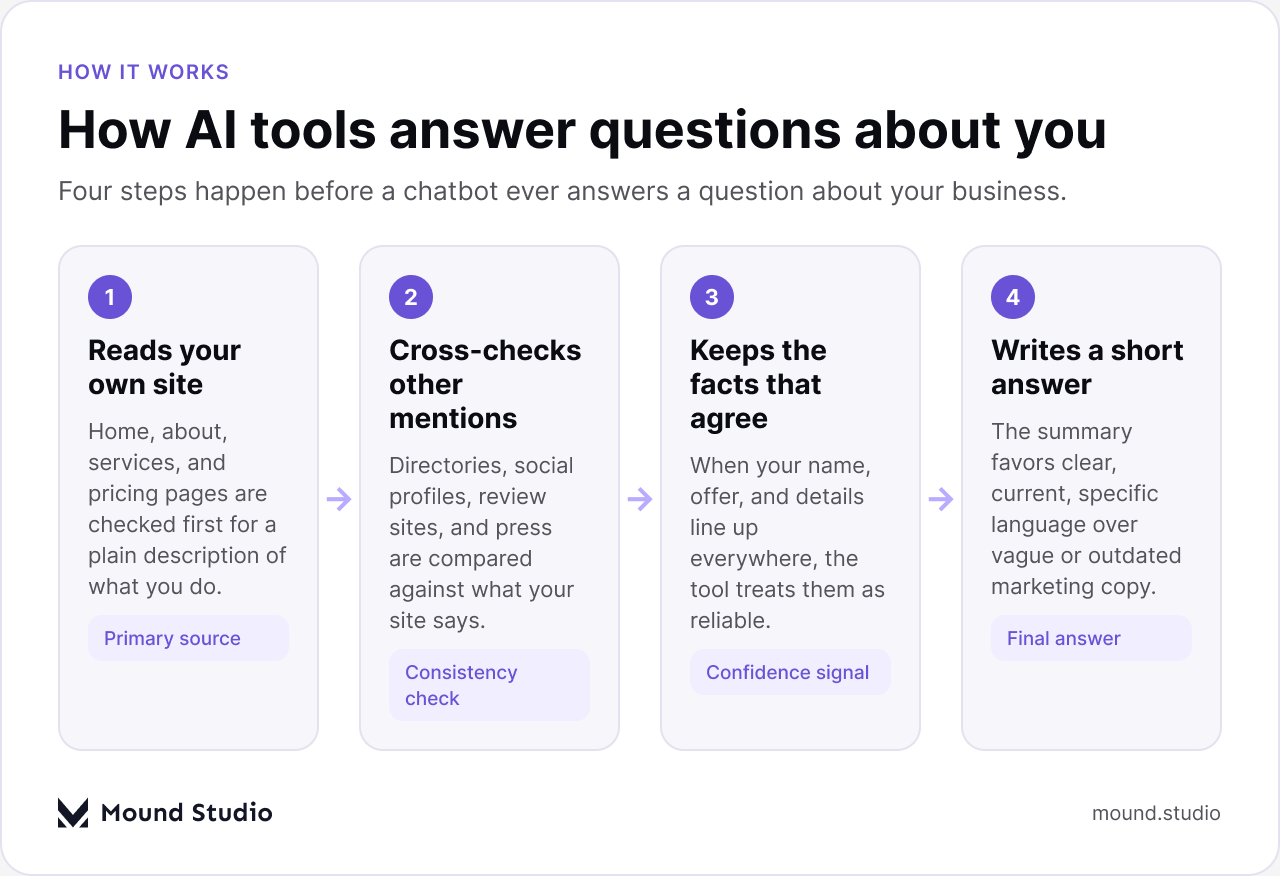
It helps to picture the actual mechanics, because "AI search" sounds abstract until you see the steps. When a person asks an AI assistant something like "what does [your company] do" or "is [your company] good for small teams," the tool is not consulting a single, authoritative profile it keeps on file for you. It is pulling together fragments.
First, it checks whatever it can read from your own site: your homepage, your about page, your services or product pages, and anything that reads like a plain description rather than a slogan. Second, it looks at how the rest of the web talks about you: directories, review sites, social profiles, press mentions, and anywhere your name shows up next to a description of what you do. Third, it looks for agreement. When your site and the wider web tell the same story, the tool treats that story as reliable and repeats it with confidence. When they disagree, the tool has to guess which version is current, and it does not always guess in your favor.
This is the part worth sitting with: your website is not the only input, but it is usually the most trustworthy one available, and it is the one you fully control. Getting it right does more for how you are described than almost anything else on this list.
It also explains why two businesses offering nearly identical work can get very different answers from the same tool. One keeps its services page current and says the same thing about itself everywhere it appears online. The other has a homepage that has not been touched in two years, a directory listing from an old address, and a social bio written by someone who left the company. The tool is not being unfair to the second business. It is working with worse material.
Before changing anything, find out where you actually stand. This takes twenty minutes and tells you more than any amount of guessing.
Patterns show up quickly. A tool might describe a service you retired two years ago, use an old company name, or answer "I don't have specific information about that" for a question your own homepage answers in one sentence. Each of those is a clue pointing at a specific page to fix.
| Question to ask | What a good answer includes |
|---|---|
| What does the company do? | A plain, current description that matches your own homepage, not last year's positioning |
| Who is it for? | A specific audience or industry, not a vague "businesses of all sizes" |
| How does pricing work? | An honest description of the pricing approach, even without exact numbers |
| How do I contact them? | A working contact route the tool can name with confidence |
Not every page on your site carries equal weight for this. A handful of pages do most of the work of telling an AI tool, and a human reader, what you actually are.
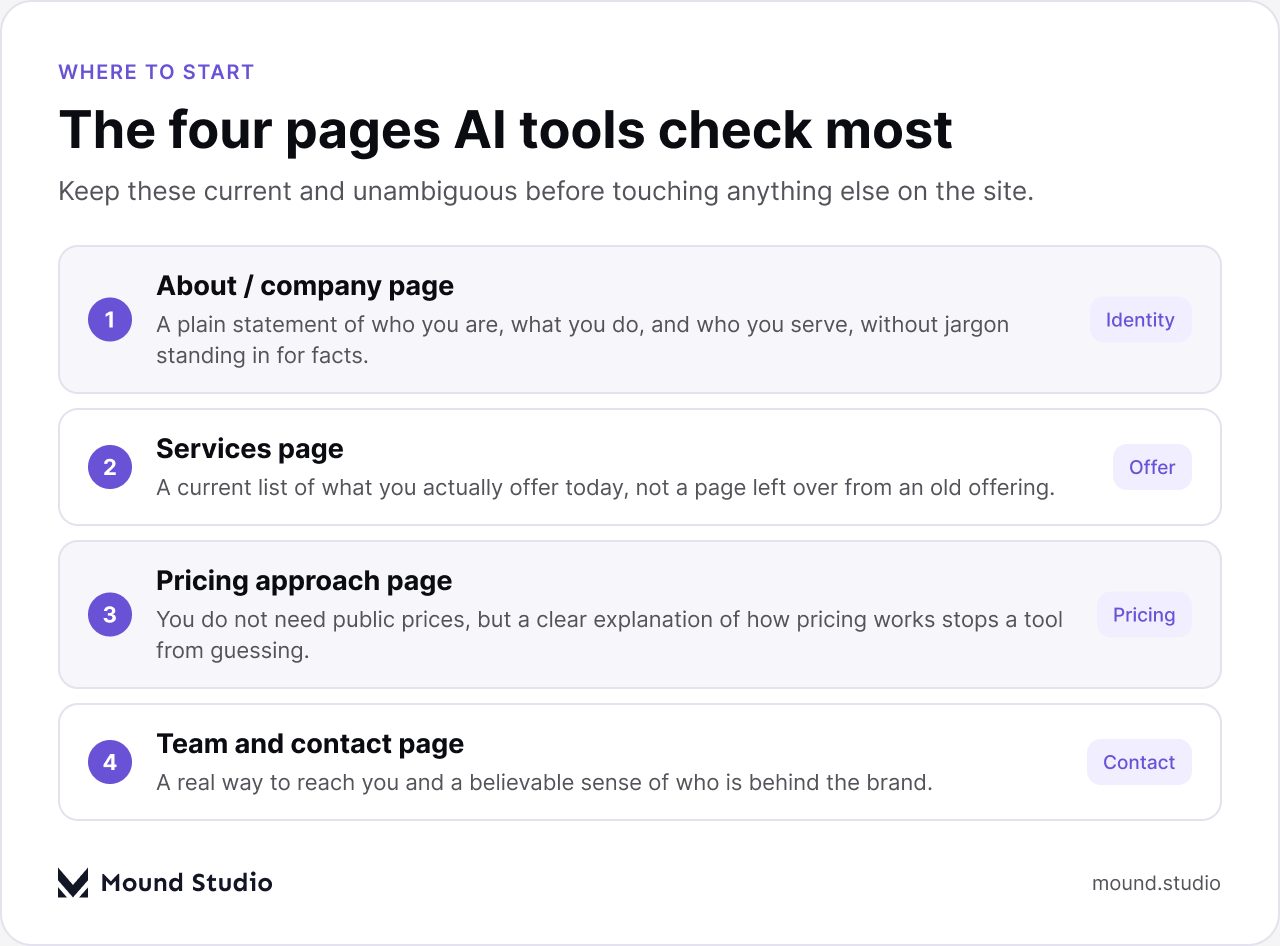
This page should say, in plain language near the top, what you do and who you do it for. Save the story and the mission language for lower on the page. A tool skimming for facts needs the facts stated as facts, not implied through tone.
List what you actually offer today. If you quietly stopped offering something, remove it. If you added something new, this page should already reflect it, not wait for a future update. An AI tool has no way to know your roadmap, only what is currently written down.
You are not required to publish exact numbers. You are well served by explaining how pricing works: fixed price versus ongoing engagement, what drives the range, and what a typical project includes. A page that avoids the topic entirely leaves the tool nothing to work with, so it either stays silent or repeats an old number from somewhere else.
A believable contact route matters more than a full staff directory. A monitored contact form, a real email address, and a short description of who is behind the work go a long way toward making an AI-generated answer feel trustworthy rather than generic. If your contact page still lists a phone number nobody answers or an inbox nobody checks, fix that before anything else on this page.
None of these four pages need to be long. A short, current, specific page beats a long, outdated one every time a tool is trying to extract a fact rather than enjoy the read.
Two more things influence how easily a tool can extract facts from your site, and neither requires a redesign.
Naming consistency. If your business is called three slightly different things across your website, your social profiles, and your directory listings, you are asking a tool to guess which one is correct. Pick one name, one short description, and use them everywhere you control, including your own footer and contact page.
| Where to check | What to compare | Common mismatch |
|---|---|---|
| Your website | Business name, services list, contact details in the footer and header | An old name or tagline left over from a previous rebrand |
| Directory and map listings | Business name, category, address, and hours | A listing nobody has claimed or updated since it was created |
| Social profiles | Bio text, services mentioned, link to your current site | A bio written years ago by someone no longer involved |
Structured data. Basic schema markup for your organization, your services, and your FAQ content gives a tool a machine-readable version of the facts you already state in plain text. It does not replace clear writing, but it removes ambiguity from how that writing gets parsed. If you have not looked at this yet, our guide on structured data for AI search walks through what to add and why.
Neither of these fixes is a substitute for accurate, current page content. They help a tool find and trust facts that are already true. They cannot make an outdated page look current.
This work does not need a dedicated team, but it does need one person willing to own it. In most small and mid-size businesses, that is whoever already owns the website: a marketing lead, an operations manager, or the owner directly. What matters is that one person runs the audit, tracks what needs fixing, and checks that the fix actually landed.
It helps to treat this the same way you would treat a broken link or an expired certificate: a small, recurring maintenance task rather than a project with a start and an end. Put a repeat reminder on the calendar, keep a short running list of what an AI tool got wrong last time you checked, and confirm each item on that list before adding new ones. A list that never gets checked off is worse than no list at all, because it creates a false sense that the problem is being handled.
If your team already reviews analytics or reviews monthly, this audit fits naturally into that same rhythm. It does not require new software or a new vendor relationship. It requires someone typing a handful of questions into a few AI tools, reading the answers with a critical eye, and following through on what they find.
Once the audit turns up problems, it helps to prioritize rather than trying to fix everything at once.
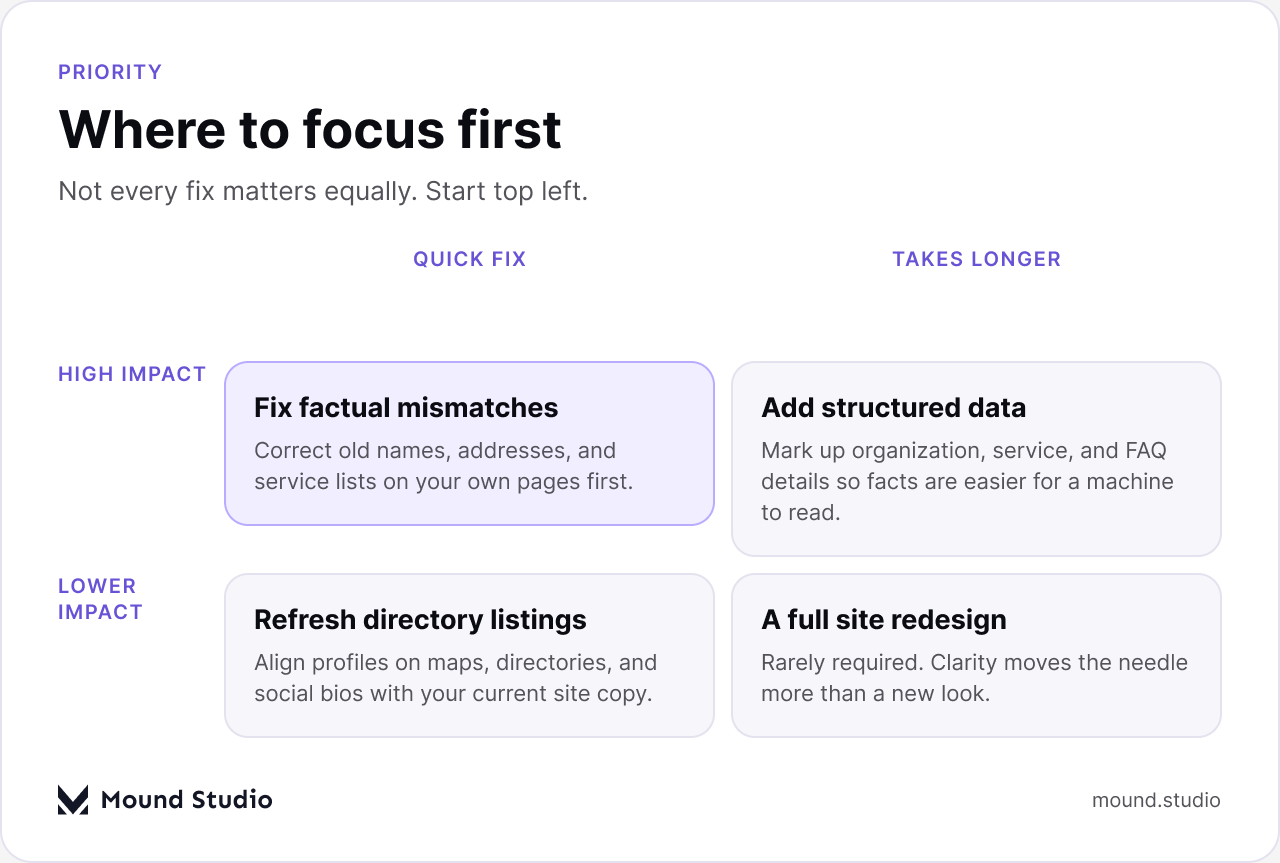
Correcting factual mismatches on pages you already control is nearly always the fastest, highest-impact move, because it requires no new tooling and no outside cooperation. Adding structured data takes more setup but pays off steadily once it is in place. Refreshing old directory and social listings matters, but usually less urgently than your own site, since your site is the source most tools weigh most heavily. A full site redesign is rarely the right first move: clarity of content moves this needle far more than a new visual design.
If you are weighing whether this belongs on your own list or an agency's, our guide on what to ask before you hire a design agency covers how to scope this kind of work alongside a broader site project. And if you have not yet looked at the more technical side of this topic, how to optimize your website for AI search is a good next read.
An AI tool describing your brand is not a hypothetical. It is already happening, quietly, every time someone asks one a question about you instead of searching for your site directly. The fix is not a redesign. It is an honest audit of what these tools say today, followed by making your own about, services, pricing, and contact pages say exactly what is true right now. If you want a second set of eyes on what your site currently tells an AI tool about you, tell us what you're working with and we'll walk through it with you.
Open a few AI chat or search tools directly and ask them plainly what your company does, who it serves, and how to contact it. Compare each answer to what is actually true today, and note which pages on your site likely fed that answer.
No. It makes facts easier for a tool to find and parse, but it cannot fix content that is outdated or missing. Accurate, current page content still does most of the work.
Whenever something material changes, at minimum. A quick quarterly check, alongside a repeat of the AI-tool audit, catches drift before it becomes a pattern of wrong answers.
No. Focus on making your own site the clearest, most current source of truth about your brand. Most of these tools read the open web rather than requiring a separate submission process.
It overlaps with SEO and with AEO, but the focus here is narrower: factual accuracy and consistency about who you are, not rankings or traffic. Getting the facts right supports both.